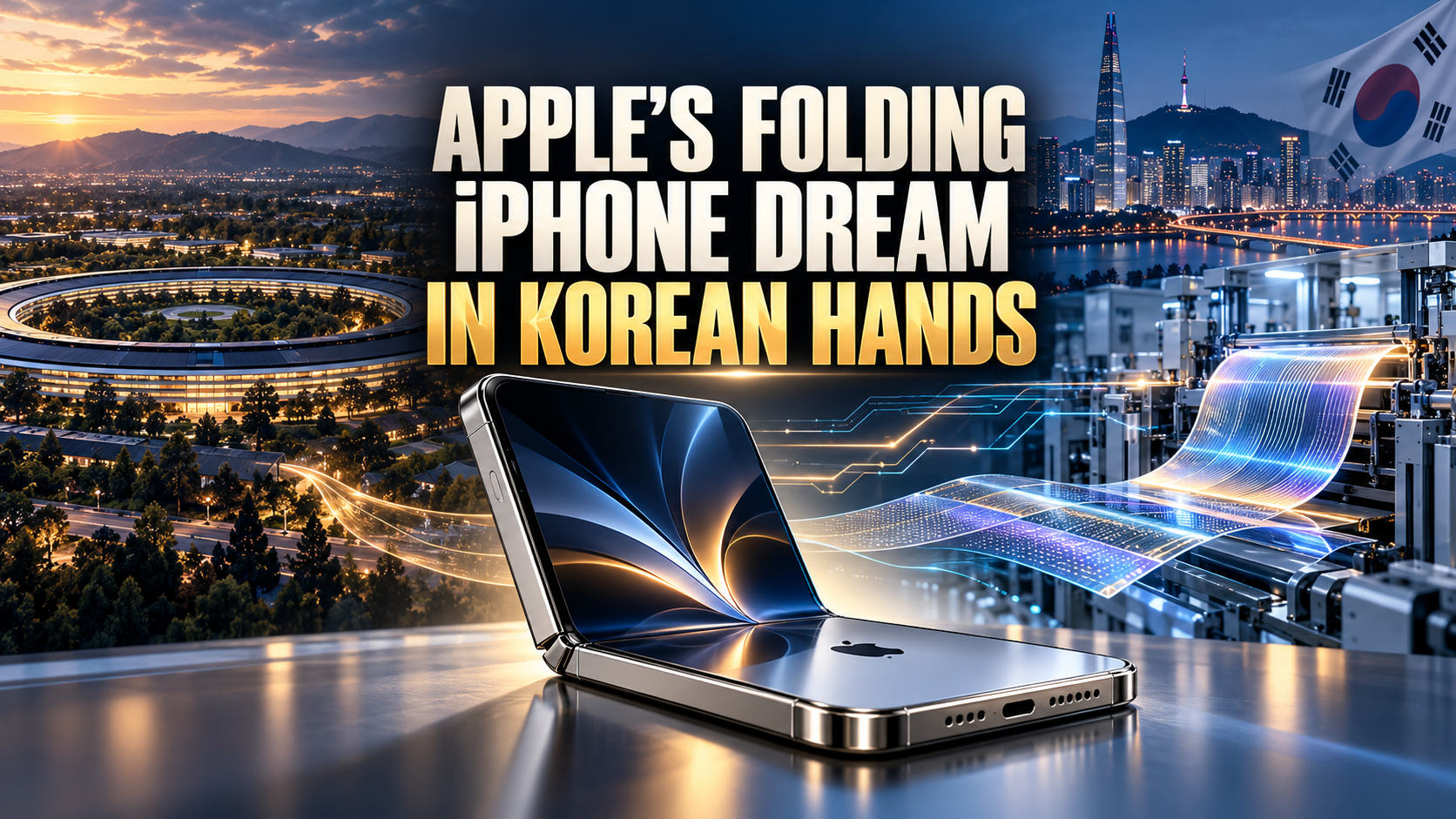
Apple’s first foldable iPhone reaches shoppers today in more than 70 countries, and almost every road to the finished device passes through South Korea. The iPhone Duo, introduced in September at $1,999, opens into a tablet-sized canvas, yet the component that makes the folding possible is a screen built by Samsung Display to Apple’s own specifications.
That is an unusual position for a company famous for spreading its orders across many suppliers. Korean trade press reported that Samsung Display won an exclusive three-year agreement for Apple’s foldable panels, starting with roughly three million units, and that its modules passed Apple’s mass-production certification with yields reported above 80 percent. A Korean industry official told the Korea Herald that without this panel the shape itself would not exist.
Apple’s hardware and display executives have pushed back on the idea of a simple purchase. They say the screen is not an off-the-shelf Samsung part: Apple set out the experience it wanted first, then worked with its partner until the engineering matched. In practice that makes the relationship closer to co-authorship than shopping, and some of Apple’s hard-won display knowledge now lives inside Korean cleanrooms.
The Korean footprint goes well beyond glass. Samsung Electronics and SK hynix supply much of the world’s memory, and a Korean telecom official noted that outside Micron there is hardly any alternative. Local reporting also points to LG Innotek, which has built slim folded-zoom camera modules for earlier iPhones, and to Samsung Electro-Mechanics for circuit boards. No teardown has yet shown how much of the Duo’s bill of materials is Korean, but the pressure on Apple’s margins is easy to imagine.
Then comes the irony that every Seoul analyst has noticed. Samsung Electronics has sold Galaxy Z Fold phones since 2019 and has long ruled the category, while its sister company Samsung Display now earns money on every Duo sold, whatever logo sits on the back. The two firms operate separately, but one family of companies is quietly profiting from both sides of the fold war. Reports put Samsung’s share of foldable OLED panels at about 85 percent this quarter, a figure Apple’s arrival can only strengthen.
The Korean market has also become a window into how the device is being received. Preorders sold out quickly, and buyers who ordered even an hour after sales opened were quoted deliveries in January. At 3.29 million won, about $2,470, the Duo costs roughly 23 percent more in Korea than in the United States, and local shoppers have been quick to compare that with cheaper Galaxy folding phones. Apple appears to be betting that its brand, not its price, will carry the day.
Scarcity is partly planned and partly forced. Foxconn handles assembly, 3D-printed hinge modules come from suppliers including Amphenol and Shinjuxing, and reports described a slow production ramp over the summer. A device with three demanding new parts, the panel, the hinge and the frame, cannot be multiplied overnight, so the first wave will feel more like a limited edition than a mass product.
What does this mean beyond the shelf? First, exclusivity cuts both ways. Apple has guaranteed itself the best foldable screens, but it has also promised not to shop elsewhere for three years. If Samsung’s lines stumble, there is no second source waiting. Apple has been here before: after the iPhone X relied on Samsung OLED in 2017, it gradually brought in other panel makers to rebalance the power. The three-year clock is really the length of Samsung’s head start.
Second, rivals are watching that clock. LG Display has concentrated its foldable work on laptops, and China’s BOE can build high-quality foldable panels, so both stand ready if the exclusivity window closes or Samsung’s capacity falls short. Korean suppliers therefore have every reason to deepen their ties with Apple now, while the door is open to them alone.
Third, the economics may be more modest than the headlines. Some Korean analysts expect foldables to make up only about 5 percent of all iPhone shipments, which would limit the impact on panel makers. Yet prestige is not measured in units. A flagship that exists only because of Korean engineering sends a quiet message to investors, governments and competitors about where the hardest parts of the smartphone are made.
Fourth, the risk is geographic as much as technical. Concentrating a landmark product in one country exposes Apple to currency swings, trade disputes and regional tension, and it exposes Korea to the moods of a single customer. Samsung Display reportedly prepared Duo modules at a facility in Vietnam, a reminder that even Korean production is spread across borders.
Finally, there is a cultural shift. Apps, accessories and repair shops must now adapt to a phone with two screens and a hinge, and a custom panel could make repairs costly for years. If buyers accept that trade, foldables may stop being an experiment and become a normal tier of the iPhone family, with a second generation expected in 2027, the iPhone’s twentieth anniversary.
The design may carry Apple’s signature, but the fold itself speaks with a Korean accent. For the next three years, anyone who wants to understand where the iPhone is going will have to look at Seoul as closely as Cupertino.