
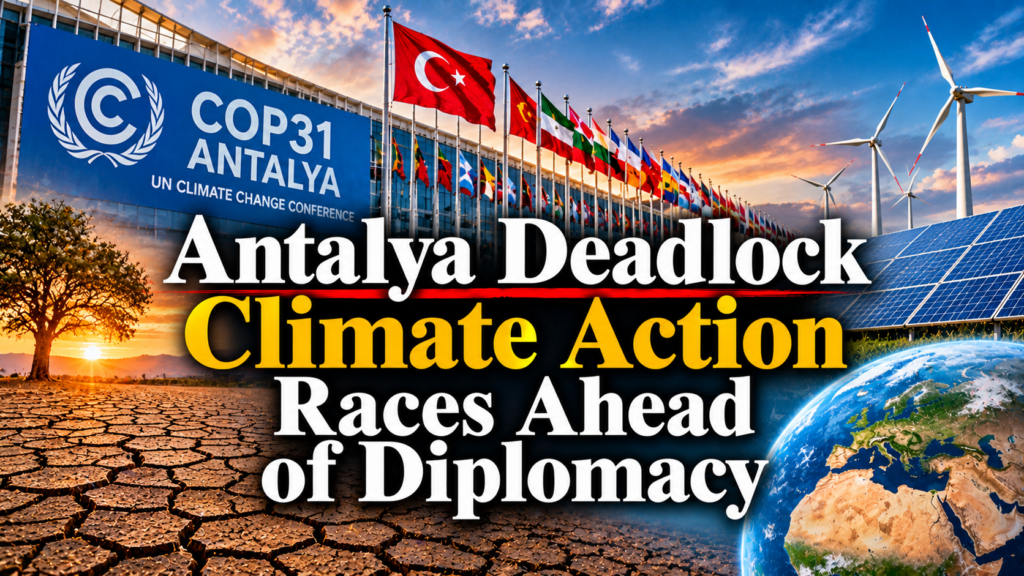
ANTALYA, Türkiye — The United Nations climate summit on Turkey’s Mediterranean coast ended on Sunday the way few delegates wanted: after two days of overtime, the presidency told exhausted negotiators that its flagship text, the Antalya Pact, had failed to win consensus. Secretary-General António Guterres said he was deeply disappointed. COP31 president Murat Kurum, Türkiye’s environment minister, said the draft would not be forced on anyone.
The sticking point was familiar. A fourth draft, running to 12 pages, made no mention of fossil fuels, and the European Union rejected it, with one of its negotiators calling it greenwashing. Britain, Panama, the Marshall Islands and other vulnerable or ambitious governments also withheld support, while large producers such as Saudi Arabia and Russia were reported to be resisting stronger language. For a low-lying island state, the gap between a promise to move away from oil, coal and gas and a vague call to cut emissions is the gap between survival and a slow retreat from the shore.
The failure matters less for what it erased than for what it left unfinished. The pledge made at Dubai to transition away from fossil fuels still stands, but Antalya produced no shared roadmap for delivering it. Some outside observers described the breakdown as among the most serious setbacks since the Copenhagen summit of 2009.
The draft contained notable ideas, and their fate is now uncertain. It would have acknowledged, for the first time in a cover text, that the world is on course to overshoot the 1.5-degree warming limit, and proposed a scientific panel to study how to limit the size and length of that overshoot. It sketched an adaptation finance roadmap linking Antalya to the next summit in Addis Ababa, though without a fixed dollar figure. It reaffirmed that rich countries carry legal finance obligations under Article 9.1 of the Paris Agreement and created space to question unilateral green trade barriers that hurt exporters in the developing world.
Not everything collapsed. Delegates did settle how workers and communities can help shape a just-transition mechanism, with a deadline set for March, and agreed a timetable for scrutinizing climate finance. Those technical decisions survived because nobody had much to gain from killing them, a small reminder that diplomacy often advances in the margins while the headlines concentrate on the center.
The most interesting story, however, may lie outside the negotiating rooms. The Environmental Defense Fund noted that governments, businesses, cities and communities arrived in Antalya ready to act, and that the energy in the action agenda was not reflected in the talks. Around 90 countries have already backed a goal of electrifying 35 percent of final energy use, a target that now lacks a formal home. Methane and other super pollutants, the link between oceans and climate, and a credible path to scale adaptation finance are likewise left without multilateral endorsement, even though they are among the cheapest and fastest ways to slow warming.
That points to a structural question the summit has now made impossible to ignore: can a consensus rule that gives every one of 196 countries and the EU a veto keep setting the pace for a problem that is accelerating? The rule protects small states from being overruled, yet it also lets a handful of producers freeze ambition for everyone else. Expect louder calls for coalitions of the willing, which would move on electrification, methane or carbon markets among countries that wish to, and let the formal process catch up later.
The economic consequences will unfold quietly. Investors in renewables, grids and storage take their cues from policy, and a vague outcome rewards neither the clean-energy boom nor the oil and gas incumbents who wanted certainty. Developing nations, which asked for adaptation money they can plan around, leave with promises still on paper, and the unresolved trade language leaves open how carbon border measures will be handled in the coming year.
There are political consequences too. Türkiye and Australia, which shared the presidency after a contest over who would host, spent months crafting compromises and still could not close the gap, a reminder that hosting a summit confers a stage but not a majority. Their efforts will be judged against what Ethiopia, which hosts COP32 in Addis Ababa next year with African priorities in mind, can salvage. Expect a heavier burden on adaptation, finance and the credibility of promises already made.
Outside the venue, thousands of people marched through Antalya on November 14 in the largest demonstration of the conference, and young activists will point to the outcome as proof that the process is out of step with the science. That frustration, not the text, may be the summit’s most durable product: a public increasingly willing to treat the annual conference as one arena among many rather than the only one.
For now, the verdict is mixed. Antalya delivered no breakthrough and no collapse of the Paris framework, but it showed how far consensus diplomacy lags behind the real economy. The next test comes quickly, with national climate plans, finance reporting and the road to Addis Ababa, and the world’s climate fate will be settled less by what governments fail to sign in conference halls than by what they decide to build at home.