
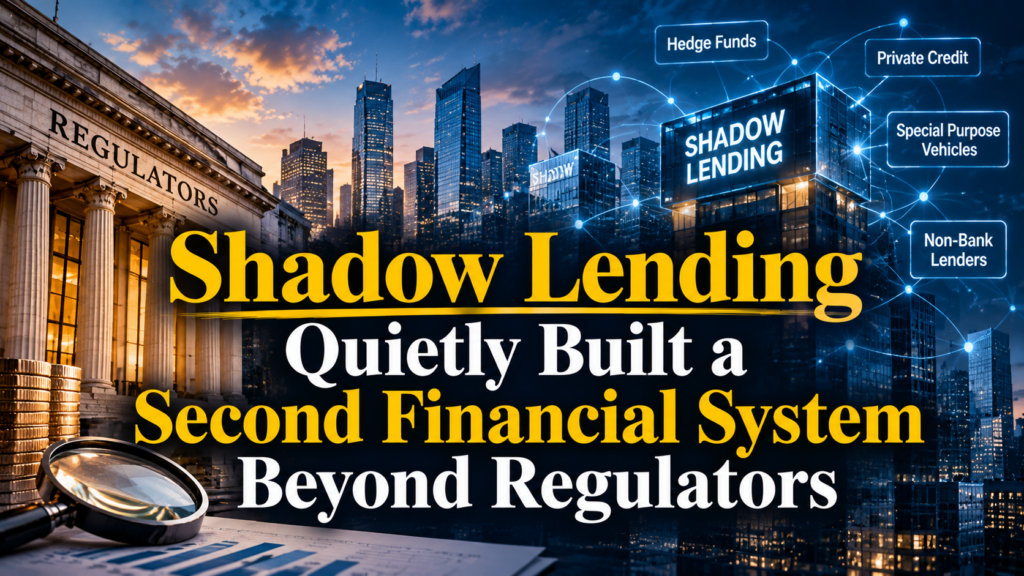
Walk down any financial district from New York to London or Singapore, and the glass towers of traditional commercial banks still dominate the skyline. Yet behind those familiar logos, a quiet structural migration has reshaped how modern capitalism allocates money. Over the past fifteen years, trillions of dollars in corporate loans that once sat on regulated bank balance sheets have moved into private credit funds, direct-lending partnerships, and insurance-backed asset managers operating largely outside public market disclosure.
At first, this migration looked like a welcome stabilization. By shifting risky leveraged loans away from taxpayer-insured deposit institutions toward long-term institutional investors, post-crisis reforms appeared to make the banking core safer. Today, however, the sheer scale and complexity of private credit have turned a niche financing tool into a parallel banking system—one whose opaque valuations, rising leverage, and hidden ties to regulated banks could amplify the next economic downturn.
How Post-Crisis Rules Sparked a Lending Migration
To understand why private credit expanded so rapidly, look at the regulatory architecture built after the 2008 financial crisis. Stricter capital requirements, liquidity buffers, and stress-testing rules compelled traditional commercial banks to pull back from mid-sized corporate lending, leveraged buyouts, and complex acquisition finance. Into that vacuum stepped private asset managers armed with pension funds, sovereign wealth capital, and insurance annuities hungry for higher yields in a prolonged era of low interest rates.
Borrowers quickly discovered the appeal of dealing directly with private funds. Instead of navigating months of syndicated loan roadshows, credit rating agencies, and public bond filings, mid-sized firms could secure bespoke financing packages in weeks from a single direct lender. Yet that speed and flexibility came with a trade-off: risk did not disappear from the financial system; it simply migrated from supervised public ledgers into private portfolios where loan covenants, borrower distress, and true default rates remain largely invisible to outside observers.
The Illusion of Calm in Unlisted Valuations
One of the most seductive features of private credit for institutional investors is its apparent price stability. Unlike publicly traded corporate bonds or leveraged loans, which reprice every second in response to interest-rate shifts and earnings surprises, private loans are typically valued quarterly using internal models. During periods of market turbulence, private credit portfolios often appear remarkably serene on paper even as comparable public debt sells off sharply.
That calm, however, frequently reflects accounting lag rather than genuine immunity to economic gravity. When higher borrowing costs squeeze cash-strapped companies, private lenders often rely on payment-in-kind arrangements—allowing struggling borrowers to add unpaid interest onto their principal balance rather than declaring a technical default. While such extensions buy time during brief slowdowns, they can mask deteriorating credit quality until refinancing walls arrive simultaneously, turning gradual stress into sudden, correlated write-downs.
Hidden Bridges Back to the Banking Core
Supporters of nonbank lending argue that private funds pose minimal systemic danger because their capital is locked up for multi-year commitments rather than funded by runnable retail deposits. Yet closer examination reveals dense financial plumbing linking private credit directly back to regulated banks and households. Commercial banks lend billions of dollars through subscription lines and net-asset-value credit facilities to the very private funds that replaced them as direct corporate lenders.
At the same time, life insurers have increasingly channeled retirement savings into complex, illiquid private credit structures, while new retail-oriented semi-liquid funds promise periodic redemptions backed by assets that take years to sell. If an economic recession triggers simultaneous borrower defaults and investor withdrawal requests, liquidity mismatches could force asset fire sales that spill rapidly across public bond markets and back onto bank balance sheets.
Bringing Illumination Without Crushing Innovation
Preserving the benefits of diverse corporate financing without inviting blind systemic risk requires updating oversight for a market that has outgrown its early boundaries. Financial regulators and central banks can begin by establishing standardized, confidential loan-level reporting across large private credit managers and insurers, giving macroprudential authorities a real-time map of sector concentration, payment-in-kind usage, and bank credit-line exposure.
Supervisory rules should also apply look-through capital charges when commercial banks lend against leveraged private loan portfolios, ensuring that systemic leverage cannot hide behind fund wrappers. For semi-liquid funds marketed to individual savers, securities regulators can align redemption windows and liquidity buffers strictly with the true settlement horizon of underlying loans, preventing the illusion of instant liquidity in inherently illiquid assets.
Trust in Finance Rests on Visibility
Every financial innovation eventually tests the boundary between productive flexibility and dangerous opacity. Private credit has proven that nonbank institutions can step into capital gaps and fund businesses that traditional lenders overlook, especially during periods of banking consolidation.
Yet markets remain resilient over full economic cycles only when risk can be seen, priced, and absorbed before it compounds in the dark. By pairing transparent supervisory reporting with honest liquidity rules, policymakers can ensure that the second financial system strengthens economic growth rather than destabilizing the first.