
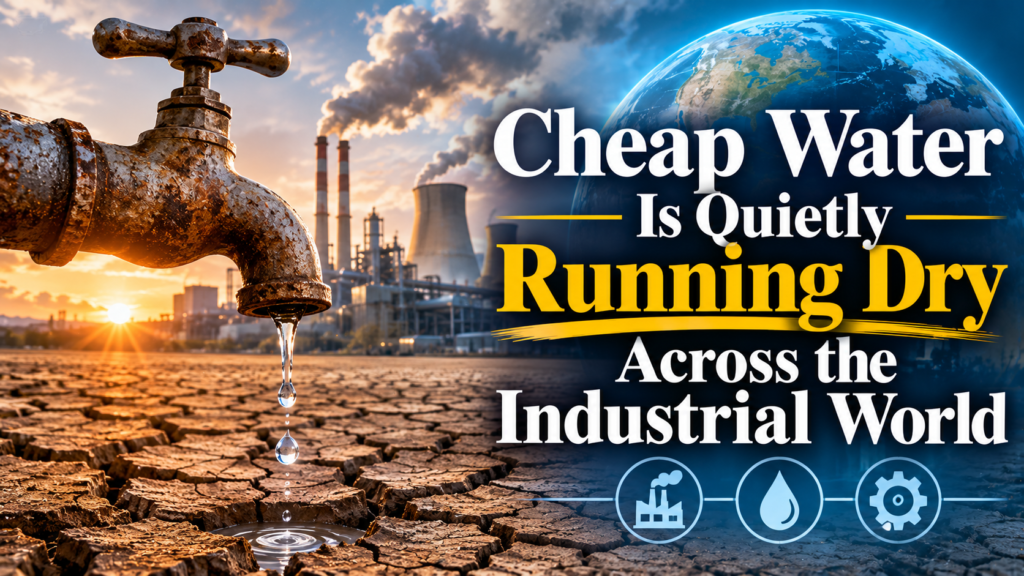
Turn on a tap in almost any modern city, and clear water arrives for fractions of a cent per liter—so cheap and effortless that households, factories, and farms alike treat it as an endless background utility. Yet beneath agricultural valleys, semiconductor fabs, and fast-growing suburbs across five continents, ancient underground aquifers are falling faster than rainfall can ever replenish them. Rivers that once carried snowmelt to the sea now run dry miles inland, while aging urban pipe networks lose nearly a third of treated water before it ever reaches a kitchen sink.
For generations, economic development rested on an unspoken assumption that freshwater was essentially free and infinitely expandable through larger dams and deeper wells. Today, climate volatility, industrial electrification, and irrigated food demand are colliding with hard hydrological limits. When water is priced near zero, markets treat scarcity as abundance until reservoirs hit dead pool and factories are forced to halt production.
How Zero-Price Water Created Structural Waste
To understand why water crises catch prosperous regions off guard, look at how societies price the resource. In most jurisdictions, municipal tariffs cover only a fraction of the energy and treatment costs needed to deliver water, while agricultural and industrial users often extract groundwater for little more than the price of electricity to run a pump. Because water bills rarely reflect scarcity, depletion, or ecological damage, neither farms nor factories face consistent financial incentives to conserve.
The resulting distortion shapes entire economies. Water-intensive crops continue to be grown in arid basins using flood irrigation, even as neighboring cities spend billions on energy-heavy desalination plants. Manufacturing supply chains cluster in regions where water appears cheap on paper, ignoring the silent drawdown of fossil aquifers accumulated over millennia. By the time wells run dry or land begins to sink from subsidence, the physical and financial costs of adjustment have multiplied.
The Hidden Water Footprint of Modern Industry
Public debate around water shortages still focuses heavily on household lawns and municipal conservation drives, yet residential taps represent only a modest share of global freshwater withdrawals. Agriculture accounts for roughly seventy percent of consumption worldwide, while modern heavy industry—from chemical refining and mining to semiconductor fabrication and data center cooling—depends on vast, uninterrupted supplies of ultra-pure water.
When droughts strike major river basins, the economic shockwaves travel far beyond local farms. Low river levels halt inland barge freight, force thermal and nuclear power stations to curtail electricity output, and compel microchip manufacturers to truck in emergency water supplies at steep expense. Water risk is rapidly becoming supply-chain risk, capable of disrupting global manufacturing and food inflation simultaneously.
Aging Pipes and the Politics of Scarcity
Compounding ecological depletion is decades of deferred infrastructure maintenance. Across both mature industrial cities and rapidly urbanizing hubs, buried water mains laid generations ago leak billions of liters daily, while stormwater systems engineered for twentieth-century rainfall patterns overflow during intense cloudbursts. Because raising water rates is politically unpopular, utilities delay pipe replacement until catastrophic breaks flood streets or contamination scandals erode public trust.
At the same time, cross-border river basins and shared aquifers are becoming focal points of geopolitical tension. When upstream nations build reservoirs or expand irrigated agriculture during prolonged dry spells, downstream neighbors face shrinking harvests and strained hydropower grids—turning hydrological interdependence into a test of regional diplomacy.
Pricing Scarcity While Protecting Basic Needs
Escaping the trap of chronic water depletion requires aligning economic incentives with hydrological reality without penalizing low-income households. Tiered lifeline pricing offers a proven path forward: guaranteeing every household an affordable baseline allocation of clean water for drinking, cooking, and sanitation, while charging progressively higher scarcity rates for excessive consumption, industrial extraction, and unrecycled cooling.
In agriculture, replacing open-access groundwater pumping with tradable basin water rights and targeted subsidies for drip irrigation, soil-moisture sensors, and drought-resilient crops allows farmers to earn income by saving water rather than over-pumping. Cities and industrial parks can reinforce those gains by mandating closed-loop water recycling in manufacturing, fixing leaky distribution mains through performance-based utility contracts, and restoring wetlands and floodplains that naturally recharge underground aquifers.
Every Economy Lives Downstream
Societies can substitute wind for coal, fiberglass for copper, and silicon for paper, yet there is no technological substitute for freshwater. Civilizations rise and endure only within the limits of the watersheds that sustain them.
By pricing water honestly, repairing neglected infrastructure, and treating aquifers as irreplaceable generational capital rather than free quarries, leaders can build economies that thrive within nature’s hydrological budget. True abundance begins the moment water stops being treated as free.