
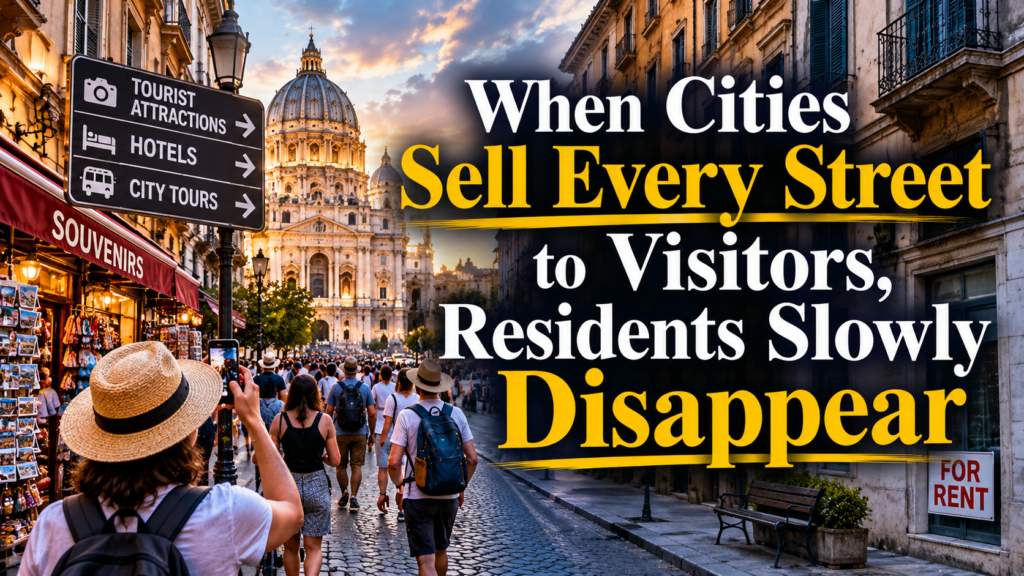
Walk through the historic core of almost any celebrated coastal or cultural city at dawn, and you can still glimpse the living neighborhood that built it: a baker unlocking wooden shutters, a retired teacher sweeping a stone doorstep, a corner grocer stacking crates of local fruit. Return to the same cobblestone lane by midday, and the city has turned into an open-air stage set. Rolling suitcases clatter across pavements where children once walked to school; family-run hardware stores and bookshops have given way to identical souvenir stalls and gelato counters; upstairs apartments sit dark behind keypad lockboxes awaiting the next forty-eight-hour arrival.
For decades, municipal leaders and development economists treated tourism as an almost frictionless engine of prosperity—a clean industry that delivered foreign currency, service employment, and global prestige without smokestacks or industrial waste. Today, from southern European capitals to Asian heritage towns and North American mountain communities, that consensus is breaking under the weight of its own success. When global travel platforms, short-term rental arbitrage, and algorithmic destination marketing converge on finite urban neighborhoods, tourism stops complementing local life and begins systematically hollowing it out.
How Digital Platforms Turned Homes Into Yield Engines
To see why modern overtourism differs fundamentally from earlier eras of travel, look at how digital platforms reshaped urban real estate. Historically, visitor lodging remained largely inside purpose-built hotels and guesthouses zoned in commercial districts, leaving residential apartment buildings insulated for local households. Peer-to-peer short-term rental platforms dissolved that boundary overnight, enabling outside investors and landlords to convert long-term family housing into high-yield nightly accommodations.
The resulting price distortion is swift and unforgiving. Because a vacationer paying nightly hotel-equivalent rates can easily outbid a local nurse, teacher, or shopkeeper earning a municipal salary, residential rents across historic centers and transit lines surge far beyond local incomes. Once permanent residents are priced out, a quiet civic domino effect follows: neighborhood primary schools lose enrollment and merge, local clinics and family pharmacies close for lack of year-round patients, and public buses clog with luggage-laden visitors while serving fewer daily commuters. Within a decade, a living community can degrade into a seasonal monoculture unable to sustain ordinary civic life outside peak travel months.
The Hidden Municipal Ledger of Mass Visitation
Advocates of unrestricted tourism growth routinely point to rising gross visitor receipts and hospitality hiring as evidence of broad prosperity. Yet a closer municipal audit tells a more complicated story. While accommodation revenues and luxury retail margins flow largely to absentee property owners, international hotel chains, and digital booking platforms, city governments shoulder the escalating daily bills for crowd management, sanitation, water treatment, policing, and accelerated wear on fragile streets and monuments.
Over-reliance on seasonal hospitality also traps local economies in low-productivity, precarious labor structures. Hospitality and retail service roles typically offer lower wages, sharper seasonal swings, and slower productivity gains than specialized manufacturing, engineering, or knowledge industries. When rising commercial rents simultaneously push out local artisans, repair workshops, and independent professional firms, cities experience a quiet variant of resource curse—where a booming visitor sector crowds out the diverse economic base needed for long-term resilience. Whenever geopolitics, public health shocks, or currency swings halt travel, single-sector tourist cities discover they have neither export industries nor a dense resident consumer base to cushion the downturn.
Algorithmic Crowds and the Loss of Civic Wonder
Beyond housing costs and city budgets lies a subtler cultural erosion. Algorithmic travel discovery—driven by viral short videos and ranked recommendation feeds—funnels millions of visitors onto identical itineraries, compressing global exploration into a predictable checklist of photogenic backdrops. Rather than encouraging unhurried curiosity and genuine human encounter, hyper-concentrated visitation turns living traditions into repetitive performances.
Local languages fade from shopfronts; regional culinary crafts are simplified for rapid tourist turnover; and everyday civic rituals lose their intimacy beneath a forest of smartphone cameras. When residents begin experiencing visitors not as welcome guests but as competitors for sidewalk space, transit seats, and apartments, civic trust frays—fueling neighborhood protests, sudden regulatory crackdowns, and lasting damage to the city’s own character. Even the physical streetscape flattens as global retail franchises lease historic guildhalls and corner theaters at inflated rents, gradually turning distinct cities into interchangeable shopping corridors dressed in antique stone.
Governing Destinations for Civic Permanence
Restoring balance does not mean closing cities to travelers or dismissing hospitality’s genuine contributions. It requires municipal leaders to reassert a simple ordering principle: a great city must remain a viable, dignified home for its permanent residents first, and a destination second. Housing authorities can start by enforcing primary-residence caps and strict zoning quotas on short-term rentals—allowing homeowners to let their own dwelling for a limited number of days each year while returning commercial whole-home conversions in housing-stressed neighborhoods to the long-term residential market.
Municipalities can also replace flat room taxes with dynamic carrying-capacity levies adjusted by season and neighborhood congestion, channeling those revenues directly into heritage maintenance and affordable resident housing. On commercial streets, civic retail protection zones—combining ground-floor storefront covenants with targeted property-tax relief for neighborhood grocers, pharmacies, bookshops, and craft workshops—keep daily necessities within walking distance. Meanwhile, destination boards can shift promotion away from overcrowded cores toward off-peak seasons, regional rail circuits, and longer cultural or educational stays, while tracking resident-to-visitor ratios and local housing affordability as hard policy triggers.
A City Is Not a Museum
People cross oceans not to inspect preserved facades or standardized luxury boutiques, but to walk through places that are genuinely alive—cities where generations still argue in corner cafes, mend shoes, teach children, and build lives together. When market incentives strip away those everyday routines in pursuit of maximum visitor volume, cities dismantle the very vitality that drew travelers in the first place.
By anchoring urban policy in housing security, commercial diversity, and fair fiscal cost-sharing, civic leaders can ensure that hospitality enriches local neighborhoods rather than replacing them. A city that protects its residents protects its enduring wonder.