
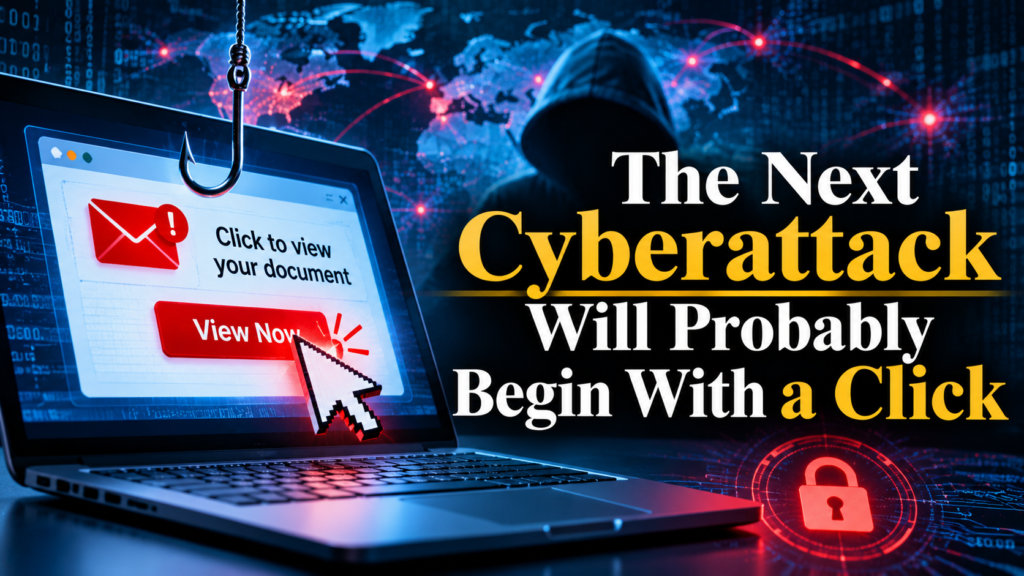
The most dangerous moment in a cyberattack is often the most ordinary. An email arrives from what looks like a supplier, a delivery company or a colleague. It carries a small request: confirm an invoice, reset a password, open an attachment before the end of the day. Someone busy, trusting or simply tired clicks. Months of defences built from expensive technology can be bypassed in the time it takes to read a sentence.
That is the uncomfortable truth at the centre of modern cybersecurity. Attackers increasingly do not break in; they log in, using stolen or guessed credentials, or persuade a human being to open the door. Industry reports have consistently found that human behaviour plays a part in a large majority of breaches. This does not make people the problem. It means that systems designed without people in mind are bound to fail.
The consequences have moved well beyond stolen data. In 2017 the WannaCry ransomware spread across the world, disrupting parts of the National Health Service in Britain and forcing hospitals to cancel appointments. In 2021 an attack on Colonial Pipeline led the company to halt operations, causing fuel shortages and panic buying across parts of the eastern United States. Digital weapons now reach water plants, schools, ports and supermarkets.
Ransomware, which encrypts a victim’s files and demands payment for their release, has become the most visible form of the threat because it turns information into a hostage. Criminal groups now operate like businesses, with specialised roles, customer-support chats and affiliate schemes. Many also steal data before locking it, threatening to publish it if the ransom is not paid. Law enforcement agencies generally discourage payment, since it funds further crime and guarantees nothing.
Supply chains offer attackers a clever shortcut. In the SolarWinds incident, discovered in 2020, intruders compromised a widely used software update and thereby gained a way into thousands of organisations, including government bodies. The lesson is that an organisation’s security is only as strong as the weakest company it relies on, a worry for small suppliers who may lack security staff but hold the keys to bigger clients.
Artificial intelligence is changing the contest on both sides. Criminals can now write persuasive messages in any language without the clumsy errors that once gave phishing away, and cloned voices have been used in scams in which a worried relative or a senior manager seems to ask for urgent money. Defenders, meanwhile, use machine learning to spot unusual behaviour inside networks in seconds. The balance is not fixed, but it reinforces an old rule: be sceptical of urgency, however convincing the voice.
Behind the headlines lie ordinary human costs. A leaked database can expose addresses, health records and identity documents, leaving people vulnerable to fraud for years. A small shop locked out of its systems for a week may not reopen. Estimates of the global cost of cybercrime run into the trillions of dollars a year, though such figures vary widely; the real price is paid in lost trust, lost time and stress.
Good security, experts often say, resembles public health. Basic hygiene prevents most illnesses, and when everyone follows it, the whole community is safer. For individuals, that means installing updates promptly, using a password manager so that every account has a unique password, and switching on multi-factor authentication, ideally with an app or a physical key rather than a text message. It means keeping backups of important files, with at least one copy disconnected from the network, so that a ransom demand loses its power.
It also means trained suspicion. Pause when a message creates urgency or secrecy. Check the sender’s real address, not just the display name. If someone calls claiming to be a bank or a relative in trouble, hang up and call back on a number you already trust; some families now agree on a private code word for emergencies. And if you do click something wrong, report it quickly. Speed, not shame, limits the damage.
Organisations have a larger task. Defenders must be right every time, while an attacker needs to be right once, so the realistic goal is resilience rather than perfection. That means patching known weaknesses, limiting who can access what, separating networks so that one breach does not spread, rehearsing the response to an incident and keeping tested backups. It also means a culture in which employees can admit mistakes without punishment, because the staff member who reports a suspicious email at once is worth more than any software.
Governments are catching up. Rules requiring companies to report serious breaches, minimum standards for critical sectors such as energy and health, and the broader obligations in laws like the European Union’s NIS2 directive aim to raise the floor.
Cybersecurity will never be finished, because the contest is between human ingenuity on both sides. What can be built is habit: an everyday awareness that every connected device is a door, and that locking it is a small cost compared with what lies behind. The next attack will probably begin with a click. Whether it ends there depends on the pause that comes just before it.