
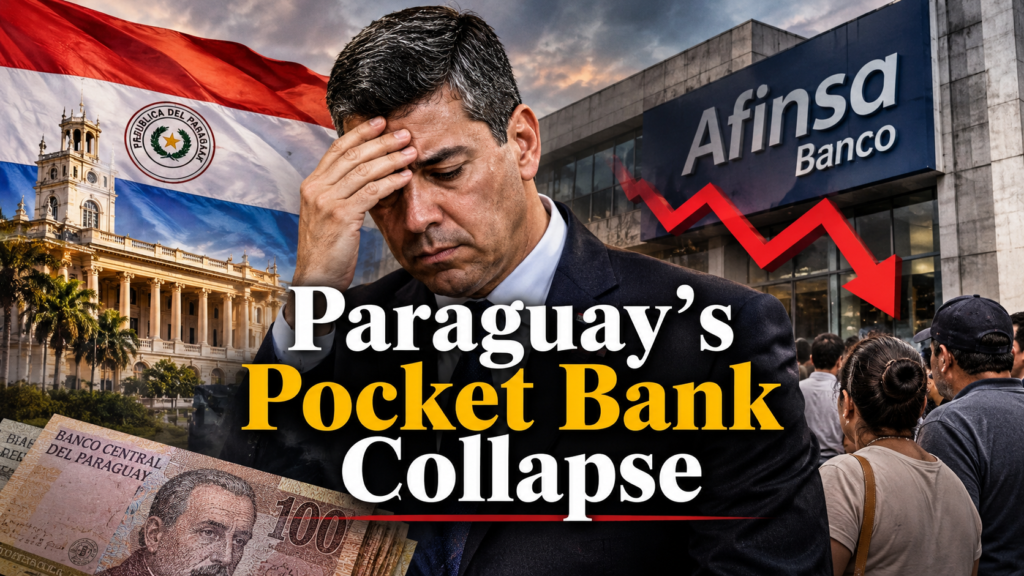
It began as an outage. In the early hours of Tuesday, 3 November, the app that millions of Paraguayans used to pay bus fares, market stallholders and landlords stopped working. Within three days of the bank behind it being seized, the Senate had removed the president, and by the weekend he was facing criminal charges. Few countries lose a major lender and a head of state in the same week.
The bank was Ueno. It started life as a fintech in 2021, became a licensed bank in late 2023 and grew at breakneck speed on phone-only accounts and cashback deals, as NPR reported. It claimed around three million customers, roughly 60 percent of Paraguay’s adult population. Then the central bank concluded that its solvency ratio had fallen below half the legal minimum and placed it into resolution, freezing the accounts.
What regulators found, according to Paraguayan press reports cited by Al Jazeera, was a pattern of lending to insiders: loans to companies linked to the bank’s owners, poorly documented, with some expenses wrongly counted as assets. NPR, citing a former finance minister, put the figure for just three such borrowers at $146 million.
Some of that money belonged to the state. The public pension and health institute, IPS, had between $355 million and $380 million in Ueno, depending on the count, about 9 percent of its investment portfolio. Al Jazeera put total public funds at the bank near $800 million. How a bank barely three years old attracted so much public money became the question that carried the scandal from the financial pages to the presidential palace.
The president’s own links were the awkward part. Santiago Peña held a small stake, about 1.6 percent, in Ueno’s parent company until he sold it in March 2025, and in 2023 he named Carlos Carvallo, the bank’s former chairman, to run the central bank. Prosecutors allege he used his office to keep public deposits flowing to Ueno and, in a later charge, that he led a group shielding the bank from oversight. Peña has pleaded not guilty. Carvallo, also arrested, has said through his lawyer that he took no part in regulatory decisions on Ueno.
The sequence was brutal. Peña signed his resignation on Thursday 5 November. On Friday the Senate removed him anyway, and by Saturday prosecutors had charged him with breach of trust and administration for personal gain. He was jailed pending investigation and later moved to a military prison.
The politics matter as much as the finance. Peña was the handpicked heir of Horacio Cartes, the tobacco magnate who dominates the ruling Colorado Party, and their relationship had been fraying. After the collapse Cartes called for no impunity, and his faction backed the removal. Vice President Pedro Alliana, sworn in to serve until August 2028, now governs amid questions about his own ties to Ueno.
For ordinary Paraguayans the crisis was immediate and small-scale. Students told NPR that classmates could not reach money for bus fares and food. Reuters found that about 80 percent of vendors at Asunción’s Mercado 4, according to a merchants’ association, used Ueno to take payments. The central bank’s acting head said around three million accounts were being opened elsewhere at once, swamping the digital platforms of other banks. There were no queues outside a branch, because this run happened on screens.
The state’s answer was a deposit guarantee fund, created in 2003 after an earlier wave of failures wiped out dozens of Paraguayan banks and finance companies. By Alliana’s Monday address, more than 1.8 million depositors had received about $640 million, and roughly 32,000 pensioners whose benefits came through Ueno were due to be paid on 16 and 17 November.
The guarantee is generous per head and thin in value. The central bank says it fully covers about 97 percent of customers, up to roughly $36,000 each. A Global Americans analysis notes, however, that this protects only about 30 percent of deposit value, leaving large depositors and investors waiting on the sale of Ueno’s assets.
Officials insist the damage is contained. The central bank calls the failure an isolated event, and the IMF said it had seen no sign of contagion to other banks or neighbouring countries. Analysts are nonetheless weighing the effect on investor confidence and Paraguay’s sovereign credit rating. Scholar Joel Correia argued in The Conversation that the episode cracked the image of Paraguay as the Dubai of South America.
Paraguay has been here before. A prolonged banking crisis ran from the mid-1990s into the early 2000s, and the guarantee fund is its legacy. What is new is the shape of the failure: a bank that lived in people’s phones, grew faster than its supervision, and was woven into the machinery of government. The questions now facing regulators are concrete. Should a single lender be allowed to hold so much public money? Who vets the people who lead the central bank? How are fast-growing digital banks stress-tested? And should deposit insurance protect value as well as headcount?
The answers will come from prosecutors, a recovery process that has barely begun, and an electorate that, as one student leader told NPR, hopes voters will not forget by the 2028 election.