
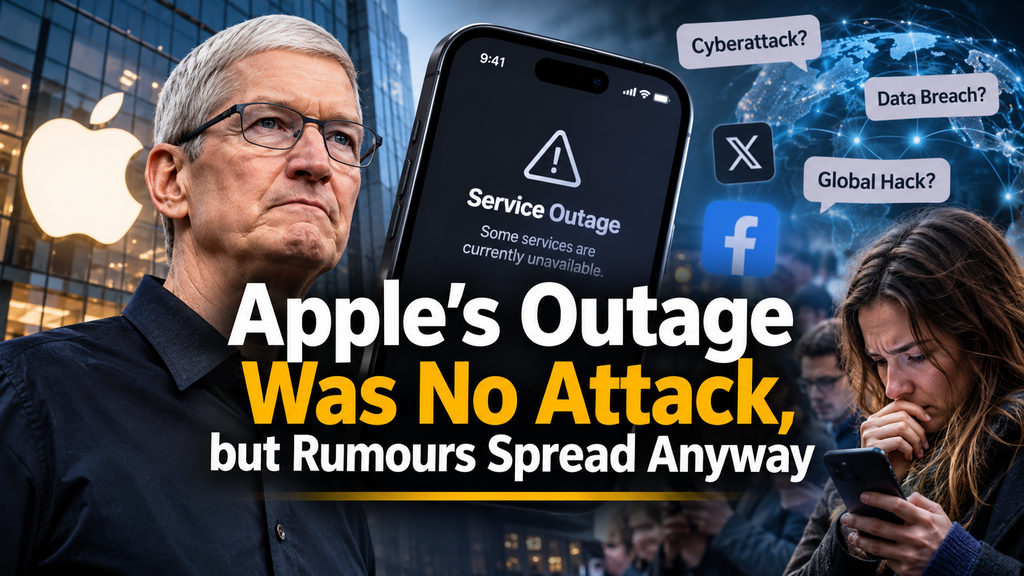
Apple’s services began failing in the late afternoon in Italy on Tuesday, and within an hour the explanation had written itself online: another cyberattack. It was wrong. Apple told Bloomberg that an internal update caused the outages and that no attack was involved. The real attack had happened the day before, on a different company’s software, and no one has shown that it touched Apple’s servers.
Users reported being signed out of iCloud and unable to log in to their Apple Accounts, while the App Store, Apple Music and AppleCare purchases failed. Apple’s status page eventually listed 16 services between 16:15 and 19:51 UTC, with 15 still open at the last check. Bloomberg reported that staff were locked out of credential-based systems for several hours and that sales, repairs and customer service in stores were disrupted worldwide. Apple said it had largely resolved the problem by evening. It has not said which update failed or how many customers were affected.
It was a bad week for the internet’s plumbing. United Airlines suffered a system outage of more than 90 minutes on Monday, JPMorgan Chase customers lost access to online accounts and Zelle, and Microsoft’s Outlook and Teams went down the week before. According to the Associated Press, each company said it saw no sign of an attack. When failures cluster, a story of coordinated sabotage is easy to believe and hard to dismiss, because companies rarely explain themselves in detail.
The attack that did happen began on Monday 16 November. Researchers including Scott Helme of Report URI found malicious JavaScript in snippets served by Optimizely, a website testing service. Report URI checked 1,611 snippets and found code in 188, belonging to 178 organisations, among them the BBC, CNN, Zoom, Salesforce, GitLab, IKEA, HSBC and Air France-KLM. Optimizely said an attacker exploited a vulnerability in its Experimentation product. Because the scripts arrived from Optimizely’s own servers, site owners and visitors had little reason to doubt them.
The code did three things. A crypto clipper swapped wallet addresses, and attacker wallets received roughly $6,600 to $7,000 within about nine hours, according to StepSecurity and Report URI. A skimmer copied card details typed into sites’ own forms. And a loader checked visitors’ iPhones and iPads, then quietly opened exploit kits aimed at older versions of iOS: Coruna for iOS 13 to 17.2.1 and DarkSword for iOS 18.4 to 18.7. Cynet said the delivery was conditional and was not a confirmed compromise of a physical device.
The timeline is revealing. The first injection appeared in the BBC’s snippet at 04:21 UTC on Monday. Mass cleanup began at 20:40, and Optimizely’s public notice came at 01:02 on Tuesday, about 21 hours after the first injection. Smartsheet’s script was reinfected after cleanup, which suggests the attacker still had access at that point. Optimizely has not explained how the flaw worked or what customers should do.
Nothing published so far connects the two events. Report URI saw its monitored Optimizely files clean by late Monday, hours before Apple’s trouble began. The victims of the attack were iPhone users visiting other companies’ websites, not Apple’s data centres. The overlap lies in timing and in nerves.
Speculation turned quickly to Iran, and the reasons are not imaginary. This month France formally blamed Iran’s Revolutionary Guard Corps for attacks on thousands of internet-connected industrial freezers in grocery stores and blood banks. The Wall Street Journal has reported a shift in suspected Iranian operations towards physical damage: water stations in the American Midwest, networks aboard energy tankers, supermarket refrigerators heated to 120 degrees Fahrenheit. Check Point links much of it to a group called CyberAv3ngers. Iran denies carrying out attacks abroad.
None of that points to Tuesday. No government or security firm has attributed either the Apple outage or the Optimizely campaign to Iran. The Optimizely actor looks different: Report URI says it first appeared on Turkish sites on 17 September, and its measurable haul was a few thousand dollars in cryptocurrency, the profile of opportunistic criminals. Even the exploit kits settle nothing. Coruna has been used by a suspected Russian espionage group and a financially motivated Chinese one, and researchers have noted its resemblance to earlier government-linked tools. A pedigree is not an attribution.
The two incidents show opposite ways a trusted system fails. Apple failed from the inside, through its own change process. Optimizely’s customers failed from the outside, through a script they had invited onto their pages. In both cases users were left with a company’s silence, and silence is where rumours grow: Apple offered one sentence, and Optimizely a notice that explained neither the flaw nor the fix.
The practical lessons are plain. Site owners can limit third-party scripts with content security policies and integrity checks. Companies can publish plain-language post-mortems within days, not weeks. Users who visited an affected site on 16 November should update iOS, check card statements and confirm any cryptocurrency address with the recipient before sending, as Malwarebytes advises.
Apple’s outage ended within hours. The Optimizely investigation has not. The question worth watching is not whether Iran was behind either event, since nothing says so, but what happens when the next real attack arrives in a week when nobody believes the explanation.