
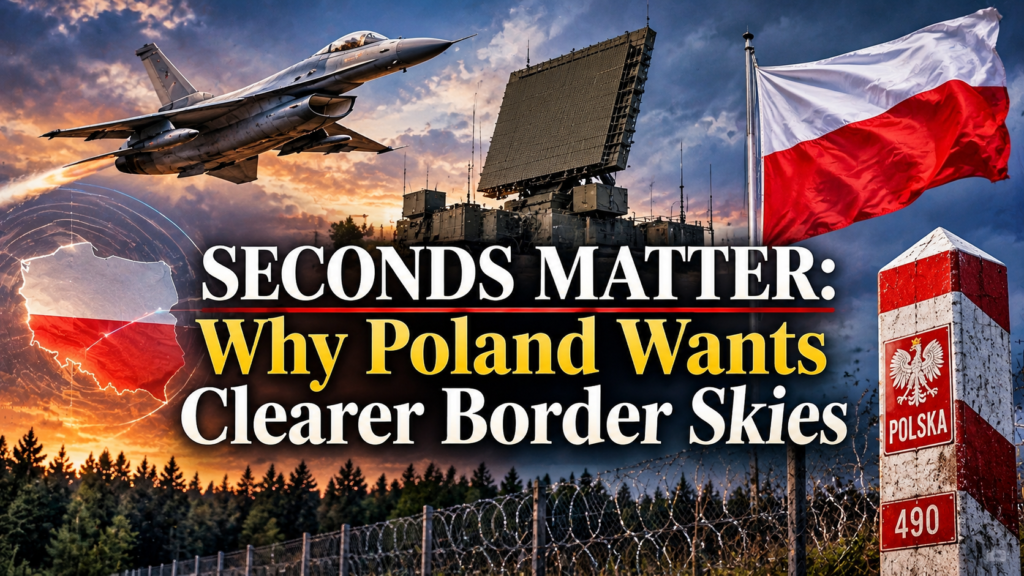
Over eastern Poland, the distance between a warning and a decision can be measured in minutes. Warsaw now wants to buy its pilots some of that time by clearing a strip of sky along the frontier with war-torn Ukraine, where anything that appears without permission should be far easier to recognise.
Deputy Defence Minister Cezary Tomczyk said on Wednesday that the government wants a new no-fly zone in force in late December or early January. It would reach from roughly a dozen to several dozen kilometres into Polish territory. This is not the Western-enforced shield over Ukraine that Kyiv sought early in the full-scale war. Poland is proposing to tighten control of its own airspace.
The logic is simple. Fewer civilian aircraft mean less clutter and less doubt. A radar contact arriving from Ukraine at a particular speed and altitude, and entering a restricted area, would give commanders another clue that it may be hostile. Tomczyk described the measure as an additional support for the armed forces.
It builds on a change introduced about two months ago. Pilots previously had to identify an intruder visually. Under “positive identification”, radar and other data can now support a decision to shoot it down. The zone would not make every object an automatic target: identification and military procedures would still apply.
Recent events explain the urgency. On November 20, during one of the war’s heaviest Russian bombardments of Ukraine, objects crossed into southeastern Poland and came down at three sites. Prosecutors later confirmed that debris at all three came from Russian Kh-101 cruise missiles. No injuries were reported in early accounts. Three days later, a Russian drone briefly entered Polish airspace.
Prime Minister Donald Tusk called the missile violation a provocation. Moscow denied responsibility and accused Poland of fuelling anti-Russian sentiment. US President Donald Trump said Vladimir Putin “has been landing drones in Poland and a couple of little missiles, by mistake”, a gentler reading that sits uneasily with Warsaw’s alarm.
The practical details will matter as much as the politics. The Defence Ministry has prepared two draft frameworks: one for restrictions around the clock and another covering 10pm to 6am. Reporting on the announcement points towards a permanent regime, but precise locations, dimensions and civilian exemptions have yet to be published.
That leaves questions for recreational pilots, drone operators, farmers using aerial equipment and businesses that inspect power lines or pipelines. Emergency medical and rescue flights will need clear access. Airports such as Rzeszow and Lublin will also watch the map, although there is currently no basis to predict cancellations or night closures. An existing temporary restriction along the Belarusian and Ukrainian borders is due to expire on December 9, making the transition another point to settle.
A cleaner sky has limits. A line on an aviation chart cannot stop a cruise missile. Radar coverage, fighters, ground-based defences and a swift chain of command must do that work. Nor can restrictions remove the hardest judgement: whether firing is safe when wreckage could fall on homes. The zone’s value will lie in how much uncertainty it removes before that choice is made.
Warsaw is also looking beyond its frontier. Bloomberg reported that it asked allies on November 23 to consider intercepting Russian missiles over Ukraine when they are heading towards NATO territory. Some governments showed openness, but the talks were preliminary and produced no decision.
Foreign Minister Radoslaw Sikorski argues that such an interception, at Ukraine’s request, would amount to self-defence. Others fear it could make the alliance a party to the conflict. According to Bloomberg’s sources, action would probably require unanimous consent, access to Ukrainian airspace and coordination through NATO’s military command. Tomczyk has said the alliance is currently not favourable to the idea.
NATO has nevertheless agreed to send an AWACS early-warning aircraft to monitor Poland’s east. Warsaw is encouraging other frontline states to consider similar airspace restrictions. If they follow, Europe could gradually acquire a belt of more tightly managed skies from the Baltic region southwards. Compatible rules and rapid exchange of radar information would make that belt far more useful than a patchwork of national measures.
The consequences would reach beyond defence. Frequent restrictions could burden local aviation and remind investors that the war’s risks do not stop neatly at a border. Clear maps, predictable exemptions and timely alerts can reduce that cost. Poor communication would magnify it, especially for communities already used to hearing military jets at night.
Three tests will show whether the plan works: how quickly an unknown object can be identified, how smoothly legitimate flights can continue, and how well information moves between Poland, Ukraine and NATO. Warsaw cannot control when Russia launches its next barrage. It can try to ensure that, when something heads west, those watching the radar have fewer doubts and more time to act.