
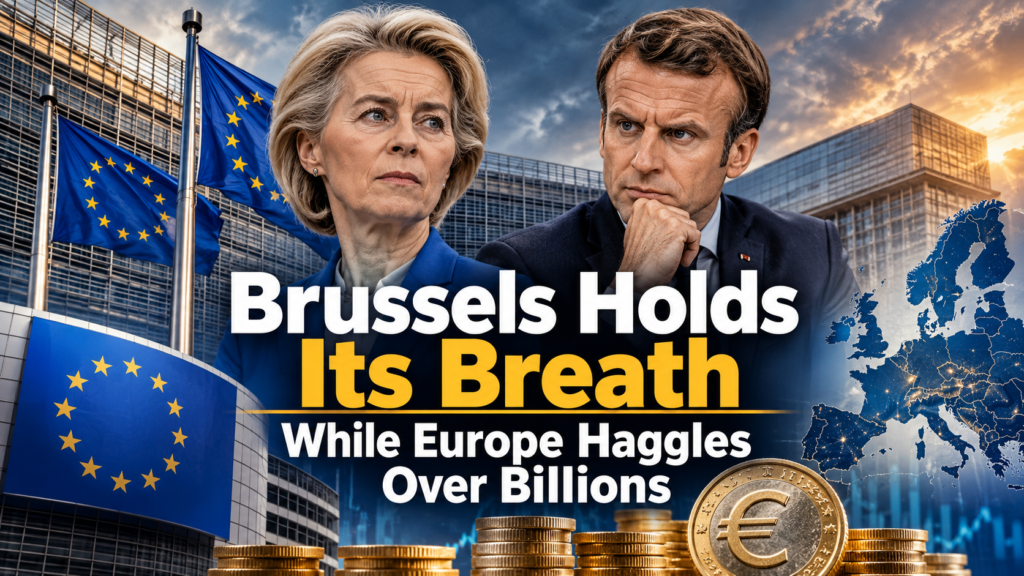
Europe’s leaders sit down in Brussels today for a summit designed to be uncomfortable. Three questions share one table: how much the Union will spend between 2028 and 2034, how Ukraine will be financed next year, and who will steer the European Central Bank after Christine Lagarde’s resignation on 29 October. Among the 27 leaders is Giorgia Meloni, who reached the Belgian capital late on Wednesday and walked into her hotel without a word to the cameras.
The silence suited the moment. Work starts at 10 a.m., but before it does, Italy is due to join the so-called friends of cohesion, a group of countries that defends regional funding. That early huddle says plenty about how the day will unfold: before anyone addresses the whole room, the room has already split into coalitions.
The pressure point is Antonio Costa’s revised negotiating box, tabled on 21 November. It totals about €1.78 trillion, some €204 billion, or 10 percent, below the Commission’s original proposal of July 2025, and a further €40 billion under the plan floated by the Irish presidency in early October. His argument is simple: keep national contributions reasonable. Gratitude has been scarce. Poland, Finland and the Czech Republic resist new own resources tied to emissions trading, even with a phase-in from zero in 2028 to 30 percent by 2034, and on Monday the Visegrád Four plus Austria called the offer unacceptable after meeting in Bratislava.
For Rome the arithmetic is sharp. Italy’s annual contribution would climb from €21.12 billion to €26.25 billion, roughly €5 billion more every year, or about a quarter. A number like that travels quickly from Brussels into the Italian budget debate, where every billion already has a claimant. Meloni therefore faces a double duty: defend a country that depends on cohesion and farm money, and avoid going home having signed a bigger cheque for less. Her leverage is the one every capital holds, since the budget needs unanimity.
Ukraine is the clock ticking behind the talks. A European official quoted by Reuters puts the 2027 funding gap at around €70 billion, even after support already planned. Costa’s text keeps up to €100 billion for Kyiv in a dedicated reserve outside the ordinary ceilings, combining grants, guarantees, loans and interest subsidies. He calls that support an investment in Europe’s own security, and the phrase hints at the strategy: link Ukraine to the Union’s defence logic and it becomes harder for any government to be seen blocking it. The draft also reportedly lifts defence spending by 232 percent.
The third item may be the most revealing. Lagarde’s early exit has handed the leaders a vacancy worth far more than a desk in Frankfurt. Anyone who has watched EU summits knows that appointments rarely stay separate from money. Put a central-bank presidency, a seven-year budget and a war-financing plan on one agenda and you have the ingredients of a package deal, in which a concession on cohesion could be traded for a nomination, or a nod to frugal capitals for a flexible Ukraine reserve. Nothing official says that is the plan. It is simply how this institution has often solved its hardest puzzles. A euro summit in inclusive format runs alongside, a reminder that the currency’s next leadership is no side dish.
Procedure matters too. Costa will present his proposal, leaders will react in plenary, and then the format shifts to a pause for one-to-one meetings, the bilaterals where real concessions are whispered. Two days have been reserved because nobody expects a quick yes. The first is likely to produce positions, the second either a framework or a postponement.
And if there is no deal? Not an immediate collapse, since the current budget runs to the end of 2027, but a loss of time. Every month wasted shrinks the runway for farmers, regions and researchers whose programmes need years of preparation, and leaves Ukraine’s 2027 needs hostage to improvisation. The European Parliament, whose consent the final budget requires, is already pushing back against cuts to the external action envelope, so even a leaders’ agreement would trigger a second negotiation. Observers of the ECB question will read any drift as proof that Europe struggles to decide just when it asks the world to trust its resolve.
For Meloni, the summit tests a different kind of weight. She is not the loudest voice in the room but a pivotal one among capitals sensitive to cohesion and agriculture, and she can help build either a blocking minority or a bridge. Which she chooses will say more about Italy’s European strategy than any speech. Whatever emerges, the shape of the next seven years is being negotiated behind closed doors, and the story only begins once they open.