
In 2020, researchers at the Massachusetts Institute of Technology reported that a computer program had helped them find a promising new antibiotic. The program had been trained to recognise molecules that kill bacteria, and it then scanned vast libraries of compounds in a fraction of the time human chemists would have needed. The substance it flagged, later named halicin, proved effective against a range of bacteria in laboratory tests. Invention had acquired a new kind of assistant.
Such stories are becoming common. Machine-learning tools now help scientists predict protein structures, propose materials with useful properties, design lighter engineering parts and sift through mountains of data that no human could read. They do not replace human curiosity so much as multiply it, allowing researchers to test thousands of possibilities before committing to a single laboratory experiment. For an economy that depends on invention, this may be as significant as the arrival of the microscope or the computer.
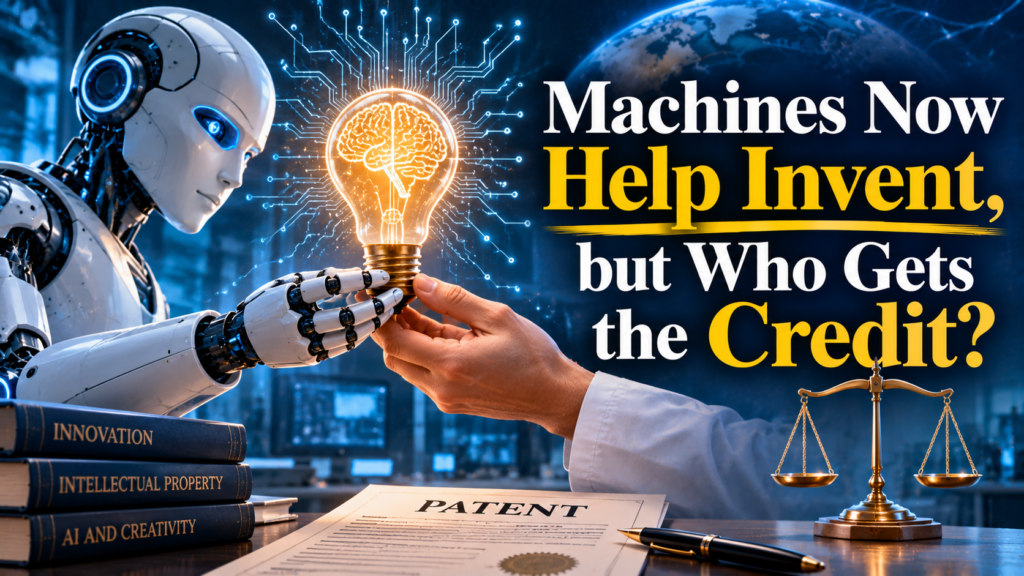
But a legal and moral puzzle follows close behind: who is the inventor? Patent systems around the world were built on the assumption that an invention comes from a person. The question became concrete when the American researcher Stephen Thaler filed patent applications naming an artificial intelligence system, which he called DABUS, as the inventor. Patent offices and courts in several major jurisdictions, including the United Kingdom, whose Supreme Court ruled on the matter in 2023, and the United States, concluded that an inventor must be a human being.
A few places have taken a different line, and the law is still evolving. South Africa’s patent office granted a patent naming the system, though its examination process is largely administrative, while courts elsewhere have been unmoved. In 2024, the United States Patent and Trademark Office issued guidance saying that inventions made with the help of artificial intelligence can be patented, provided a person made a significant contribution. The practical message is clear: the tool may assist, but a human must be able to claim real intellectual involvement.
That answer is sensible but not simple. Where does assistance end and invention begin? A researcher who chooses the problem, designs the experiment and judges the results has plainly contributed. A person who types a request and accepts the first output may have contributed little. Courts and patent examiners will have to draw such lines case by case, and the lines will shift as the tools improve.
The stakes are economic. Patents grant a temporary monopoly in exchange for disclosure, a bargain designed to reward effort and encourage sharing. If machines can generate thousands of candidate inventions cheaply, the system could be swamped with applications, making it harder to tell the truly novel from the trivial. Large organisations with the most computing power and data may gather the most patents, while individual inventors and small firms risk being crowded out. The incentive that was meant to protect the lone inventor could end up favouring the best-resourced one.
There are cultural stakes too. If routine design work is increasingly done by software, what happens to the craft of learning to invent? Skills develop through struggle, and a generation that relies too heavily on automated suggestions may find it harder to spot when a suggestion is wrong. Machine outputs can be confident and mistaken. Human expertise remains essential for checking, testing and understanding why something works, especially when safety is at stake.
Safety and ethics are not abstract. Tools that can design useful molecules can in principle be misused, and researchers have warned that powerful models need guardrails and careful access. Many scientific communities now discuss how to share benefits while limiting risks, through measures such as screening of requests, responsible disclosure and ethical review. An invention is rarely good or bad on its own; what matters is who controls it and what they choose to do.
What would sensible rules look like? Many experts suggest keeping inventorship human, so that responsibility and credit rest with accountable people, while requiring applicants to disclose how AI tools were used. Public funding could prioritise open datasets and shared computing so that smaller players can take part. Clear standards for testing and verifying machine-made proposals would protect the public. And patent offices need resources, including their own digital tools, to keep up with the volume.
Individual inventors can take practical steps. Keep careful records of which ideas and decisions were your own. Treat suggestions from software as hypotheses to be tested, not answers to be trusted. Use the tools to explore more widely, then apply human judgement about which problems are worth solving. The hardest part of invention has rarely been generating options; it has been deciding what matters.
Machines may soon help produce many of the discoveries that change our lives, but they have no stake in the outcomes. People do. The question of credit is really a question about responsibility, about who answers for what an invention does in the world. As the tools grow more capable, it matters more, not less, that the choice of what to invent, and for whom, stays firmly in human hands.