
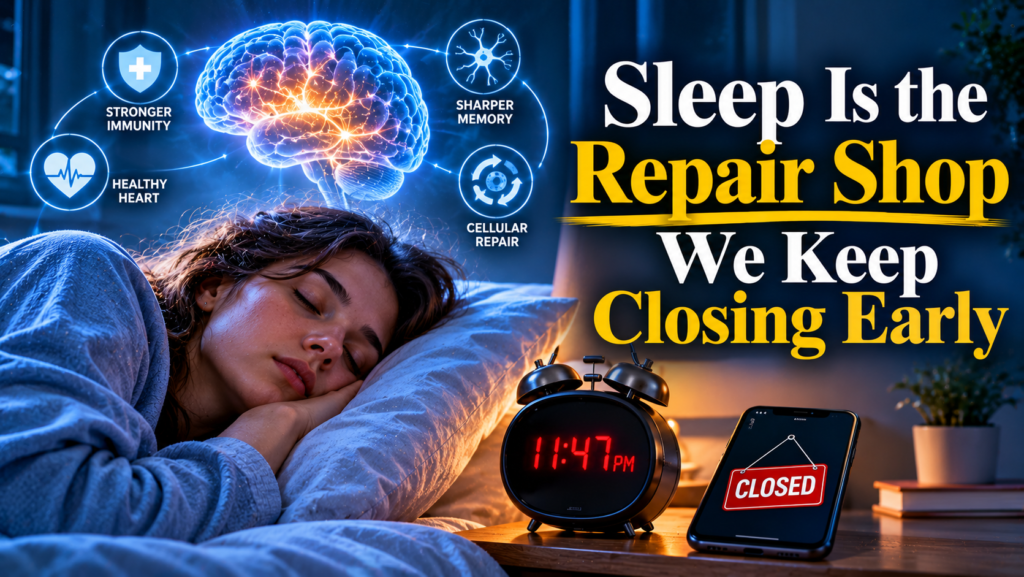
Every night, while the lights are off and the world seems to pause, the body performs some of its most important maintenance. Memories are sorted, hormones rebalanced, tissues repaired and the immune system recalibrated. Yet in busy modern societies sleep is often treated as a luxury, the first item to be trimmed when a deadline looms or a series demands one more episode. It is the repair shop we keep closing early.
How much does a person need? Sleep scientists and medical societies generally advise that most adults need seven or more hours a night, with teenagers and children needing more. Individual needs vary, and a small minority genuinely function well on less. But surveys in many countries suggest that a large share of adults regularly fall short, and many insist they have adapted. Research on performance tells a different story: people who are chronically underslept often misjudge how impaired they are.
The consequences are broad. Short or disrupted sleep has been linked to higher risks of heart disease, high blood pressure and type 2 diabetes, to weaker immunity, and to low mood and anxiety. Attention, memory and judgement suffer, which is why tired people make more mistakes at work and on the road. Drowsy driving is a recognised cause of serious crashes in many countries. Poor sleep is not only a private nuisance; it is a public safety question.
Why does sleep matter so much? The science is still unfolding. Studies, largely in animals, suggest that the brain uses sleep to clear metabolic waste through a network of channels, an idea that has drawn intense interest in relation to long-term brain health. Sleep also appears to help the brain consolidate what was learned during the day, turning fragile impressions into stable memories. The clearest message is humble: researchers do not fully understand every function of sleep, but no one has found a way to do without it.
Our clocks are also set by light. In 2017 the Nobel Prize in Physiology or Medicine went to three scientists who uncovered the genetic machinery of the body’s internal clock, the circadian rhythm that tells us when to be alert and when to rest. That clock responds powerfully to light, which is why bright screens and artificial lighting late at night can push bedtime later. The modern world has effectively abolished darkness, and the body has not yet adapted.
Work patterns can fight biology. People on night shifts or rotating rosters, including nurses, drivers, and factory and hospital staff, live out of step with their internal clocks. The International Agency for Research on Cancer has classified night shift work as probably carcinogenic to humans, reflecting evidence that long-term circadian disruption may affect health, although the size of the risk and how to reduce it remain under study. Employers who design rosters carefully, with predictable patterns and enough recovery time, protect both staff and the public they serve.
Societies can make choices too. Teenagers’ body clocks shift later during adolescence, which makes very early school start times a struggle. Several places have experimented with later starts, and California passed a law requiring many schools to begin later, in an effort to protect pupils’ sleep. Health bodies have also argued for permanent standard time rather than switching clocks twice a year, though the debate remains lively.
For individuals, the most helpful steps are unglamorous. Keep regular sleeping and waking times, even at weekends, because irregularity confuses the body clock. Seek daylight in the morning and dim the lights in the evening. Keep the bedroom cool, dark and quiet, and leave the phone out of reach. Limit caffeine in the afternoon and heavy meals or alcohol close to bedtime, since alcohol may help people fall asleep but tends to fragment sleep later in the night. A short wind-down routine tells the brain that the day is over.
What about the weekend lie-in? Catching up on sleep can help after a bad week, but evidence suggests it does not fully undo the effects of regular shortfalls. For people who struggle despite good habits, cognitive behavioural therapy for insomnia is widely recommended by medical guidelines as a first-line treatment, often before sleeping pills. Loud snoring with pauses in breathing, extreme daytime sleepiness or sleep that never feels restful deserves a conversation with a doctor, since conditions such as sleep apnoea are common and treatable.
There is a social side as well. Parents of newborns, carers of ill relatives and people working two jobs rarely have the luxury of a calm eight hours. Treating sleep as a personal virtue ignores these realities. Noise from busy roads and cramped, unsafe housing can erode sleep for those with the fewest choices. A fair society would count rest among the things it protects.
The next time a night seems like a good place to find extra time, it is worth remembering that the body does not accept time borrowed from sleep without interest. A well-rested person thinks more clearly, feels more kindly and carries illness a little more lightly. Opening the repair shop on time every night may be the simplest health decision a person ever makes.