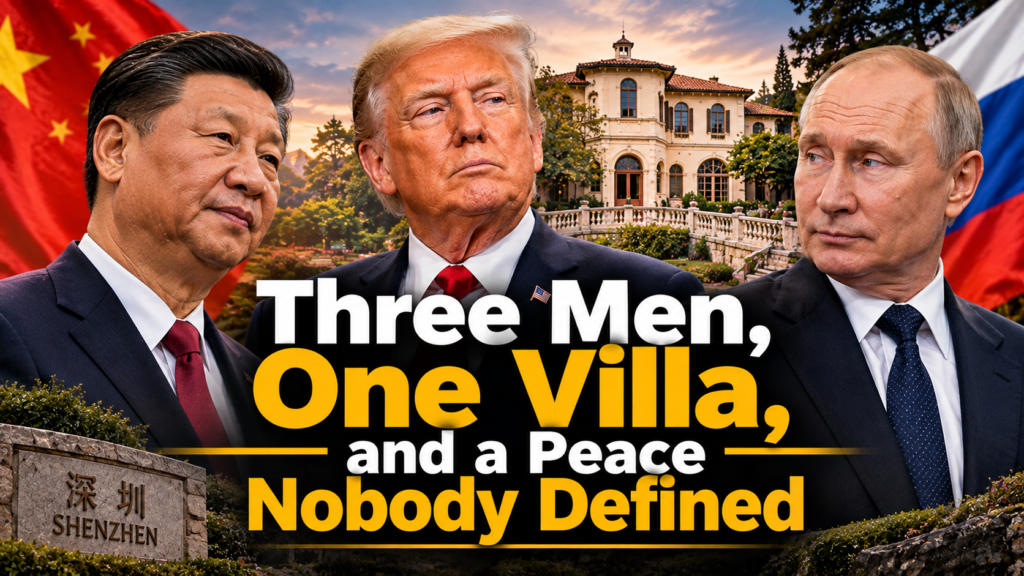
For a little over an hour on Thursday, the three most powerful men in world politics sat in the same room in Shenzhen. Donald Trump, Vladimir Putin and Xi Jinping met at the Kylin Villa on the sidelines of the APEC summit, in the first three-way meeting among them. When it was over they published a joint declaration of peace. What it left out was as telling as what it said.
The text, as reported by the AP and other outlets, says nuclear war cannot be won and must never be fought. It calls for reforms at the United Nations, though without saying which, and for more oil production and supply. It also says international courts should not abuse their jurisdiction, and it asserts the immunity of state officials. It does not mention Ukraine. It does not mention the war involving Iran.
The tone in the room was warm. Putin called Xi a dear friend, Trump called Putin his friend, and the Russian leader said the three countries are bound by their status as victors of the Second World War and by a shared responsibility for international peace. Putin added that he did not think anyone had expected things to go so well.
What was actually decided
Very little that can be measured. Trump said afterwards that he and Xi agree Iran must fully reopen the Strait of Hormuz and must not obtain a nuclear weapon, but the AP found no sign that either Xi or Putin committed to help. On Ukraine, the Kremlin said it was not the main topic of the trilateral session, though it came up in the bilateral talks. Trump later joined a video call from Berlin with Volodymyr Zelensky and more than 40 European leaders and said he had discussed a peaceful end to the war with both men.
The summit’s real product, then, is a photograph and a vocabulary. Anyone who wants a quick measure of what changed should look at who got something. Putin, who faces an International Criminal Court arrest warrant, got his first APEC appearance since 2017 and a text that attacks the court. Trump, coming off heavy midterm losses, got to appear as the man who talks to everyone. Xi got the stage, and by keeping the talks away from specifics he cast himself, in the words of one analyst quoted by the AP, as the adult in the room.
The clause nobody is discussing
The court language deserves more attention than it received. The United States opposes the ICC warrant against Benjamin Netanyahu, and Russia opposes the one against Putin. By putting immunity for state officials into a joint text, the three capitals have drawn a line around a shared interest: none of their leaders wants to be answerable to a tribunal they do not control. It is the one part of the declaration that is concrete, and it is aimed at a body that most of Europe supports.
Europe in the corridor
The most direct consequence falls on Europe. Analysts have compared Shenzhen to Yalta, but a commentary in Majalla argues the comparison fails: there is no alliance among the three, their priorities diverge, and Beijing has kept Ukraine off the agenda rather than endorse a US-Russia deal at Kyiv’s expense. That is some comfort to Brussels and Kyiv. It is limited comfort. European governments have watched understandings between Washington and Moscow, including a deal to buy Russian diesel, take shape without them, and the Shenzhen photograph reinforces the impression that big decisions are made elsewhere.
There is also a quieter risk. A declaration that says nothing about Ukraine can be read in Moscow as tacit permission to keep fighting, and in Beijing as proof that Russia needs China more each month.
The nuclear signal
The nuclear passage is the hardest to read. Words about reducing risk arrived just after Russia sent two nuclear-capable Tu-95 bombers to Vietnam, and as Russian television showed an officer carrying the briefcase for Moscow’s nuclear command. Trump has said the three states are uniquely placed to discuss cutting arsenals. Xi is expected to resist any invitation to join US-Russia arms talks. Without a mechanism, a promise that nuclear war must never be fought repeats a sentence leaders first used in the 1980s.
What to watch next
Three tests will show whether Shenzhen was a beginning. The first is Hormuz: if shipping and the US blockade shift in the coming weeks, the Trump-Xi understanding was real. The second is Ukraine, where any new round of talks would show whether Putin’s good mood has a price. The third is the American Congress, which will be in Democratic hands from January and may limit what Trump can concede on China, Taiwan or chips.
For now, the meeting offers a lesson in how power is displayed. Three leaders agreed that peace is a shared responsibility. Nobody said whose peace, on what terms, or who pays for it.