
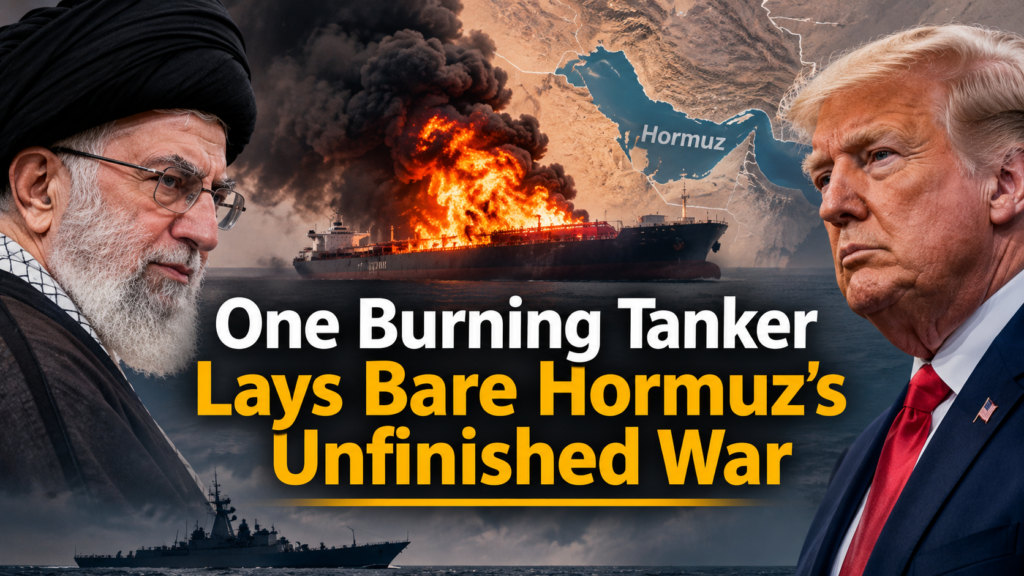
A tanker east of the Strait of Hormuz hit a naval mine and caught fire, Iranian media reported on Wednesday. Within hours, the story had already shifted shape. Iran’s navy, quoted by Press TV, spoke of three oil tankers set ablaze and disabled. Other Iranian outlets gave different numbers, and Italian live coverage led with a single vessel. No ship has been named, no flag or cargo given, and no crew figures have emerged.
That is the first thing a reader should know: everything so far comes from Iranian state-linked sources. As of Thursday, neither the UK maritime trade office nor US Central Command had publicly confirmed the incident in the material this reporter could review.
The Revolutionary Guard’s explanation, carried by the IRIB news agency, is blunt. The vessels, it said, ignored naval warnings, sailed inside restricted areas and had switched off their navigation systems. Passage through the waterway, the Guard added, must be coordinated with Iranian authorities. No legal basis or coordinates were offered.
A pattern, not an isolated event
This is not the first claim of its kind. On 11 and 12 November, the Guard and the army reported several tankers burning after striking mines or suffering what they called accidents. A British maritime firm confirmed one separate case, but it was a projectile strike that caused an engine-room fire, not a mine. On 13 November the Guard said a liquefied natural gas carrier had hit a mine. The US military says it has cleared the mines it was aware of.
Put those statements side by side and a puzzle appears. Either mines remain in or near the lanes despite American clearance claims, or the reports are a way of dressing up strikes and warnings in the language of accident, or some combination of both. Without independent inspection of a hull, nobody outside the region can say which. A mine carries no return address.
A blockade without an exit
The timing sits inside a larger standoff. The US naval blockade of Iranian ports began on 13 April after talks in Islamabad collapsed, was lifted on 18 June after a memorandum between Washington and Tehran, and was reinstated on 14 July. Since then American forces have boarded, turned back and disabled ships.
Tehran has answered by requiring authorization for vessels using the strait. Hardline commentators on state television have gone further in recent weeks, urging the government to go after the blockade militarily or to close the strait entirely. Diplomacy, meanwhile, looks stuck. President Trump wrote on 12 November that the United States does not need a deal, while Iran says it will discuss the format of talks only after its seven conditions are met, including lifting the blockade. Secretary of State Marco Rubio has called those conditions unacceptable.
Seen from there, a burning tanker is a message with several readers. To Washington, it says the southern escort route is not as safe as advertised. To shipowners, it says the permission of Iranian authorities is the price of passage. To Iran’s own hardliners, it shows the leadership is acting.
The insurance clock
The financial consequences may arrive faster than any diplomatic ones. Hormuz hull and cargo war-risk premiums have already risen by tens of times since the war began in late February, according to the International Union of Marine Insurance, whose secretary general put insurers’ losses at about two billion dollars in September. Daily crossings have fallen to roughly 20, from more than 130 before the conflict, based on S&P Global figures. The US has launched a 40-billion-dollar reinsurance facility and Saudi Arabia is building a marine insurance pool.
A new mine report, even an unverified one, forces underwriters to reprice. A claim of mines east of the strait, in the approaches rather than the narrows, would widen the area they treat as dangerous. Oil was reported more than 40 percent above pre-war levels in mid-November, and a fresh scare tends to keep that premium in place.
A question the claim itself raises
There is a less obvious point. If mines really are a danger east of the strait, the ships most exposed may not be the ones headed for Iranian ports, which the blockade already targets, but vessels using the corridors that other states have promoted as bypasses. Pipeline and rail bypasses look more attractive with each such report, though none can be built in months.
What to watch
Three things will tell readers whether this is a real turning point. The first is independent confirmation: a named vessel, a flag state, a statement from the maritime authorities or a satellite image. The second is the American reaction, since a clear denial or a counter-claim would change the story. The third is the insurance market, where a jump in quoted rates would show that traders are taking the report seriously even without proof.
Until then, the honest summary is short. Something may have burned east of Hormuz on Wednesday. Iran says mines did it. The rest, for the moment, is a claim.