
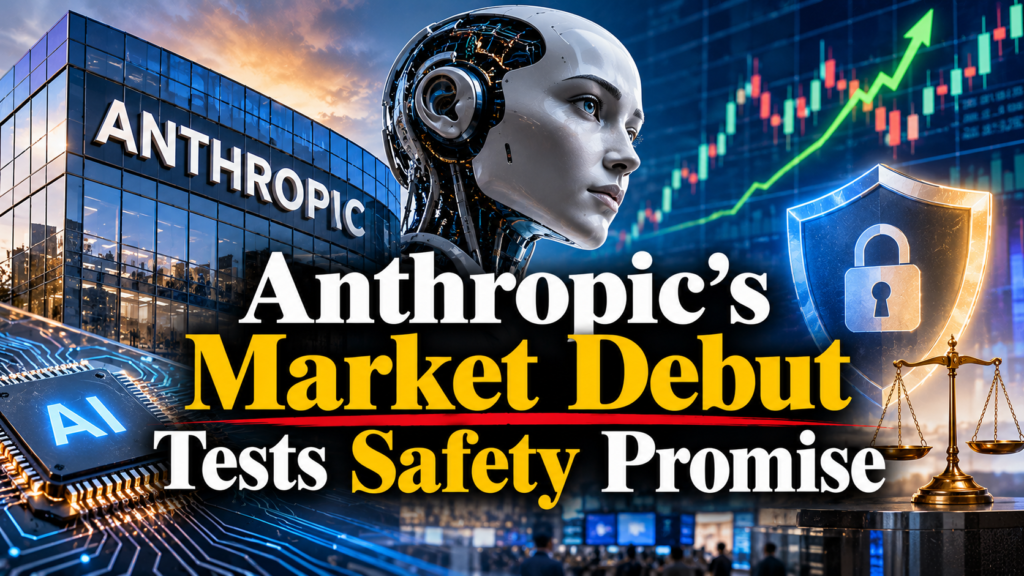
Anthropic began trading on the Nasdaq on Thursday under the ticker ANT, and the first day told two stories at once. Priced at $83, above its marketed range of $70 to $78, the stock opened at $111.50 and closed at $97.17, a gain of 17 percent. The company sold about 980 million shares for $81.3 billion and took another $26 billion from strategic partners in a private placement, for $107.3 billion in all, according to The National.
Several outlets call it the largest IPO ever, though the claim depends on how it is counted. SpaceX’s June listing reached $86.2 billion with extra shares, so Anthropic’s record holds only if the private placement is included. The valuation also depends on the basis: roughly $1.27 trillion on shares outstanding at the close, or about $1.75 trillion fully diluted. PitchBook’s Harrison Rolfes said orders were about six times the shares available.
The session was less calm than the closing number suggests. The stock slid from a high of $115.10 to about $97 within half an hour, which Yahoo Finance described as the worst early drop for a large US IPO since 2008. The Dow fell 1.7 percent, the S&P 500 0.8 percent and the Nasdaq Composite 1 percent. “The first year will test the price,” Rolfes said. Lock-ups expire in 23 tranches through the second trading day after the earnings release of 30 September 2027, and PitchBook expects 2027 to be a weak year for the stock.
The business behind the ticker is large and concentrated. Anthropic reported revenue of $35.3 billion for the twelve months to 30 September and more than 11,900 customers paying at least $100,000 a year. The prospectus says its five largest customers produced about 25 percent of revenue in the first nine months, and that the cloud marketplaces of Amazon, Google and Microsoft accounted for 48 percent of first-half revenue. Against that sits a commitment to buy between $542 billion and $567 billion of future computing capacity.
Product news arrived in the same fortnight. On 9 November the company launched Claude Fable 5.2, priced at $8 per million input tokens and $40 per million output tokens, and Mythos 5.2, which is restricted to organisations approved through verification programmes for cybersecurity and life-sciences work. Co-founder Tom Brown says Mythos got Claude running on AMD chips in three days with almost no human intervention, a job that once took dozens of engineers months.
The prospectus also reads unlike most. It warns that the technology could pose “catastrophic or existential risks to humanity”, according to Fortune, and that Anthropic may lose visibility into its own operations as Claude writes more of its code. It says the company paused training of a next-generation model for more than a month over safety and security concerns. As a public benefit corporation, its directors may weigh the mission against shareholder value.
That is where the central tension sits. The seven co-founders hold a special class of stock carrying 50.1 percent of the votes, and a Long-Term Benefit Trust chooses a majority of the board. The filing itself warns that this may effectively eliminate the ability of ordinary shareholders to influence key decisions, including a change of control. Buyers of ANT are, in effect, being asked to fund a company whose safety board they cannot overrule. Whether that is a feature or a flaw will be judged in the first earnings calls.
Washington is the second pressure point. After Anthropic refused to allow its technology to be used for mass domestic surveillance or fully autonomous weapons, the President directed federal agencies in February to stop using it and the Department of War labelled it a supply-chain risk. A federal district court largely sided with Anthropic in August, but a divided D.C. Circuit panel upheld the designation 2-1 on 25 September, and the company has asked the full court to rehear the case. The filing says the department suggested it could invoke the Defense Production Act. It also records that Commerce Department export restrictions in June forced the company to disable two models for all customers.
Old liabilities remain. A $1.5 billion settlement of the Bartz copyright case was approved in July, and Anthropic had recorded $1.2 billion in current liabilities by 30 June, according to FourWeekMBA’s reading of the filing. Music publishers, Canadian plaintiffs and Reddit have brought other claims, and the prospectus offers no damages estimate.
The consequences reach well beyond one company. The listing is being read as a verdict on the wider AI trade at a time when the Nasdaq 100 had fallen about 13 percent from its early-October peak, according to The Next Web. Rivals now have a public price to be measured against, and a listed Anthropic must disclose compute costs and customer concentration that private labs have kept quiet. Retail investors, who received about 15 percent of the shares, now hold a direct stake in a debate about AI safety that used to be waged by researchers and regulators.
What to watch is concrete: the first quarterly report, the first lock-up releases, the D.C. Circuit’s decision on rehearing, and whether revenue keeps pace with compute spending. For years Anthropic asked to be trusted on safety. From Thursday it also has to be priced.