
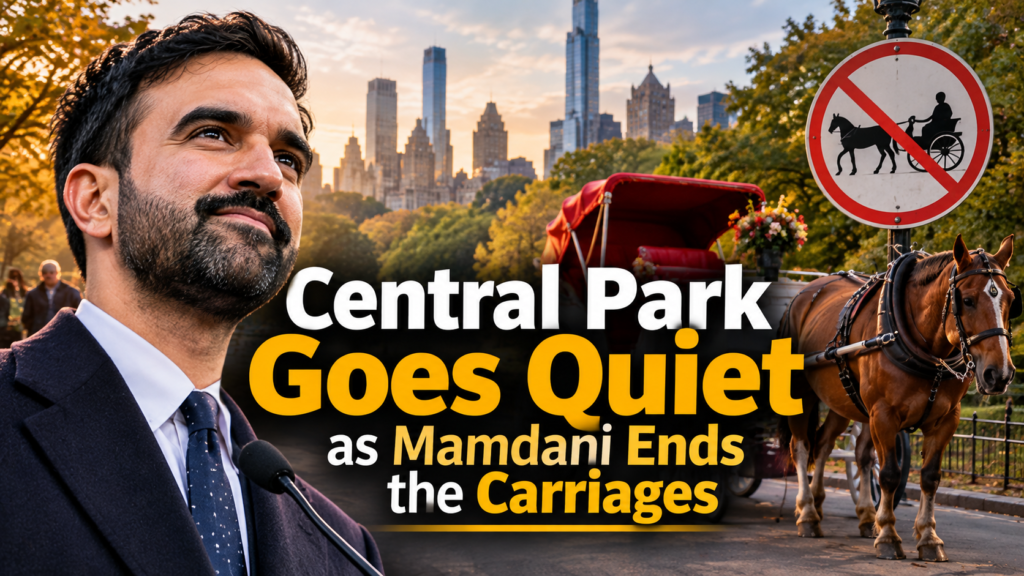
Mayor Zohran Mamdani signed Romanch’s Law at City Hall on Thursday, setting an end date for something New York has seen almost every day for more than 160 years: tourists in a horse-drawn carriage, rolling through Central Park. Under the law, no new carriage horse licences will be issued, and carriage operations in the park stop on 1 June 2028.
The signing took only a few minutes. The legal fight that followed was already scheduled for noon. Union leaders, lawyers and carriage workers planned to gather at the Manhattan federal courthouse to challenge the law as unconstitutional.
A death that changed the vote
The law carries the name of Romanch Mahajan, an 18-year-old tourist from India who died in June after a startled horse bolted, a carriage collided with another and overturned. Campaigners had pushed for a ban for almost two decades, citing cruelty to the animals and danger to the public. It took a death to move the votes. The City Council passed the bill overwhelmingly in October, after Mamdani and Speaker Julie Menin struck a deal.
Other incidents added weight. A carriage horse named Deniz collapsed and died while pulling tourists. The Central Park Conservancy counted eight horse-related incidents in about 13 months and welcomed the agreement on public safety grounds. PETA called the change long overdue and claimed more than 70 percent of New Yorkers back a ban, a figure that has not been independently verified.
The workers’ side
About 200 drivers, owners and stable workers depend on the trade. The mayor has said the city has a responsibility to the people who built careers in it, and his transition framework includes a retraining programme with CUNY’s LaGuardia Community College and a goal of buying back carriage medallions. The law gives city agencies until 1 April 2027 to draft a plan covering job placement, counselling and referrals into other transport and tourism work. Officials must consider compensation for owners and help with retiring horses, but no payout is guaranteed.
That last point is where the union attacks. John Samuelsen, president of the Transport Workers Union, calls the bill horrifically flawed and unconstitutional, says it offers no meaningful economic relief, and accuses Menin of exploiting Mahajan’s death. He has also warned that promises of support could be dropped in a fiscal crisis. The union had asked instead for tougher driver exams, better training and added safety rules.
The question nobody has answered
For a measure meant to protect horses, the law says surprisingly little about what happens to them. Reports on the bill speak only of considering help with retirement. A horse past working age is expensive to keep, and a deadline does not create stable space. If the plan is not funded and in place well before June 2028, the city will face a welfare problem of its own making: animals with no job, no owner able to pay, and no obvious home. The success of the ban will be judged in stables as much as in the park.
What takes the carriages’ place
Mamdani’s framework includes a feasibility study on replacing carriages with vintage-style electric vehicles. The idea is controversial and has not been adopted, but it shows the city’s real worry: Central Park without carriages is a different product for visitors. Tourists who want the old picture-postcard ride will have to find it somewhere else.
Yet the cost to tourism may be smaller than feared. Visitors come for the park as much as for the ride, and the coverage reviewed for this article offered no analysis of what the carriages earn or what a ban would cost tourism. That gap is itself a finding.
A test for the new mayor
Politically, the ban is a safe fight for Mamdani. It has a Council majority, a public tragedy behind it and organised support from animal-welfare groups. It also lets him show he can deliver in a city that expects big promises from him. The risk is more subtle. If transition money fails to arrive, a policy sold as protecting workers and horses could end up hurting both, and the same union that is now in court is one he will need on other fights.
Then there is the court. A federal judge will decide whether the law stands, and a ruling in the union’s favour would reopen a question that has divided the city for twenty years. A loss for the workers would give other cities with carriage trades a template. In either case, the horses of Central Park have a deadline, and nobody has yet explained where they will go when it arrives.