
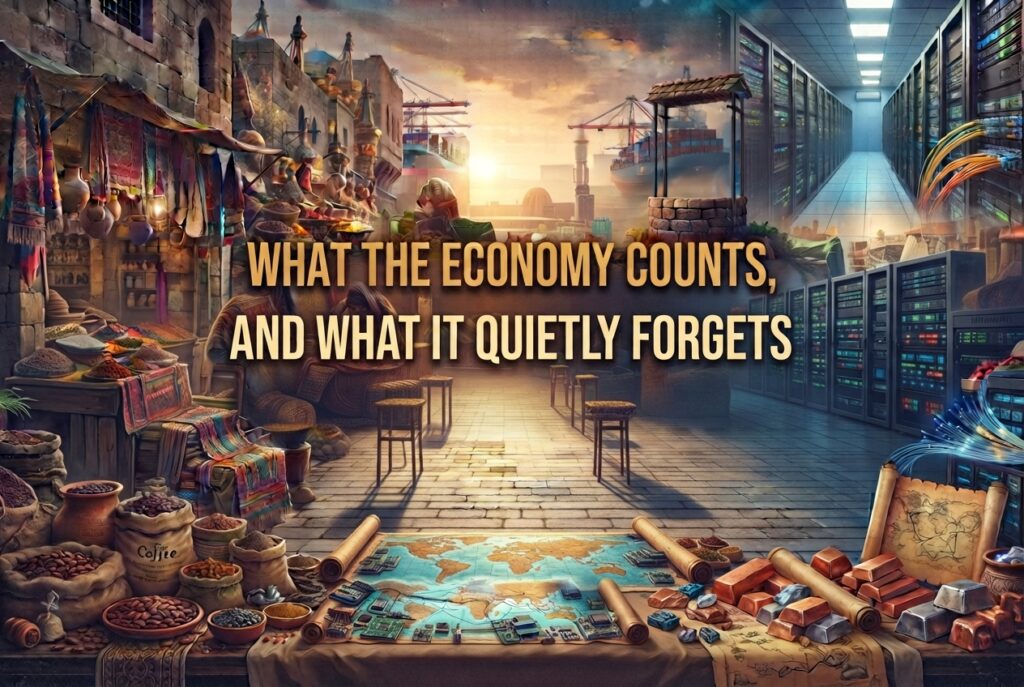
Each quarter, governments publish a single number meant to summarise the economic life of tens of millions of people. Gross domestic product rises or falls, headlines declare a verdict, and markets and ministers react. It is one of the most powerful statistics ever invented, and one of the most misunderstood.
GDP took shape in the 1930s and 1940s, in the shadow of the Depression and then the war, when governments urgently needed to know how much their countries could produce. Its architect, the economist Simon Kuznets, cautioned from the start that national income was a poor guide to a nation’s welfare. Eighty-odd years later, the warning still stands. GDP adds up the value of things that are bought and sold, and in doing so it ignores a great deal that is neither.
It counts the rebuilding of a flood-damaged town as growth, yet does not subtract the homes that were lost. It records the sale of a pack of cigarettes and the hospital treatment that may follow as two separate contributions. And it largely overlooks the unpaid work that holds households together: raising children, caring for elderly parents, cooking, cleaning. The International Labour Organization estimates that women perform roughly three quarters of such unpaid care worldwide. An economy that cannot see this labour cannot easily value it, support it or notice when it is breaking.
The pandemic made the blind spot visible. Suddenly, the people described as essential were not the highest paid but the nurses, cleaners, delivery drivers and shelf-stackers whose wages had rarely matched their importance. For a brief moment, society saw how much of the real economy runs on work that spreadsheets treat as a cost rather than a foundation.
A second hidden half lies in the informal economy. Roughly six in ten workers worldwide earn a living outside formal contracts, from market traders to domestic helpers to small-scale farmers, according to the ILO. They are productive, resourceful and often invisible to official statistics, which also means they are usually invisible to pensions, credit and legal protection. Where the informal sector is large, a country’s headline figures can understate both its vitality and its vulnerability.
Meanwhile, the ground itself is shifting. Many wealthy countries are ageing, with fewer workers supporting more retirees, which strains health systems and pensions alike. Productivity growth, the engine that lifts living standards over time, has been sluggish across much of the advanced world for years. And a new wave of technology, led by artificial intelligence, is arriving with promises of efficiency and anxieties about work. History suggests that technological revolutions create more jobs than they destroy, but history is equally clear that the transition can be harsh, uneven and slow for the people and towns caught in its path.
Place matters as much as technology. Within the same country, a prosperous capital and a struggling former industrial region can seem to belong to different worlds, with different schools, wages and futures. When people feel their community has been left behind, the consequences travel beyond economics: studies of recent elections in several countries have linked regional decline to political discontent and falling trust in institutions. An economy is not only a machine for producing goods; it is a promise that effort will be rewarded wherever one happens to live.
Public finances add another layer. Governments borrowed heavily to survive the 2008 crisis and again during the pandemic, and now face the task of paying for ageing societies, defence and the green transition at the same time. Climate change itself has become an economic force, as floods, heatwaves and droughts damage crops, buildings and productivity. Ignoring such costs does not make them disappear; it only moves them to a later budget.
A few governments have begun to widen the lens. New Zealand introduced wellbeing budgets in 2019, asking ministers to justify spending by its effect on health, environment and community as well as growth. Bhutan has long championed gross national happiness, and the OECD publishes a Better Life Index that compares countries on housing, work-life balance and safety alongside income. None of these replaces GDP, nor should it. The aim is a dashboard rather than a single dial.
For ordinary readers, a healthier economic literacy starts with a few questions. Who benefits when the figures rise? What is left uncounted? Does growth reach wages, or only profits? Is it being built on borrowed time, borrowed money or borrowed resources? These are not hostile questions; they are the questions any careful household asks about its own budget.
An economy, after all, is nothing more mysterious than the way millions of households arrange to feed, house, educate and care for one another. Its numbers matter, but they are a map, not the territory. The goal is not growth for its own sake, but an economy in which people can see their effort recognised, their future secure and their lives counted in full.