
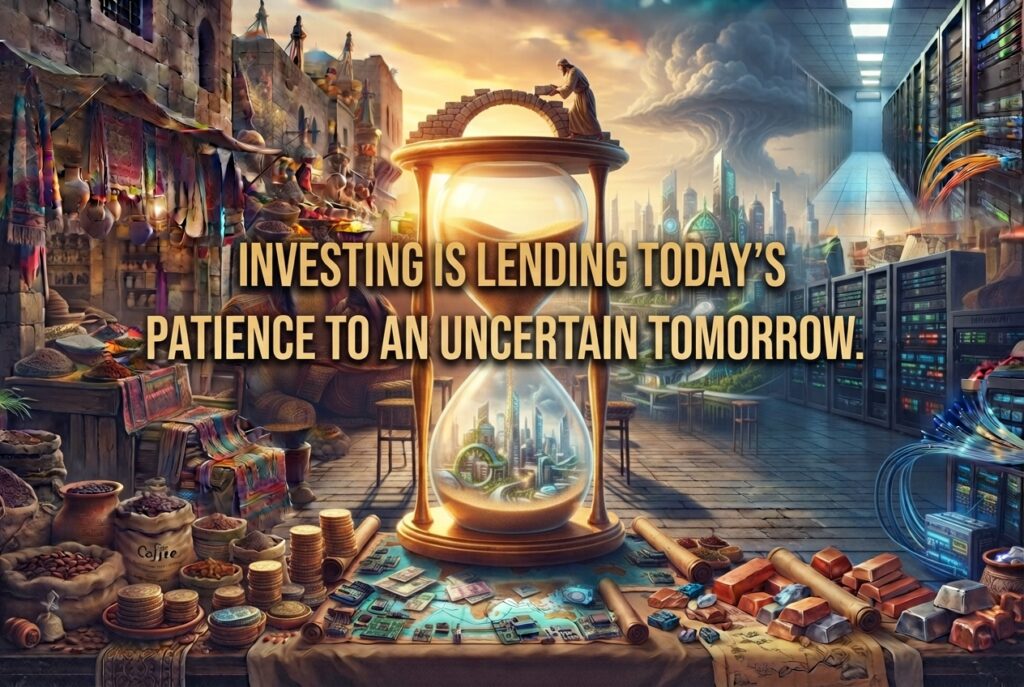
Every investment begins with the same quiet sacrifice: someone chooses not to spend today so that something might exist tomorrow. A farmer keeps back seed instead of eating it. A family skips a holiday to fund a child’s education. A pension fund buys a share of a wind farm that will not turn a profit for years. Strip away the jargon, and investing is simply lending today’s patience to an uncertain future.
That uncertainty is the whole point. If the future were known, there would be nothing to reward. Returns are the payment for bearing risk, which is why the safest options tend to pay the least. Yet the word risk is often misunderstood. Many people picture it as a jagged line on a chart, the price swings that make a stomach lurch. The deeper risks are quieter: needing your money at the wrong moment, putting everything into a single idea, or keeping savings so safe that inflation slowly eats their purchasing power.
Time is the most generous partner an investor can have, and the least appreciated. A handy rule of thumb says that dividing 72 by an annual return gives roughly the number of years it takes money to double; at seven percent, about ten years. If such a return were achieved, a sum left alone for forty years would double four times. The arithmetic is not magic, and returns are never guaranteed, but it rewards starting early far more than it rewards finding the perfect moment. Waiting for certainty is itself a costly decision.
Investing is also wider than the stock market. A bond is a loan to a government or company, paying interest in return. Property offers rent and possible appreciation, but it is hard to sell quickly and often bought with borrowed money, which magnifies both gains and losses. A small business, a start-up, a farm, a workshop: each is a bet on someone’s work. And among the most reliable investments is the one rarely listed on any statement, a person’s own skills and health. A language learned, a qualification earned or a decade of good habits can outperform many financial products.
Diversification, the habit of spreading bets across different kinds of assets, regions and industries, has been called the only free lunch in investing. It does not eliminate loss, but it reduces the chance that one disappointment sinks a whole plan. Its enemy is excitement. Investors tend to pile into whatever has recently soared, which means buying most heavily when prices are highest and expectations most generous. The sober alternative is rarely thrilling and often works.
Costs are the other silent variable. A fee of one or two percent a year sounds trivial until it is applied, year after year, to a growing pot, where it can consume a surprising share of lifetime returns. Because investors cannot control markets but can control costs, taxes and how often they trade, these are the levers that deserve the most attention.
The darker corner of the subject is fraud. Wherever people hope to grow money, someone offers to do it impossibly well. The collapse of Bernard Madoff’s scheme in 2008 showed that even sophisticated investors can be fooled by steady, too-smooth returns and an air of exclusivity. The warning signs are remarkably consistent: guaranteed profits, pressure to decide quickly, secrecy about how the money is made, and rewards for recruiting friends. If something sounds extraordinary, the sensible response is to slow down, not speed up.
The consequences of investing ripple well beyond personal wallets. Capital decides which factories open, which housing is built, which technologies get funded and which fall away. Pension savings channelled into infrastructure can modernise a country; money chasing short-term gains can hollow out long-term projects. A growing number of investors now ask how their money affects communities and the climate, though measuring that impact honestly is hard, and labels such as “sustainable” deserve scrutiny rather than blind trust.
There is also a human dimension that no spreadsheet captures. Those who invest steadily may gain something beyond returns: a sense of agency over their future, and a buffer against shocks. Those who cannot invest, because every euro is needed for rent and food, are left outside the machinery of compounding. Access to saving, to fair products and to financial education is therefore not a technical detail; it shapes who gets to build wealth across generations.
For anyone starting out, the usual advice is humble but sturdy. Build an emergency fund first. Invest only money that will not be needed for several years. Spread it widely, keep the costs low, add to it regularly and resist the urge to check it daily. Be clear about the goal, whether a home, an education or retirement, because the goal sets the timeline and the timeline sets the acceptable risk. None of this guarantees a result, and every approach carries the possibility of loss.
The best investors, it is often noted, are not the cleverest but the calmest. Markets will keep inventing new stories, and fortunes will keep being made and lost on them. Beneath the noise, the principle remains as old as the farmer holding back seed: give up something now, with care and patience, in the hope of a harvest you cannot yet see.