
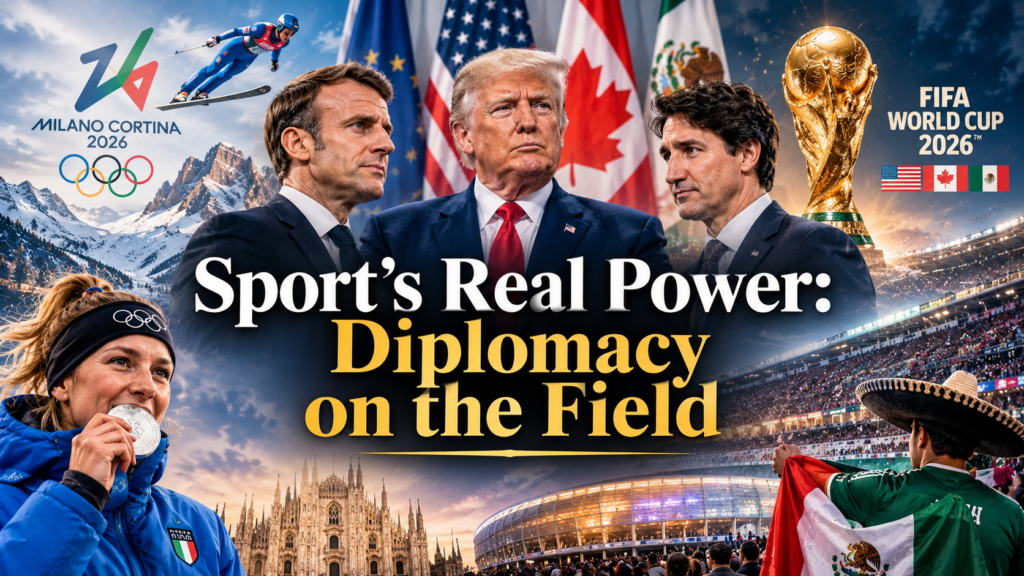
When the lights of the Winter Games came on in February across Milan, the Valtellina and the Dolomites, spectators watched the downhill runs and the ski jumps. People who work in international relations were looking elsewhere: at the VIP boxes, the private dinners, the handshakes that were not on the schedule. In 2026, major sporting events stopped being a simple shop window. They became a stock exchange of influence, where national reputations are priced and where things that would be unspeakable in official forums get quietly negotiated.
The summer of the football World Cup, hosted for the first time by three nations together, the United States, Canada and Mexico, made the phenomenon even clearer. Forty-eight teams, hundreds of delegations, a crowded calendar: every match was an opportunity for contact. The ball was the pretext, diplomacy the substance. And the very fact of organizing in three forced governments with sometimes difficult relations to sit at the same table on visas, borders and security. Technical cooperation is often the first brick of political trust, and a tournament makes it compulsory.
So who really wins? Not necessarily the country that collects the most medals or fills the most stadiums. The first winner is the so-called middle power. The Gulf states, for example, have turned sport into a genuine foreign policy: they buy visibility, build alliances and get accepted into the planet’s most exclusive clubs, while preparing to host the 2034 World Cup. For them an event is not an expense, it is an investment with a geopolitical yield.
The second winner is less visible: sporting bureaucracy. The International Olympic Committee and FIFA now behave like quasi-sovereign entities. Before awarding an event they negotiate tax exemptions, fast lanes and special rules. A candidate city signs commitments that no other business could ever extract from its own government. Hosts come and go, the awarding bodies remain, and with each edition their bargaining power grows.
Then there is a category I would call the silent winners: the territories. Milano-Cortina tested a diffuse model, with venues scattered over hundreds of kilometers and facilities that were largely already in place. After years of Games conceived as cathedrals in the desert, the idea is that real success is not the new structure but the one you did not have to build. Here diplomacy does not run through ministries but through the valleys: mayors, regional presidents, hoteliers and volunteers speaking as equals with counterparts from other continents. It is a diplomacy of territories that Italy knows well and rarely talks about.
The third winners are the athletes, who have become involuntary ambassadors. A statement at the finish line, a gesture on the podium, a refusal to shake hands can be worth more than an official communiqué. Sport is also a laboratory for sanctions: the decision to let some athletes compete under a neutral flag showed how thin the line is between principle and punishment, and how every exception is read as a political message.
The uncomfortable question remains: who loses? Often the citizens. Declared costs rarely match final ones, debts are inherited, promised benefits fade away. Critics speak of sportswashing, the use of spectacle to make a political system look more presentable. Organizers reply that openness produces more change than isolation. Both have arguments, which is exactly why the match is played on transparency: whoever accepts independent audits, local referendums and readable budgets earns a credibility that no opening ceremony can buy.
Perhaps a new way to measure success is the trust dividend. What counts is not how many tourists arrive, but how much trust remains among institutions, communities and international partners once the stands have emptied. A country that delivers the athletes’ village on time, handles security without scandals and leaves behind useful infrastructure has already won, even without a single gold. The real medal is the ability to govern the unexpected.
The consequences are already visible. The calendar of upcoming events, from Los Angeles 2028 to Brisbane 2032, by way of the French Alps and Salt Lake City, shows a system reorganizing itself around a few reliable hubs. Major events are becoming multi-site, more flexible, more dependent on private partners and more exposed to geopolitical tension. Those without capital or stability risk being shut out of a circuit that hands out prestige the way colonies were once handed out.
In the end, the most important podium of the Games is not on television. It is the podium of signed contracts, of alliances built in corridors and of reputations repaired in three weeks. The spectator applauds the athlete, but the true champions are others: they wear jackets, not tracksuits, and they do not stop at the finish line. Understanding who they are, and at what price they win, is the task of anyone who wants to watch sport without being dazzled by the lights.