
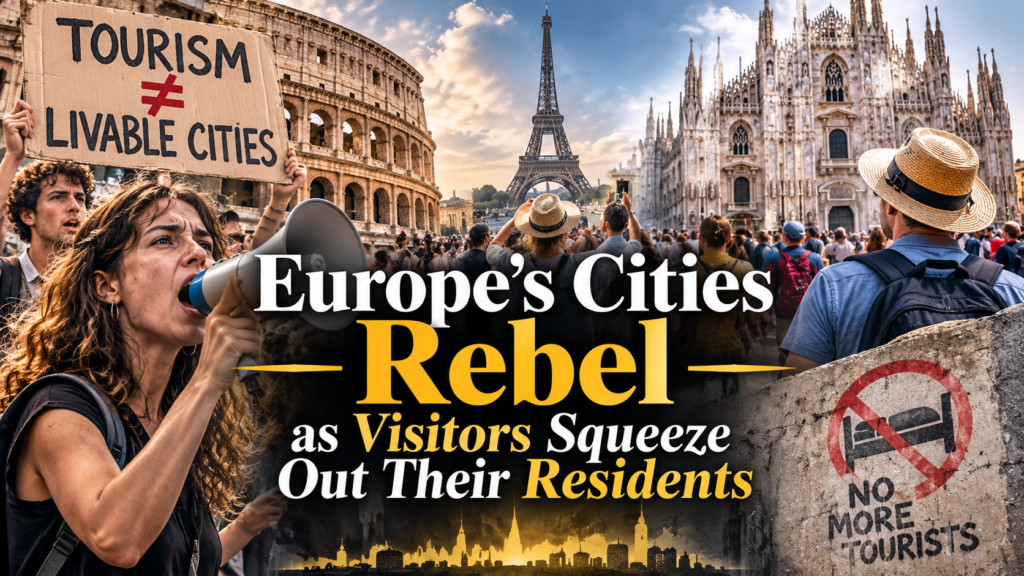
The slogan painted across a wall in southern Europe this summer was brutally simple: “Arrábida is not for sale.” The protesters, marching against a luxury developer’s plan to privatise five beaches in a Portuguese nature reserve, were not complaining about tourists. They were defending the idea that a place belongs first to the people who live there. From Lisbon to Barcelona, from Florence to the Albanian island of Sazan, where tens of thousands reportedly protested a planned luxury resort, the same question is being asked: who is a city for?
The scale of the tension is easy to understand. Europe welcomed about 758 million international tourists in 2024, roughly 40 percent of the world total, and the World Travel Market now forecasts European arrivals to rise another 5 percent in 2026, faster than the global average. Tourism supplies about a tenth of EU output and one job in ten. Yet roughly 80 percent of travellers crowd into about 10 percent of destinations, so the benefits are spread thin while the burdens fall on a few historic centres.
The pressure point is the apartment. A flat rented by the night can earn more than the same flat rented for a year to a local family, so every short-let platform listing pulls a home out of the housing market and into the hospitality business. Lisbon, Barcelona and Madeira have all seen rising rents and gentrification, and lower-paid workers are often among those pushed to the outskirts.
Spain has gone furthest. Barcelona will not renew the licences of more than 10,000 tourist apartments when they expire in November 2028, and Spain’s government has had some 65,000 listings removed from Airbnb. Italy is moving city by city. Florence became the first Italian city to ban new tourist lets in its historic centre in 2025 and this June extended the freeze to more residential districts. Milan and Florence now ban key boxes on public-facing structures, the devices that let guests check in without meeting anyone. Venice charges day-trippers an entry fee, and Rome, strikingly, has few limits so far. The national government, meanwhile, has no plans for nationwide rules; deputy prime minister Matteo Salvini has called such restrictions “penalising and excessive.”
Brussels is catching up. A new EU regulation required platforms to share host data with national authorities from 20 May this year, which should let cities finally see who is renting what. In 2026 the European Parliament also adopted a resolution on smart tourism, with rapporteur Daniel Attard arguing that short-term rentals should “serve communities, rather than exploiting them.”
It would be a mistake, however, to cast the story as villains and victims. Short-term rentals provide income to thousands of households, including pensioners and families who rely on a spare room. Bans can simply move the pressure: visitors drift to emerging destinations such as Porto, Kraków, Valencia and Ljubljana, which soon face the same dilemma. Critics warn of economic fallout from curbing tourism, and evidence on how far bans lower rents is still limited.
There is also a twist few have noticed. The WTM forecasts that arrivals in the Middle East could fall about 40 percent in 2026 because of conflict and disruption to Gulf aviation hubs. If travellers who once booked Dubai now choose Lisbon or Rome, which seems plausible but is not yet proven, Europe’s squeezed cities may be absorbing someone else’s crisis.
What would a smarter response look like? Three ideas deserve more attention than blanket bans.
The first is a parity tax. The incentive problem arises because nightly income can far exceed what a long-term tenancy pays. A tax that rises with that premium would make it hardly profitable to turn homes into hotel rooms, while leaving untouched the owner who rents a spare room occasionally.
The second is a resident floor. Just as cities require affordable housing in new developments, they could set a minimum share of long-term residents in each historic district, and stop issuing tourist licences when the floor is threatened. A city’s character depends on people actually living in it.
The third is a housing dividend. Visitor fees and tourist taxes, now often absorbed into general budgets, could be ring-fenced for housing that local workers can afford. Every night sold would then help fund a home for someone who serves the guest at breakfast.
The consequences of inaction are not abstract. Neighbourhoods emptied of residents lose schools, shops and the everyday life that visitors came to see, so the tourism product eats itself. Essential workers who cannot afford to live near their jobs leave, and the political backlash, from sabotaged key boxes to street marches, becomes harder to defuse each season.
Europe cannot and should not close its doors; tourism pays too many wages. But the protests are carrying a clear message: a city that belongs to visitors alone is no longer a city. The test of the coming years will be whether Europe can share its streets without selling off its homes.