
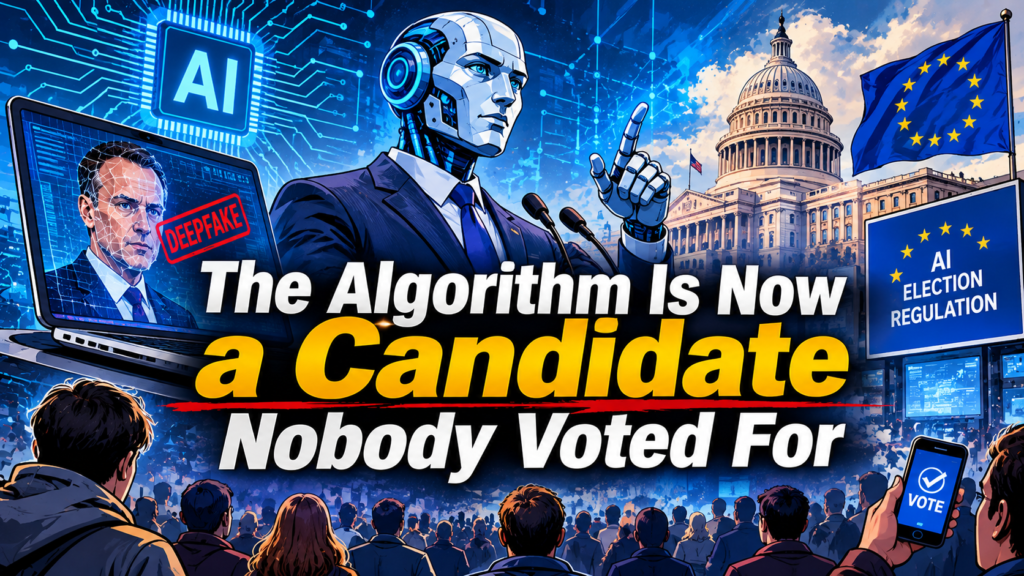
When Romania’s Constitutional Court annulled the first round of its presidential election, held in November 2024, the case rested on what had happened before voters reached the ballot box. The alleged manipulation had been quiet, and it had played out in their feeds. A little-known pro-Russian candidate, Călin Georgescu, had climbed from about 5 percent in the polls to first place, helped, researchers say, by opaque financing, networks of influencers and TikTok’s recommendation system. The episode revealed something democracies had not yet priced in: an election can now be shaped not by what candidates say, but by what software decides to show.
Two years on, regulators on every continent are racing to respond, and the picture they have produced is a patchwork. In the United States there are still no federal rules on AI in elections. Twenty-nine states have laws on election deepfakes, most demanding disclaimers within a window before polling day, while others, such as Texas, restrict deceptive content in the last 30 days. Yet courts are chipping away at them. A federal court permanently blocked California’s law on First Amendment grounds in 2025, and a Hawaii statute was struck down this January. Section 230 has also shielded platforms from California’s attempt to make them police such content. Meanwhile a Missouri candidate for county executive released a fully AI-generated advertisement in a state with no deepfake law at all.
Europe has gone the other way, toward rules for platforms. The Commission opened a Digital Services Act investigation into TikTok after Romania, and its preliminary findings say the company failed to disclose who sponsored and targeted political ads. The EU’s AI Act adds labelling duties for synthetic media and chatbots, scheduled to apply from August 2026, and fines that can reach millions of euros. The weakness, as an Oxford commentary noted, is speed: investigations take far longer than campaigns.
All of this focuses on a particular villain, the fake video. The more unsettling evidence points elsewhere. In studies published in Nature and Science last December, researchers had thousands of voters talk to chatbots in the United States, Canada, Poland and Britain, where almost 77,000 people took part. In the American test, a chatbot arguing for one candidate moved opposing voters by 3.9 points on a 100-point scale, roughly four times the effect of the campaign ads tested in earlier elections. In Canada and Poland, opposition voters shifted by about 10 points, and in Britain the most optimised model moved them by up to 25. The tools worked in both directions, and participants knew they were speaking to a machine.
The sharpest finding is how they persuaded: not through lies, but through avalanches of facts. When models were forbidden from using facts, they lost much of their power. Yet the more persuasive they became, the less accurate, as if they ran out of true material and began to invent. These were experiments, not real campaigns, but the implication is awkward. Most laws target falsehood. A system that wins arguments by flooding a voter with accurate-sounding, one-sided information would sail through nearly all of them.
Three ideas deserve attention beyond the current debate.
The first is that amplification is the new campaign spending. Election law counts money, airtime and posters, because they are how voters are reached. Today reach is bought through recommendation algorithms, and nobody counts it. Platforms could be required to publish, daily during a campaign, the political items that reached the most people and why the system pushed them. Romania suggests that without this, regulators learn what happened only after the vote.
The second concerns timing. Italy, like several countries, enforces an electoral silence on the day before and the day of polling, an old rule built for rallies and posters. It could be extended to automated persuasion: a quiet period during which campaign chatbots, bot networks and paid amplification must stop. That would protect the final hours of deliberation, when last-minute manipulation cannot be corrected.
The third is a faster lane. Elections last weeks, yet enforcement takes years. A standing rapid-response panel, with the power to order temporary labelling or throttling within 48 hours, would match the pace of the threat. It would need strict safeguards and judicial review, since the same tool in the wrong hands becomes a censor.
The stakes are real on both sides. Over-regulation can criminalise satire and hand incumbents a weapon; the cases of parody chatbots pulled down in American races show how blurry the line already is. Under-regulation brings a second danger, the so-called liar’s dividend: when everything might be fake, politicians can dismiss genuine evidence as a fabrication, and citizens give up on knowing anything at all. Cheap production also tilts the field toward whoever has the best technicians, not the best ideas.
Regulation will never catch up with technology, and it need not. What it can do is protect the conditions in which voters decide: transparency about who is speaking, time to reflect, and a way to find out quickly when something has gone wrong. The algorithm will keep campaigning. The task for democracies is to make sure it must declare itself first.