
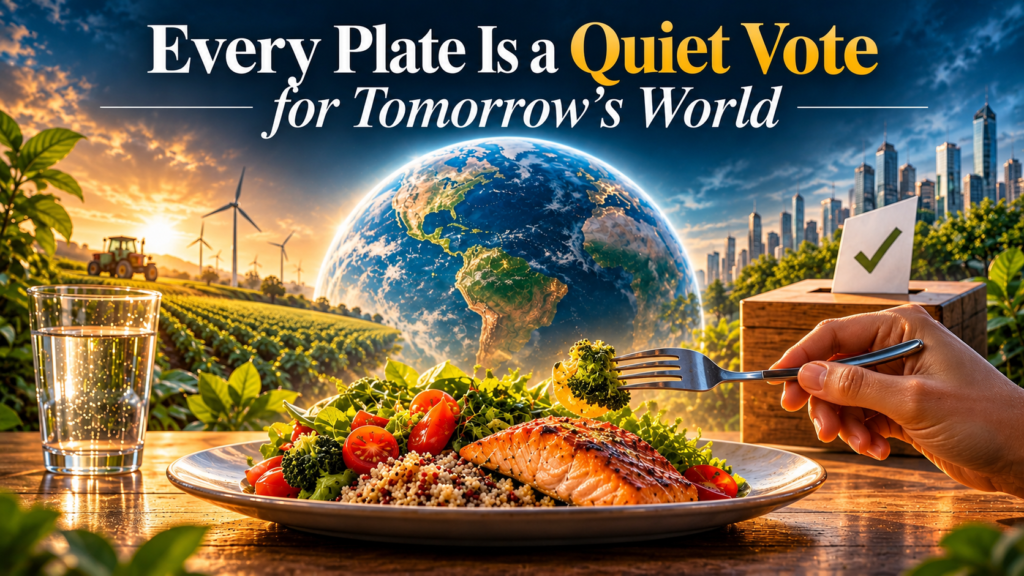
Nobody remembers choosing it, yet the most consequential decision of the day is usually made before nine o’clock. Toast or nothing, coffee in a paper cup, a sandwich grabbed on the move. Multiplied by eight billion people and three meals a day, those small choices form the largest industry on Earth, and one of the least understood.
Start with the paradox. Hundreds of millions of people still go to bed hungry, while more than a billion live with obesity, according to the World Health Organization. Both problems often exist in the same country, sometimes in the same family, because the cheapest calories are rarely the most nourishing. Hunger and excess are not opposites; they are two symptoms of one system that rewards quantity over quality.
That system hides its real prices. The figure on a supermarket label covers farming, packing, transport and profit, but not the diabetes clinic, the polluted river or the warming atmosphere downstream. Food production is responsible for roughly a third of global greenhouse gas emissions and accounts for most of the fresh water humans withdraw. Meanwhile, around a third of everything grown is lost or thrown away, which means an enormous share of that environmental damage buys nothing at all. A tonne of wasted bread is not just a lost meal; it is wasted land, water, fuel and labour, quietly rotting in a landfill and releasing methane.
The second hidden cost is variety. Over the centuries, farmers cultivated thousands of crop species and countless local varieties. Today, rice, wheat and maize alone supply roughly half of the calories people get from plants. A diet that narrow is efficient, until it is not. One drought, one blight or one war in a major grain-exporting region can push bread prices up in cities thousands of kilometres away, as the energy and grain shocks of recent years made painfully clear. Diversity on the plate is not nostalgia; it is insurance.
Then comes the quiet erosion of cooking itself. As convenience foods have multiplied, the everyday skill of preparing a meal from scratch has thinned out in many households. Research continues to link diets heavy in ultra-processed products with a higher risk of heart disease and other chronic illness, though scientists still debate exactly which mechanisms are responsible. What is less debated is the cultural loss. A recipe is a kind of oral archive, carrying a family’s migrations, celebrations and hard winters. When it stops being cooked, it stops being remembered.
Climate change is now rewriting the menu from the other direction. Coffee, cocoa, wine grapes and staple grains are all shifting their growing zones as temperatures rise, and the farmers who feel it first are typically smallholders with the least capital to adapt. Fishing communities watch stocks drift towards cooler waters. Behind every price spike for olive oil or chocolate lies a story about weather that most shoppers never read.
Yet the most promising ideas are surprisingly ordinary. Public canteens in schools and hospitals are among the largest food buyers in any country; if they favour seasonal, regional and varied produce, they reshape what farmers choose to plant. Supermarkets that sell imperfect fruit at fair prices, and households that plan meals around what is already in the fridge, cut waste without any new technology. Cold storage and decent roads in poorer regions can save more food than any laboratory invention. Even fermenting, pickling and drying, humanity’s oldest preservation tricks, are enjoying a revival for good reason.
Policy has a role too. Labels that show environmental and health impact alongside price would let markets work with better information. Subsidies could shift from the cheapest commodities towards the foods nutrition science actually recommends. And cooking, taught in schools as a life skill rather than an elective, would repay its cost in public health for decades.
For individuals, the message is not guilt but attention. Eating a little more plant variety, wasting a little less, buying from nearby producers when possible and cooking one more meal a week are modest steps, yet multiplied across millions of tables they carry real weight. Nobody needs to be a perfect consumer. They need only remember that food is not just something we buy; it is something we take part in.
Every plate carries a vote about land, labour, climate and health, cast three times a day, usually without a thought. The task of this decade is to make that vote an informed one, and to build a food system in which the good choice is also the affordable, delicious and obvious one. The meal in front of us is the shortest route to the future we want.