
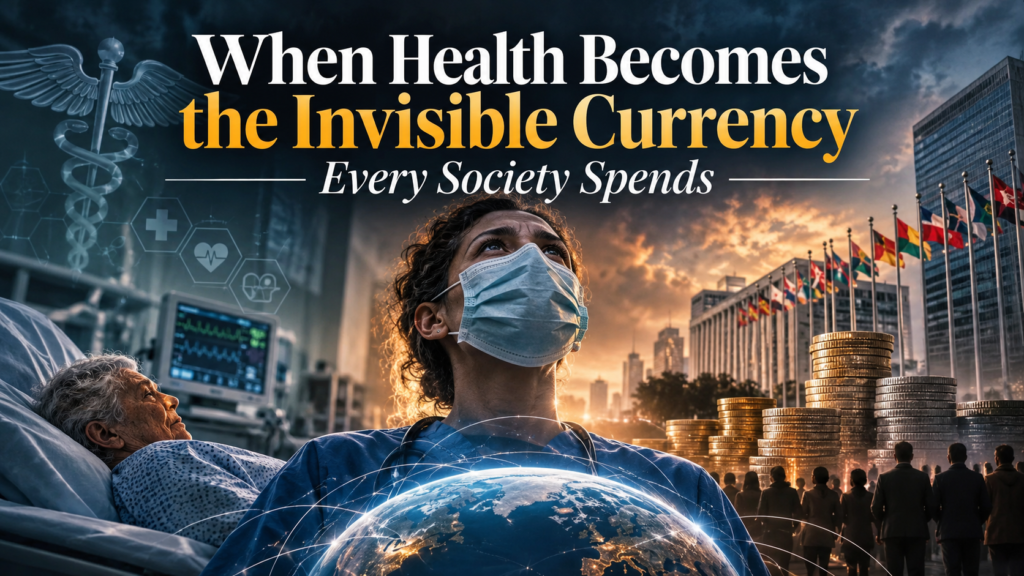
Long before anyone receives a diagnosis, health has already been quietly spent. It leaves the account in small withdrawals: a night of broken sleep, a commute through traffic fumes, a week without a conversation that lasted longer than a payment at the till. Most of us only check the balance when the bill arrives, in a waiting room, under fluorescent light.
The World Health Organization defined health in 1948 as complete physical, mental and social well-being, not merely the absence of disease. Seventy-odd years later, that definition reads less like an ideal and more like a budget statement. Chronic illnesses such as heart disease, diabetes, cancer and respiratory disorders now account for roughly three out of four deaths worldwide, and they are shaped far less by a single bad decision than by the thousand ordinary conditions surrounding a life: what the neighbourhood sells, how the shift rota is written, how far the nearest clinic sits from the nearest bus stop.
That is the first uncomfortable idea. Health is largely manufactured outside hospitals. Doctors repair; streets, schools, employers and landlords produce. A child raised beside a busy road breathes a different future from one raised beside a park. The WHO links air pollution alone to millions of premature deaths each year, and the burden falls hardest on those who cannot afford to move. Health, in other words, is distributed the way money is distributed, and the two tend to compound each other.
Mind and body, long treated as separate departments, are drawing on the same account. Depression and anxiety are estimated to cost the global economy around a trillion dollars a year in lost productivity, a figure that rarely appears in budget debates because it arrives disguised as absenteeism, mistakes and quiet resignation. Loneliness, once dismissed as a private sorrow, has been associated in research with mortality risks comparable to heavy smoking. A society that counts only broken bones and tumours is auditing the wrong ledger.
Then there is the screen. Smartphones have placed a doctor, a pharmacy and a fitness coach in every pocket, and just as easily a feed engineered to hold attention past midnight. Wearable devices promise early warnings, but they also create a new class of the worried well, people anxiously monitoring numbers that were never meant to be watched minute by minute. Meanwhile, the data these gadgets collect is among the most intimate a person can generate, and the rules on who may analyse it, or sell it, still trail far behind the technology. Privacy has quietly become a health issue.
The consequences ripple outward in ways that are rarely traced. When illness strikes a household without strong public protection, the damage is seldom confined to the patient: a relative cuts back working hours to provide care, savings drain away, a teenager leaves school early. Ageing populations across Europe and Asia deepen the pressure, as fewer workers support more years of later life. Even trust is at stake. The pandemic years showed how quickly confidence in science, governments and neighbours can fracture when health information becomes a battleground, and how slowly it is rebuilt. Add antibiotic resistance, which threatens to turn routine surgery and childbirth into gambles again, and the picture is of a system whose silent risks accumulate faster than its headlines.
Yet there is a hopeful counterpoint, and it is not exotic. Prevention works, and it is cheap compared with cure. Cities that redesign streets for walking and cycling reduce pollution, injuries and sedentary disease in a single stroke. Schools that serve decent meals and teach children about sleep and stress build habits that outlive the classroom. Employers who treat rest as a source of productivity rather than a weakness find fewer sick days and sharper teams. Primary care that reaches people early, in their own language and close to their own homes, catches problems while they are still inexpensive to solve.
What is missing is accounting. Governments book hospital spending as health and almost everything that keeps people out of hospital as something else. A practical shift would be to ask, before approving a housing estate, a tax rule or a factory permit, one plain question: what will this do to the health of the people it touches?
For individuals, the lesson is humbler but no less real. Health is not a project to launch on the first of January; it is the sum of defaults, repeated daily. Protect sleep, move a little every day, keep friendships alive, and see a doctor while the problem is still whispering. But personal discipline can only go so far in a world designed against it, which is why the real task belongs to the collective: building places where the healthy choice is also the easy one.
The most expensive illnesses are the ones we notice last. A society that learns to read its health balance early, and to treat sleep, air, belonging and fair access to care as shared assets rather than private luxuries, will spend less on repair and gain far more in years worth living. The account is open, the withdrawals are already happening, and the only real question is whether we will start paying attention before the statement arrives.