
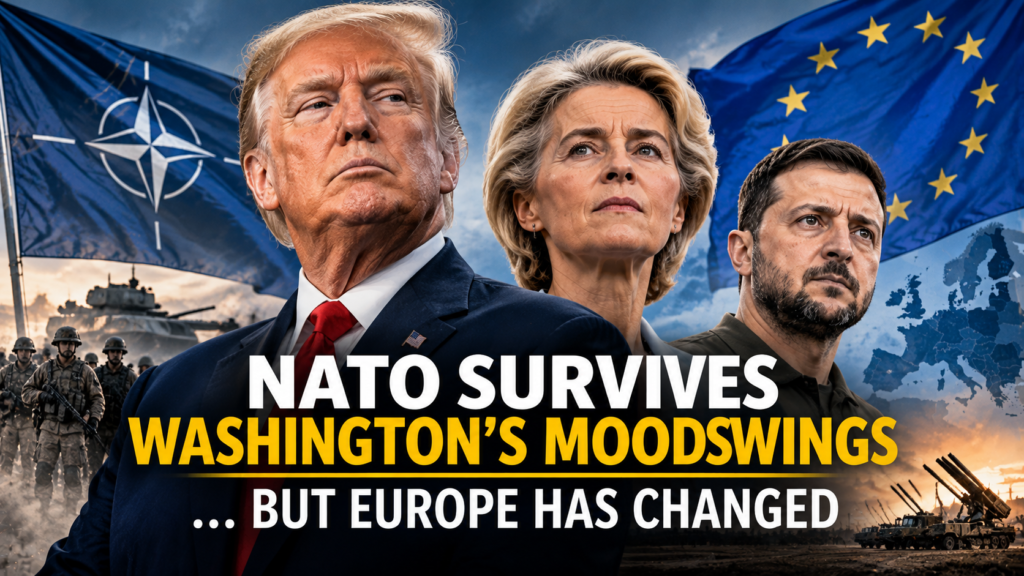
When Russian tanks crossed into Ukraine in February 2022, the transatlantic alliance looked like the one fixed point in a shaken world. Finland and Sweden rushed to join, American weapons flowed east, and the 1949 treaty seemed younger than it had in decades. Nearly five years later, the picture is stranger and more interesting. The treaty text has not changed by a comma, yet almost everything built on top of it has been rewritten.
The rewriting happened in stages. First came the loyalty phase, in which Washington led and Europe followed. Then came the invoice phase: at the 2025 Hague summit, allies pledged to spend 5 per cent of economic output on defence by 2035, with 3.5 per cent for core military needs and 1.5 per cent for related security. Then came the shock phase. America’s direct military aid to Kyiv was all but halted, January brought Donald Trump’s threat to seize Greenland from Denmark, a NATO ally, and trust among ordinary Europeans fell sharply. The EU’s own security institute found that the share of citizens with a negative view of the United States rose by 14 points in about six months.
Yet the alliance did not break. At the Ankara summit in July, all 32 leaders reaffirmed what they called an ironclad commitment to Article 5, and allies pledged 70 billion euros for Ukraine in 2026, with at least as much promised for 2027, largely without American money. Secretary General Mark Rutte said European allies and Canada were already investing around 4 per cent, a year into a ten-year effort. Ukraine, meanwhile, left once more without a timetable for membership.
Then came the midterms. As of 5:31pm CET on 16 November, the Associated Press’s count of the US House shows the Democrats with 256 seats won and the Republicans with 169, with 10 seats counted as won for no party; the AP results do not say why, or which way those seats will go. The label “Majority reached” beside the Democrats is not a call by the AP. In the Senate, as of 5:30pm CET, the AP’s count shows the Democrats at 55 seats in total and the Republicans at 44, with one seat counted as won or held over for no party, and again the AP results do not say why or which way it will go. The label “Control reached” beside the Democrats is not a call by the AP. These counts may have changed since.
Whatever the final arithmetic, analysts agree on one thing: the vote will not restore the old alliance. The EU’s security institute argues that the midterms leave Europeans with the same dilemma, deep mistrust of Washington and no affordable way to break with it, and one of its analysts expects America’s role in Europe to keep shrinking. Trump’s own NATO envoy says he sees no shift in foreign policy. Before the vote, Politico reported that allied capitals were bracing for a worst case, a president bruised at home who turns pressure on allies abroad.
Perhaps the best way to understand the new Atlantic order is to stop reading the 1949 text and start reading the side letters: a trade deal ratified by Europe in June, more than 50 billion dollars in new defence agreements announced around Ankara, munitions co-production deals, spending trajectories checked like quarterly earnings. The alliance has quietly shifted from a vow to a service contract, with milestones, penalties and renewal clauses. That suits Washington’s transactional instincts, and it hands Europe something it rarely had before: leverage, because whoever pays the bill can also shop elsewhere.
Europe’s most underrated ally may now be American public opinion. A June poll by the Chicago Council on Global Affairs found 68 per cent of Americans want the United States to keep or increase its commitment to NATO. Brussels think tanks now urge EU capitals to court Congress and state governments, hoping to give the alliance a second anchor that does not depend on a single White House.
The consequences ripple outward. For Moscow, a divided West is an opportunity, but a Europe spending near 4 per cent is a harder target than the one it faced in 2022. For Ukraine, the danger is dependence on European budgets that are already stretched. For Germany, which plans to borrow more than 800 billion euros by 2030 for infrastructure and defence, the alliance’s centre of gravity has moved toward Berlin and Warsaw. For laggards such as Spain, singled out by Trump at Ankara, the price of staying behind is political as much as financial. And in Greenland and the Arctic, the memory of January lingers as proof that an ally can become a headline overnight.
The Atlantic is not closing; it is being renegotiated, line by line. The alliance that emerges will rest less on sentiment and more on capacity, which may feel colder but could prove sturdier. The question hanging over every capital is whether a treaty that now depends on invoices can still inspire the sacrifice that only an oath can ask for.