
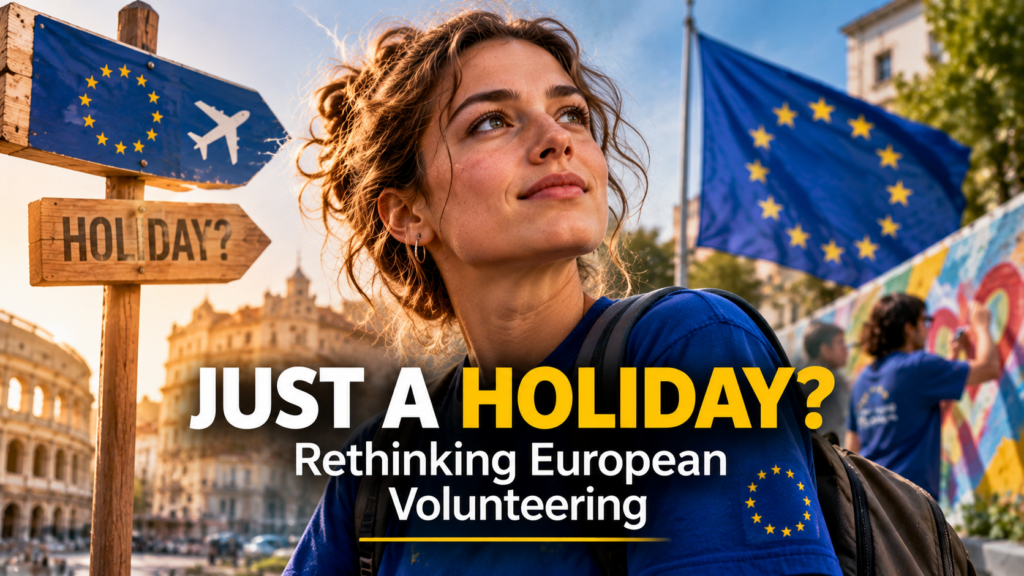
A young woman from Lombardy spends nine months in a coastal town, helping at a youth centre two afternoons a week. Her flight, lodging and monthly allowance are paid by the European Union. She comes home fluent in a new language, with a wider circle of friends and a stronger sense of being European. Nobody in the town can quite say what changed because she was there. That is the quiet dilemma at the heart of the European Solidarity Corps.
The programme has about €1.01 billion for 2021 to 2027 and offers people aged 18 to 30 the chance to serve communities in Europe and in partner countries. Nobody serious doubts the idea. A European Parliament briefing on the programme’s interim evaluation credits it with building youth engagement and social cohesion, and says its main weakness is a lack of funds. Yet the harder question is rarely asked: how much of the money buys solidarity, and how much buys a well-subsidised gap year?
Nobody can answer, and that is the real problem. The European Court of Auditors, reviewing the Commission’s proposal to fold the Corps into Erasmus+ from 2028, notes that the indicators in this field mostly count participants, while result indicators rely largely on what participants say they felt. They do not capture what was learned, and they say little about what the host community gained. A programme that measures headcount and satisfaction will naturally reward projects that are easy to fill and pleasant to join.
The incentives are not hard to see. Applicants gravitate to attractive destinations, and hosting organisations that depend on volunteer numbers have little reason to turn away a cheerful applicant with no relevant skills. Over time, projects drift toward being a pleasant experience for the visitor rather than a service for the neighbourhood. This does not describe every project, and many are excellent. But a system that cannot tell the difference between the two is spending public money blind.
The consequences reach beyond budgets. Taxpayers will not keep funding what they suspect is tourism with a good conscience, and the proposed merger into a much larger Erasmus+ programme, which the auditors warn could reduce the Corps’ visibility, may leave it with fewer defenders when money gets tight. Host communities suffer too: when volunteers are fitted into schedules rather than needs, a small charity spends its scarce time supervising someone it never asked for.
Then there is soft power. Europe likes to say it wins influence through attraction rather than force. But attraction works only when it is mutual. If a young person in Tunis, Tbilisi or Nairobi mostly meets Europe in the form of short-stay visitors who cannot return the hospitality, the message is not partnership. It is asymmetry. Partner countries appear in the programme’s rules, but they sit at its margins, and the real conversation between generations on both sides of Europe’s border is thin.
A better Corps would start by changing what it buys. First, fund outcomes. Every project could publish a short public ledger before it starts and after it ends: what need was identified, what changed, and who verified it. The verifier should be the host community, not the volunteer’s own survey. Projects that cannot fill the ledger would not be renewed.
Second, make the Corps genuinely two-way. Pair each European volunteer with a young person from a partner country and let them co-lead the same project, in each other’s home towns, one after the other. Visitors become partners, and the hospitality is returned. For countries whose young people face visa walls, it would also offer something the EU rarely does: a dignified route in.
Third, add an intergenerational tandem. Place every project beside an older local expert, such as a retired teacher, farmer or engineer, and have volunteers record and apply that knowledge. Europe’s ageing societies and the young majorities of its neighbours share a problem of broken links between generations. A programme that deliberately connects an elder, a young European and a young local would build the dialogue that speeches only promise.
Fourth, allocate by need, not by scenery. A matching system could give priority to under-served places and require training, language preparation and a clear skill contribution before departure. Applicants who want a postcard year can still find one, but not on the public purse.
Fifth, treat alumni as an asset, not a statistic. Five years later, where are they? Who works in the partner region, who started an organisation, who still talks to their host family? That follow-up would show whether the money bought lasting ties.
None of this requires more money, though the programme probably deserves more. It requires a different test. Volunteering can be a bridge between generations and continents, but only if someone checks that the other end of the bridge exists. If the Corps passes that test, its next budget will be easier to defend. If it does not, a fund meant to express Europe’s best instincts risks becoming the thing critics already claim it is.