
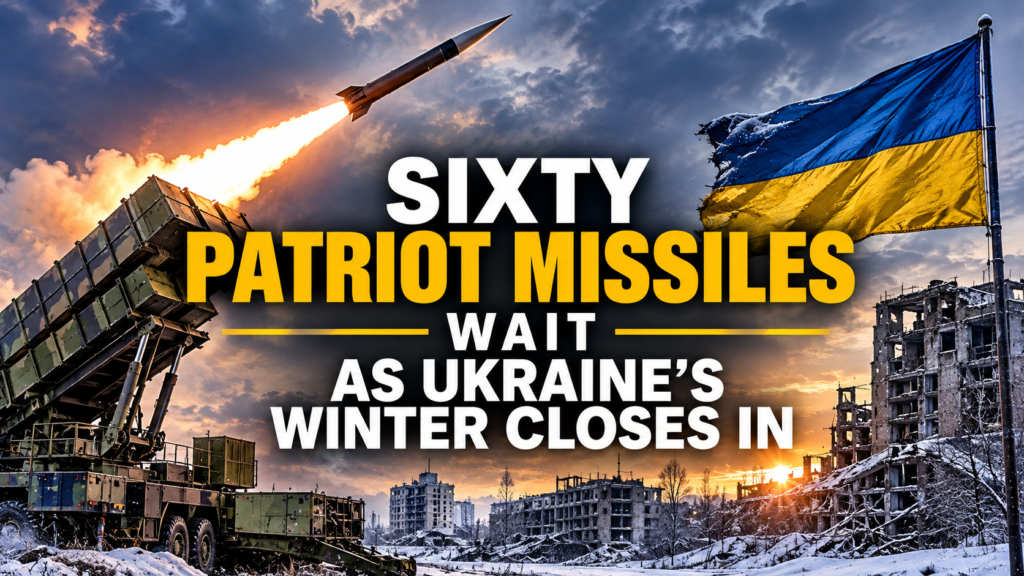
Somewhere in a storage depot, some of them reportedly in European arsenals, sit about sixty interceptor missiles that Ukraine badly needs. They have been paid for, allocated and promised. What they still lack is a signature.
The Financial Times reported on Tuesday that US Defense Secretary Pete Hegseth has yet to approve the transfer of roughly 60 Patriot interceptors earmarked for Ukraine, citing people familiar with the matter. Other outlets put the split at around 40 modern PAC-3 missiles and about 20 older PAC-2 rounds. Because the weapons are American-made, Washington must authorise their export or re-export, even when European governments funded them or hold them on their own soil.
A stalled pen
The Pentagon’s public line is that nothing has changed. A spokesperson told the FT that US policy on supporting Ukraine remains unchanged and pointed to continuing work with European partners to speed up industrial cooperation on Patriot production. No timetable for the missiles was given.
Kyiv sees it differently. President Volodymyr Zelensky said an agreement covering 48 missiles is waiting for approval and that the decision depends entirely on Hegseth. He had made a similar complaint in October, when he said Ukraine had waited almost a month for sign-off on missiles for Patriot and NASAMS systems. The FT also reported that a separate Ukrainian request to manufacture Patriot interceptors on its own territory has made little progress.
Why sixty matters
Sixty sounds small beside the thousands of missiles and drones Russia has fired during this war. But air defence runs on thin margins. Zelensky has said Ukraine receives, on average, only about 12 Patriot missiles a month. At that rate the stalled consignment equals roughly five months of normal supply, held back at the very moment demand is rising.
The PAC-3 is the more valuable of the two types. Its maker, Lockheed Martin, describes it as a hit-to-kill interceptor able to destroy ballistic missiles, cruise missiles and aircraft by direct impact. It is the kind of weapon that protects a power station or a crowded district from a ballistic strike, which is why a handful of rounds can decide whether a night ends with a blackout or with a damage report.
Winter is the deadline
The timing is the sharpest part of the story. Russia has stepped up attacks on Ukraine’s energy infrastructure ahead of what will be the country’s fifth winter of full-scale war. This week alone brought fresh strikes on Zaporizhzhia, Kyiv and Chernihiv, and a drone attack on a shuttle bus in the Kharkiv region that reportedly killed one person and wounded seven.
Heating, hospital power and water pumping all depend on a grid that has already been hit hard. Interceptors do not repair a damaged substation, but they can decide whether the substation is hit at all. Every week of delay therefore carries a cost that is measured in cold apartments and generator fuel, not in diplomatic language.
Ownership without control
The episode exposes a quiet flaw in how Western support works. European governments can buy missiles, ship them and store them, yet still need a US permission slip to pass them on. It is like owning a house but needing your neighbour’s key to open the door. Poland’s foreign minister said in October that his country had no Patriot interceptors to spare, a reminder that European shelves are close to empty.
The consequences could reach beyond Ukraine. Allies who now fund American weapons for Kyiv may ask for clearer rules, firmer delivery dates or a bigger share of production. Others will draw a harder conclusion and press for European-made air defence that does not depend on a single capital’s approval. Either path would reshape transatlantic defence trade for years.
There is a mixed picture on the US side. Reports say Washington approved the sale of 500 PAC-3 missiles to Ukraine last month, worth about $2.1 billion. Orders on paper, however, do not stop a missile in the air. Production lines take time, and the gap between what is signed and what arrives is where Ukrainian cities are exposed.
A war that keeps widening
The Patriot debate unfolds against a wider battlefield. Ukrainian naval drones reportedly struck two Russian vessels, one military and one cargo ship, in the Libyan port of Benghazi, a sign of how far the conflict now stretches from its frontlines. Meanwhile, independent Russian media estimate that Russian dead and missing since 2022 may total around 700,000, a figure that cannot be independently verified but points to the human weight behind every strategic decision.
For now, the question is simple and urgent. Either the pen moves and the missiles roll before the worst of the cold, or the stockpile waits while the sirens sound. Ukraine’s planners, and a good many European ministers, are watching the same desk.