
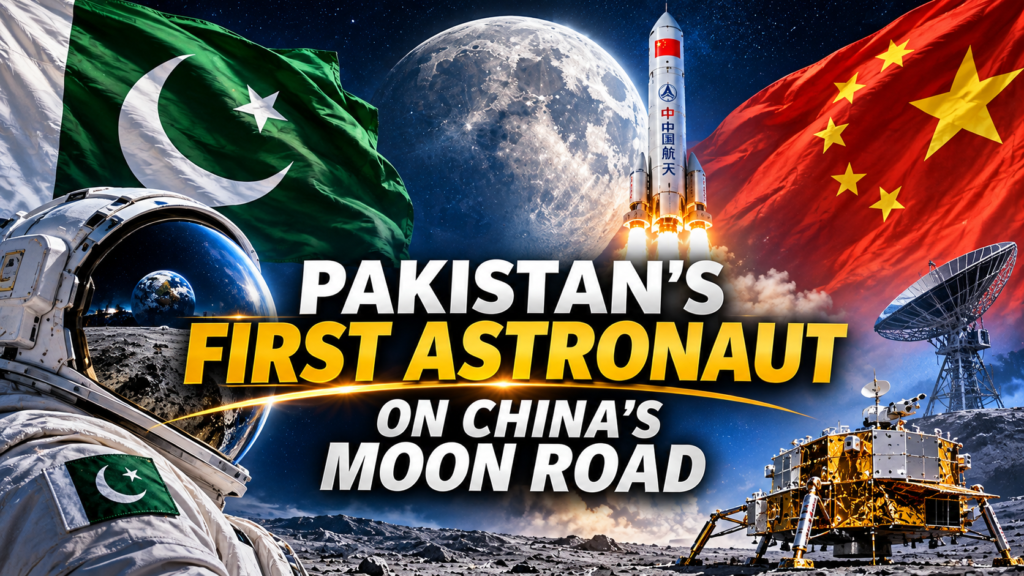
The sky over the Gobi Desert was still pale on Wednesday morning when a Long March-2F rocket lifted off from the Jiuquan Satellite Launch Center, carrying three people toward China’s Tiangong space station. Liftoff came at 8:18 a.m. Beijing time, and Chinese state media said the Shenzhou-24 spacecraft reached its planned orbit about ten minutes later. A little over three hours after that, according to Chinese space officials, it had docked with the station.
On paper it was another routine crew rotation. In practice it was the first time a foreign astronaut has ever flown to a Chinese space station.
The crew
Commander Tang Hongbo, 51, is a veteran of the Shenzhou-12 and Shenzhou-17 missions. With this flight he becomes the first person to visit Tiangong three times. Flight engineer Wu Yi, 39, is making his first trip to space. The third seat belongs to Muhammad Zeeshan Ali, a 40-year-old Pakistani air force pilot, who flies as a payload specialist and is also on his first mission.
His role is different from that of his crewmates. Tang and Wu are expected to stay about six months, the usual length of a Shenzhou tour. Ali’s stay is planned at roughly a week or so, and Pakistani officials have said he will come home aboard the Shenzhou-23 spacecraft that carried the outgoing crew up. It is a tidy piece of orbital logistics: the visitor arrives with one crew and leaves with another, so the station never has to wait for a dedicated return ticket.
More than a seat on a rocket
Reports describe Ali’s place on the flight as part of bilateral cooperation between Beijing and Islamabad, and some outlets link it to China’s Belt and Road Initiative. That framing deserves attention. For decades, space has been a showcase for prestige, and a flight like this offers China something money cannot easily buy: a partner nation that can say, in front of its own citizens, that its first astronaut went to orbit on Chinese hardware.
For Pakistan, the gain is tangible and symbolic at once. The country has a long-running space agency and a record of launching satellites, yet no citizen had ever left the atmosphere. A week aboard Tiangong gives its scientists a chance to run experiments in microgravity and gives a generation of students a national hero to point to.
A rival to the old club
The deeper story is about who gets invited. The International Space Station has been the world’s most visible example of cooperation in orbit, but it is ageing and is scheduled to be retired around the end of this decade. US law has also restricted NASA’s direct dealings with China for years. Tiangong, by contrast, is young, modular and now open to guests.
Taken together, these facts point toward a quiet split in how humanity uses low Earth orbit. One cluster of partners flies with the United States and its allies. Another, still small but growing, could form around China. Countries that cannot afford their own crewed programme, or that cannot get a seat on Western vehicles, now have a second door to knock on. Whether many will walk through it is an open question, but the door exists as of today.
The Moon is the real destination
Beijing has said it aims to put astronauts on the lunar surface by 2030, and each crewed flight to Tiangong serves as a rehearsal for that ambition. Long stays in orbit teach engineers how crews, life-support systems and spare parts hold up over months. Experiments carried out by Tang and Wu will feed into the knowledge needed for a sustained presence beyond Earth orbit.
Washington has its own lunar goals through the Artemis programme, so the next few years will look less like a sprint and more like two parallel expeditions with different partners and different rules. That competition may speed up technology. It may also complicate agreements on safety, landing sites and the use of resources on the Moon, areas where international law remains thin.
What could go wrong, and what comes next
Spaceflight is unforgiving, and a mission with a foreign guest carries extra scrutiny. Any technical fault, medical issue or delay would be judged not only as an engineering problem but as a diplomatic one. China’s space agency has a reliable record with the Shenzhou programme, which helps, but confidence is built one flight at a time.
If this mission goes smoothly, expect more invitations. Other friendly governments may ask for seats of their own, and China will have an incentive to say yes, since each foreign astronaut deepens the network of partners behind its programme. Scientific payloads, training agreements and ground-station deals could follow, quietly turning a single flight into a long-term relationship.
For now, three people are floating in a lab some 400 kilometres above the Earth, and a bigger idea is floating with them: that the next chapter of human spaceflight may have more than one author. Whether it brings cooperation or competition, or a little of both, will depend on choices being made far below the clouds.