
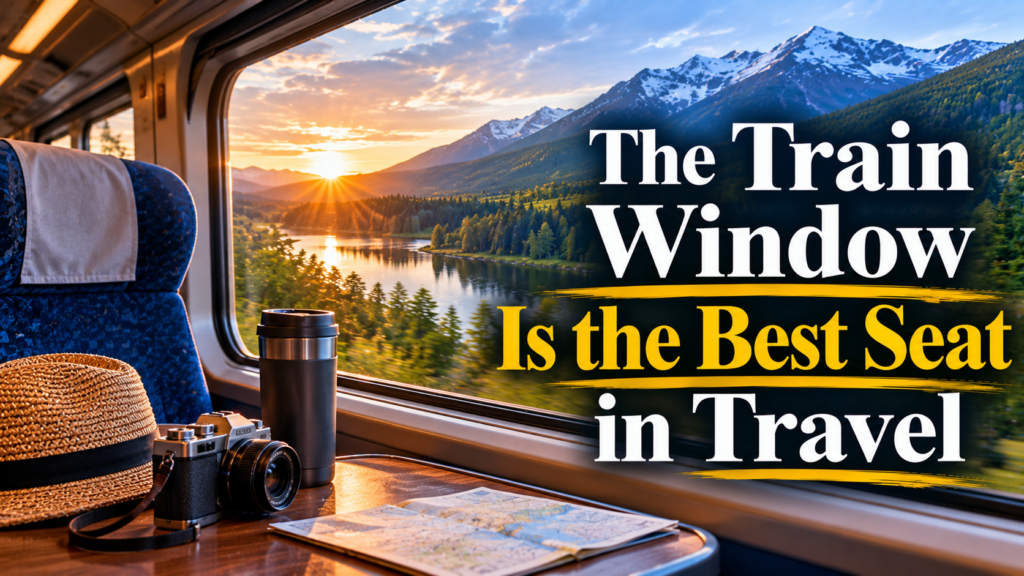
There is a moment, a few minutes after a long train leaves a station, when the city thins into gardens and back fences, and the traveller discovers they are no longer in a hurry. The seat is comfortable, the table is wide enough for a book and a cup of coffee, and the landscape begins to scroll past like a film that nobody directed. It may be the best seat in travel: the train window.
Railways once defined what a journey meant. The Orient Express began running in 1883, linking Paris with Constantinople and becoming a legend of glamour and intrigue. The Trans-Siberian line, completed in 1916, stretches across nearly ten thousand kilometres of Russia and remains one of the longest rail journeys on Earth. In Switzerland, the Glacier Express crawls through the Alps at a pace chosen not for efficiency but for views. For generations, getting there was half of the story.
Then aeroplanes and motorways took over, and trains were treated as a relic. The revival began in Japan, where the Shinkansen opened in 1964, just before the Tokyo Olympics, and showed that trains could be fast, punctual and safe at speeds that once seemed impossible. France launched its TGV in 1981, and Spain’s AVE followed in 1992. Today China operates by far the largest high-speed network in the world, and trains between major cities in Europe and Asia are often quicker door to door than flying once airport queues and transfers are counted.
Why do travellers love them? Partly it is practical. Stations sit in the middle of cities, there is no security theatre, no luggage squeeze, no hours of waiting at a gate. Partly it is physical: there is room to stand up, walk to the café car and look out at the world. Mostly, though, it is psychological. A train journey has a shape, with a beginning and an end and places along the way, which makes distance feel earned rather than skipped.
The Channel Tunnel, opened in 1994, made that experience tangible for many Europeans. A passenger can board in London and be in Paris in a little over two hours, stepping off in the centre of the city with a book half read. For people who work on laptops, a train can be an office with a view. For families, it is a moving living room where children can roam. For older people or those with reduced mobility, it can be easier than airports.
In 1972, the Interrail pass gave young Europeans the chance to roam across borders with a single ticket, and generations of students still remember sleeping in compartments and waking up in new countries. It is a rite of youth, and one that has since been extended to older travellers. The idea that a ticket can be a licence to wander, rather than a reservation for one trip, has proved surprisingly durable.
Trains are not perfect. Fares can be expensive, particularly when booked late, and ticketing across countries can be confusing, with different companies and different booking systems. Some networks are underfunded and delayed, and in many regions, such as large parts of North America, passenger services are sparse, slow or absent. A train that arrives late or is cancelled is no more romantic than a delayed plane. The charm of rail depends on a system reliable enough to deserve it.
The effects on places can be significant. A town with a high-speed station may see new commuters, shops and hotels, and cities a few hours apart can function like one economic area. But the benefits are not automatic. Some places lose out when express trains bypass them, and critics note that new lines are costly and can favour large cities over smaller ones. Whether rail strengthens or hollows out a region depends on how services are planned and who they serve.
Night trains are enjoying a revival too, trading a hotel bill and a morning flight for a bed on wheels. A sleeper departing in the evening can deliver a traveller to another country by breakfast, and for those who enjoy the gentle rocking and clatter, sleep comes easily. Still, a compartment is smaller than a hotel room, and shared compartments are not for everyone, so it is worth checking the type of berth before booking.
Planning a rail trip is easier than it looks. Check timetables on official railway websites or on aggregator sites that cover several countries, reserve seats on popular services, and allow generous time for connections. Pack light, since luggage racks are limited. Choose a window seat on the side with the best view, which locals will usually recommend. And bring something to do, though many travellers find that watching the world slide by is entertainment enough.
The great promise of the train is that it makes the journey part of the destination. In an age that treats distance as an obstacle to be removed as quickly as possible, a seat by a window offers another idea: that moving through a landscape, patiently, is itself a kind of arrival. The best seat in travel is still the one beside the train window, because it gives back what speed took away.