
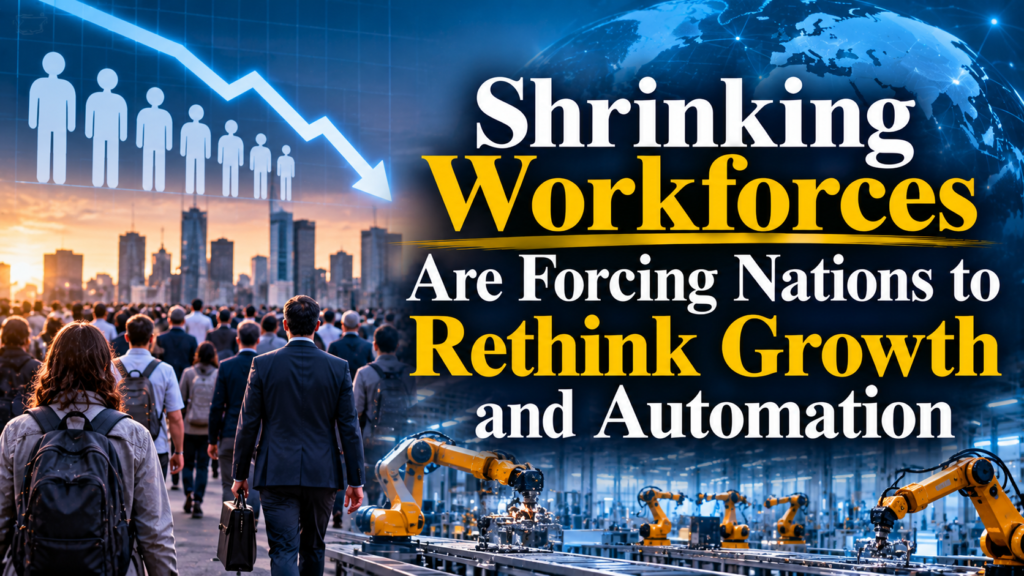
For more than two centuries, modern economic growth rode on a reliable demographic tailwind: each generation was larger and better educated than the one before it, supplying expanding factories, offices, and tax bases. Today, from East Asia and southern Europe to North America and parts of Latin America, that historic engine has reversed. Fertility rates have fallen well below replacement levels across dozens of economies, while rising life expectancy means retirees are rapidly outnumbering new entrants to the labor market.
This demographic inflection is no longer a distant forecast for mid-century planners; it is already reshaping labor markets, public budgets, and industrial strategy in real time. As hospitals struggle to staff nursing wards, construction firms turn down infrastructure contracts for lack of skilled tradespeople, and pension systems face widening deficits, nations are discovering that managing prosperity in an aging society requires rewriting the basic rules of work, technology, and social solidarity.
How Falling Birth Rates Reversed the Growth Formula
To grasp the scale of the demographic shift, consider how post-war economic models were built. Pension systems, universal healthcare funds, and public debt projections all assumed steady expansion in the ratio of working-age adults to dependents. When birth rates declined gradually, rising female labor participation and rural-to-urban migration cushioned the slowdown for decades.
Now those buffers have largely been exhausted, and workforce contraction is accelerating across major manufacturing and service economies simultaneously. Fewer workers means slower potential gross domestic product growth unless every remaining worker becomes substantially more productive. At the same time, aging populations shift consumer demand away from housing and durable goods toward healthcare, personal services, and eldercare—sectors that have historically proven hardest to scale.
The Automation Paradox in Aging Societies
Faced with persistent labor shortages, policymakers and executives routinely point to robotics and artificial intelligence as the natural remedy. Indeed, countries with the oldest workforces—such as Japan, South Korea, and Germany—already lead the world in industrial robot density, using automated assembly lines and logistics systems to sustain export competitiveness despite shrinking domestic cohorts.
Yet technology alone cannot effortlessly bridge every demographic gap. While robots excel at repetitive factory welding and warehouse sorting, acute shortages are concentrated in hands-on human roles—nursing, eldercare, early childhood education, plumbing, electrical grid maintenance, and hospitality—where empathy, physical dexterity, and unpredictable environments resist simple automation. Furthermore, deploying advanced automation requires heavy upfront capital investment at the exact moment aging societies save less and spend more on retiree healthcare.
Fiscal Strain and Intergenerational Tension
Beneath labor statistics lies a delicate political contract between generations. When pay-as-you-go pension and healthcare costs climb faster than economic output, governments face mounting pressure to raise payroll taxes on younger workers, extend statutory retirement ages, or cut public investments in schools, science, and climate adaptation.
If younger cohorts perceive that rising housing costs and tax burdens leave them unable to start families or build wealth while public spending tilts overwhelmingly toward older voters, social cohesion frays. Preserving democratic stability in aging nations depends on ensuring that economic opportunity remains vibrant for the young even as dignity is protected for the old.
Adapting Work, Lifelong Learning, and Smart Automation
Navigating demographic contraction successfully requires combining targeted technological adoption with profound reforms to how human careers are structured across longer lives. Rather than treating retirement as a rigid cliff at age sixty-five, employers and pension rules can encourage phased, flexible career transitions—pairing ergonomic workplace redesign, reduced-hour advisory roles, and portable health benefits so experienced workers who wish to stay active can contribute without burnout.
Public vocational and university systems must simultaneously pivot from front-loaded youth degrees toward modular, mid-career skill accounts that enable workers in their forties and fifties to retrain alongside evolving digital tools. Meanwhile, industrial policy can direct automation incentives toward physical bottlenecks—such as eldercare mobility aids, automated construction prefabrication, and hospital logistics—while pairing selective, skills-aligned immigration pathways with affordable family housing and childcare.
Prosperity Beyond Population Growth
Economic history has long equated national vitality with sheer headcount, yet a smaller, older society need not be a stagnant one. The end of rapid population growth challenges nations to shift from extensive expansion—simply adding more hands—to intensive ingenuity that elevates the capability and well-being of every citizen.
By aligning human-centered automation, flexible multi-generational careers, and fair fiscal stewardship, aging nations can turn demographic headwinds into a catalyst for higher productivity and deeper social resilience. The future belongs to societies that learn to thrive not by growing larger, but by growing wiser.