
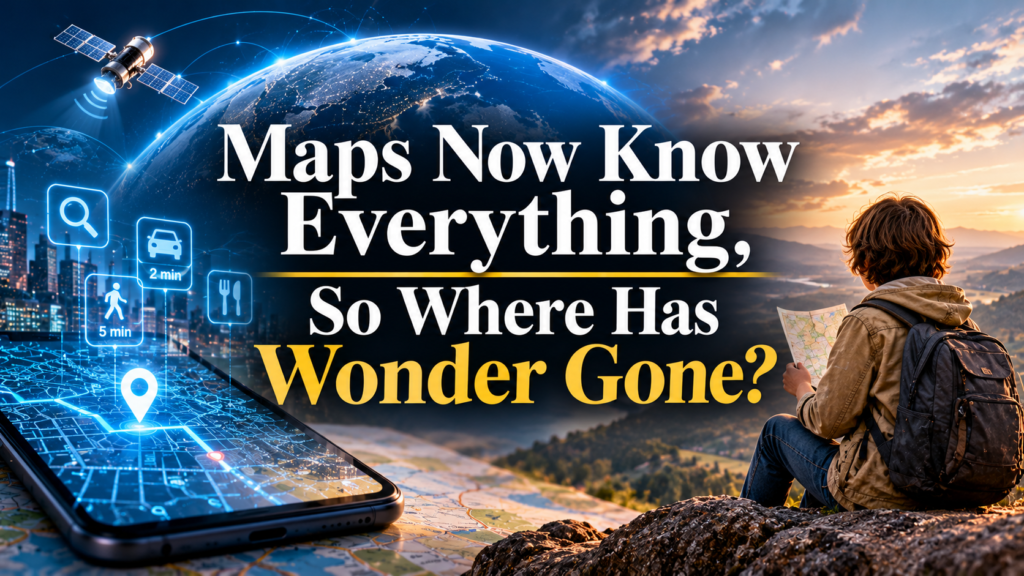
Not long ago, getting lost was part of travelling. A wrong turn led to a stranger’s directions, a stranger’s directions led to a conversation, and the conversation sometimes led to the best meal of the trip. Today a blue dot on a phone screen can guide a visitor through a city they have never seen, translate a menu in a heartbeat and name the best-rated café within five minutes’ walk. Travel has never been easier, and some travellers have begun to wonder what the ease has cost.
The convenience is a genuine gift. Online maps, launched at scale in 2005 and now carried in every pocket, have made unfamiliar places less intimidating for first-time travellers, for people travelling alone, and for those with reduced mobility who can check routes in advance. Real-time translation lets visitors communicate in languages they could never learn in a week. Booking platforms have opened corners of the world once reachable only through expensive agents. Fewer people are held back by fear of the unknown, and that is worth celebrating.
But when everyone consults the same ranking, everyone arrives at the same place. Travel writers have long noticed that review-driven discovery sends crowds to the same few restaurants, viewpoints and lanes, while excellent places a street away stay empty. The photographs even begin to match, as the same angle, the same pose and the same sunset are collected by thousands. A journey planned to the minute can become a checklist, with the world reduced to a series of confirmations of what was already seen on a screen.
There is a psychological cost, too. Uncertainty, the thing travel apps promise to abolish, is also the raw material of memory. Experiences that surprise us, challenge us or even embarrass us tend to stay vivid for years, while smooth, predictable ones blur together. Some research has linked time spent living or travelling abroad with greater cognitive flexibility and creativity, though the benefit seems to come not from the plane ticket but from engaging with another way of life rather than merely observing it.
Older traditions of travel suggest another way. Each year hundreds of thousands of people walk the Camino de Santiago across northern Spain, carrying little, sleeping in shared hostels and relying on the kindness of strangers and the company of fellow pilgrims. Many are not religious. They come, it seems, for something the modern trip rarely provides: slowness, simplicity, and the sense that the journey itself is the destination.
The effects reach local communities as well. When algorithms funnel visitors into the same streets, residents bear the crowds while the businesses just beyond the map see little benefit. Shops and cafés start to cater to what the ranking rewards, until neighbourhoods around the world begin to look curiously alike, with the same brunch menus, the same minimalist furniture, the same playlists. Diversity, the very reason people travel, is quietly flattened by the way they search for it.
Yet technology need not be the enemy of wonder. The same phone can guide a traveller to a village market, a local guide, a small museum or a cooking class run by a neighbour. Used as a door rather than a leash, it expands possibility. The difference lies in how it is used: to confirm, or to explore.
Travellers who want to recover some of the old magic can try a few small experiments. Spend the first hour in a new city without a map, simply walking. Eat in a place with no English menu and point at what the neighbouring table is having. Ask someone who lives there where they would go on their day off. Leave one day completely unplanned. Learn ten phrases of the local language, not because an app cannot do it, but because the effort itself is a form of respect.
Accessibility deserves a place in this conversation too. For travellers with disabilities, planning ahead with reliable information is often not a spoiled surprise but a necessity, and technology that reports step-free routes or quiet spaces can be life-changing. The aim is not to ban preparation, but to leave room, wherever possible, for chance.
Travel at its best does something modest and profound: it reminds us that our own way of living is one of many. That lesson is hard to learn from a screen. It arrives in a misunderstood word, an unexpected kindness, a street that was not on the list.
The world has never been more mapped, and perhaps never more worth wandering without a map. The next time a journey begins, it might be worth putting the phone in a pocket and letting the first wrong turn happen.