
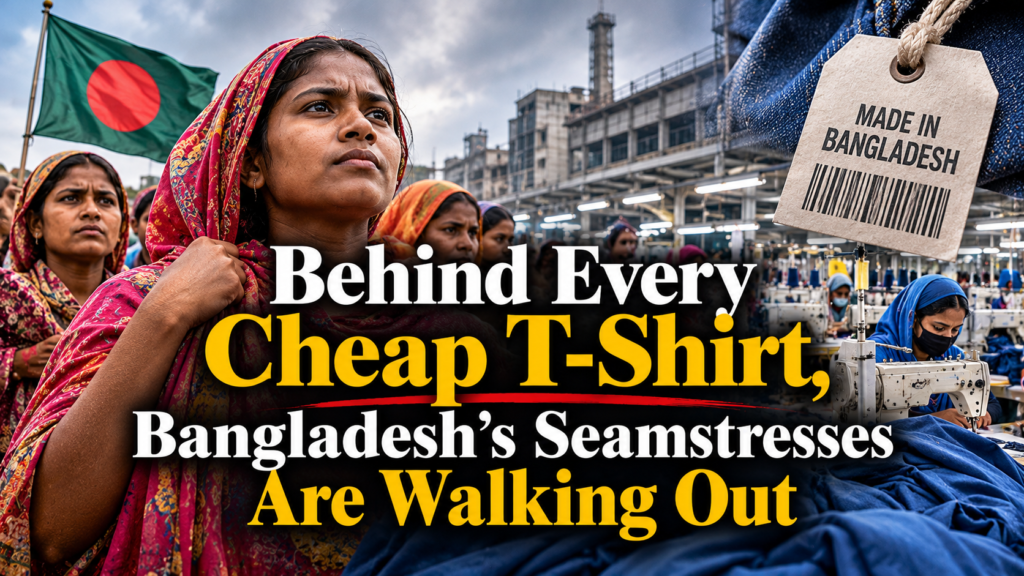
Laili Begum has sewn clothes for export for years, and by her own account she often cannot afford a proper meal more than once a day. On the morning she spoke to Al Jazeera, her family had eaten puffed rice and a snack, and lunch did not exist. At 37 she earns about 15,000 taka a month, roughly $121, or up to 20,000 with overtime. A shared room costs her 3,500. She cannot afford a 2,200-taka gas cylinder, so she cooks by burning discarded paper. Her children, aged 15 and 12, have been taken out of school because she cannot pay for it.
Stories like hers sit behind the scenes of unrest around Dhaka, where garment workers have blocked highways and walked out of factories since the end of October, after protests that had been building since August. The manufacturers’ association says the disruption has touched 529 factories and nearly a million workers. Police have answered with tear gas, sound grenades and batons.
The arithmetic explains the anger. The minimum wage for the sector is 12,500 taka a month, about $102, set in late 2023. Workers want 30,000, roughly $241, which is a rise of 140 percent. The figure has a basis: the Global Living Wage Coalition estimated a living wage for Dhaka last year at 30,459 taka, and some union federations are asking for even more, with proposals of 32,000 and 37,125. Meanwhile official inflation reached 8.34 percent in September. Rasel Khan, a 30-year-old worker in Ashulia who supports a family of six, told Al Jazeera he has borrowed about 100,000 taka just to get through.
The state’s first reply was institutional. On 1 November the government created a six-member wage board of officials, owners and worker representatives, and on 4 November the board agreed in principle to a new pay structure from December, with the first higher salaries arriving in January. It did not name a number. An amendment in April also shortened the review cycle for the sector’s minimum wage from five years to three, a sign that the old rhythm no longer matched prices.
The street has met a harder response. Dozens of people have been arrested, and police filed mass cases naming thousands of unknown suspects, including more than 10,500 in five cases in the Mirpur and Pallabi districts, as Human Rights Watch reports. The rights group also says Toufiq Sheikh, 21, died after being beaten while caught between protesters and men hired by factories. The labour minister, Ariful Haque Choudhury, has blamed a group seeking to destabilise the government and urged workers to go back to work.
Owners tell a different story about money. They point to rising production costs, periodic gas and electricity shortages, and energy-market uncertainty linked to the war in the Middle East. Sheikh Hossain Muhammad Mustafiz, a manufacturer, says large wage increases could cost jobs unless international brands agree to pay fairer prices. The competition is real: Al Jazeera cites minimum pay of about $210 a month in Cambodia, $140 to $210 in Vietnam, and well above that in southern China. The United States has also imposed a 19 percent tariff on Bangladeshi goods.
That leaves a detail that is easy to miss. The wage board has three seats, for government, owners and workers, and none for the party that sets the price of the shirt. H&M said some supplier factories had temporarily closed but that it saw no major disruption to its supply chain. Workers’ leaders are demanding transparency on the prices brands pay factories, which is a way of asking for a fourth chair. If the buyers’ price does not move, any wage rise lands entirely on factory margins, and owners could pass the squeeze down the line through speed, overtime or lost jobs. What looks like a dispute between workers and bosses is a three-way negotiation with one party absent.
The stakes reach beyond the factory gate. The industry employs about 4 million people, a large share of them women, earns more than 80 percent of Bangladesh’s export income, which reached about $39 billion in the last fiscal year, and accounts for around a tenth of national output. When a seamstress pulls her daughter out of school, the cost is not only hers. It shapes the next generation of workers. Selim Raihan, an economist at the University of Dhaka, told Reuters that prolonged unrest is a bigger threat than higher wages, and that treating cheap labour as a permanent competitive strategy would be a mistake.
For shoppers far away, the effect will be small and slow. The price tag is a kind of ledger, and for years part of the bill has been paid in meals skipped and children kept home. Workers’ representative Babul Akhter has asked that the new wages be applied from January salaries, and that arrested workers be freed and cases withdrawn. The number the board finally announces, and whether the brands answer it, will show who is willing to carry the cost of a cheap shirt.