
The word is only four letters long, and it was never meant to leave the briefing room. In the shorthand of Israeli military intelligence, as the film that now carries its name explains, “naza” stands for the number of civilians expected to die in an air strike. A person becomes a unit. A death becomes a line in a calculation. Then two filmmakers put that word on a screen, and within days it was being argued over in government offices, shouted outside a family home and painted on a wall.
The documentary, NAZA, was made by Israelis Yuval Abraham and Rachel Szor and rests on three years of interviews with 24 people presented as soldiers and intelligence personnel, their identities hidden. It premiered at the Venice Film Festival in September, drew a record 25-minute standing ovation and won the special jury prize. Its directors were already familiar names: they were among the four co-directors of No Other Land, which took the Oscar for best documentary in 2025.
Israel’s political class answered fast and, as Abraham pointed out in Venice, often without having watched it. Culture Minister Miki Zohar called the work treason and said he would move to strip the directors of their citizenship. Prime Minister Benjamin Netanyahu compared making the film to launching dozens of ballistic missiles at Israel. Former prime minister Naftali Bennett, a rival on the campaign trail, called it a blood libel. Protesters gathered outside the home of Szor’s parents. The army rejects the film’s allegations.
Here is the first lesson in how art reaches politics: a film does not have to persuade anyone to become powerful. It only has to be impossible to ignore. The attackers largely did not dispute the testimony; they questioned the loyalty of the messengers. Calling someone a traitor changes the debate from “what happened?” to “who is allowed to say it?”, and the second question is far easier to win in a hurry.
The second lesson is about vocabulary. Governments and armies talk in euphemisms, because a phrase like collateral damage makes the unbearable sound administrative. Political communication depends on that softness. The most disruptive thing NAZA did was simply translate. Once an audience hears a euphemism as a euphemism, it stops working, and that may explain why the reaction was aimed so intensely at a single word and at the people who carried it into the open.
The third lesson is visual, and it comes from the port city of Ashdod. A street artist painted the directors’ faces on a wall and branded them traitors. It was an answer to art, delivered as art. Then another artist changed the lettering so the same wall read “heroes.” Same faces, same bricks, opposite verdict. Political messaging today is less a broadcast than a palimpsest. A ministry can issue a statement, but it cannot control who holds the last can of paint.
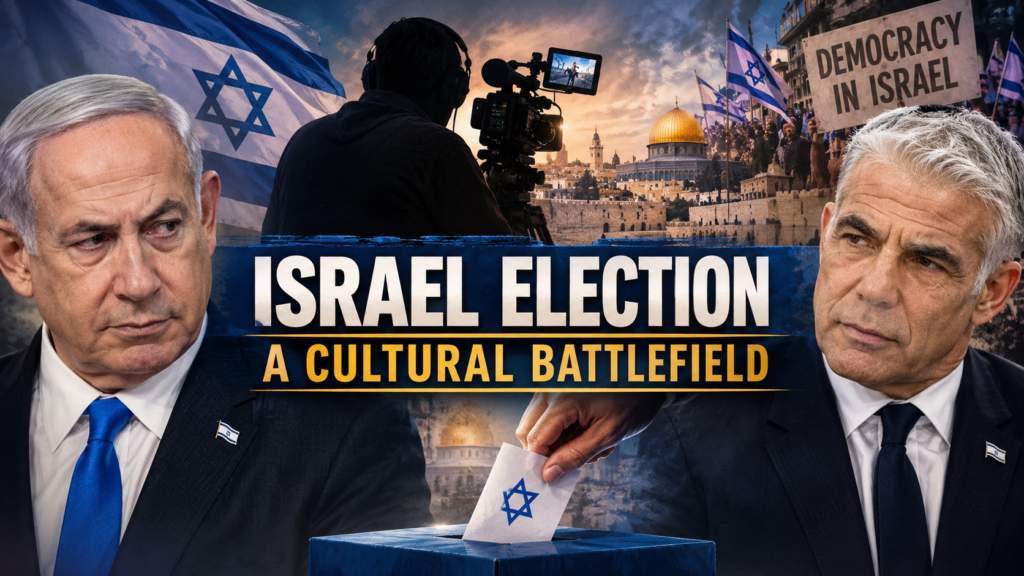
What did all of this do to the vote? Honestly, nobody knows. Some commentators argued the storm was a gift to Likud, letting it campaign against supposed traitors. Others said it dragged the conduct of the war into a debate that wanted to avoid it. When Israelis voted on October 27, Netanyahu’s bloc won 53 seats and the opposition bloc 48, with neither anywhere near the 61 needed to govern, and turnout reached 77.9 percent, the highest in decades. A cautious reading is that the film did not decide the election, but it shaped which questions the campaign could not escape and gave both camps a symbol to rally around.
The consequences reach well past one ballot. More than a thousand Israeli filmmakers signed a petition defending the directors, saying that criticism of art is legitimate but violent incitement against its makers should alarm everyone. Reporters Without Borders linked the threats to wider pressure on the press. Even if a citizenship law is never passed, the threat is itself a message, and its audience is the next young director deciding whether a risky project is worth the price.
There is also an irony that every censor eventually learns. Attacks on a work are the best publicity it can buy. From Venice to a New York premiere met by protesters, the outrage kept NAZA in the headlines longer than any festival campaign could have. Politics amplifies the art it tries to bury.
The film’s critics raise serious points. Anonymous sources cannot be independently checked by viewers, and some object that a film about Gaza made by Israelis gives little room to Palestinian voices. Defenders reply that this is exactly the point: the film is addressed to the society that carries out the strikes, not to the people under them. Both arguments are really about audience, about who a work of art is for, and that question may matter more to politics than any statistic in the film.
The lasting lesson is that art rarely changes votes overnight. It changes the words available for a conversation. Governments understand this, which is why they sometimes respond to a film the way they respond to a missile. Whether NAZA is remembered as a documentary or as a turning point will depend on what Israelis choose to say next, and which words they choose to say it with.