
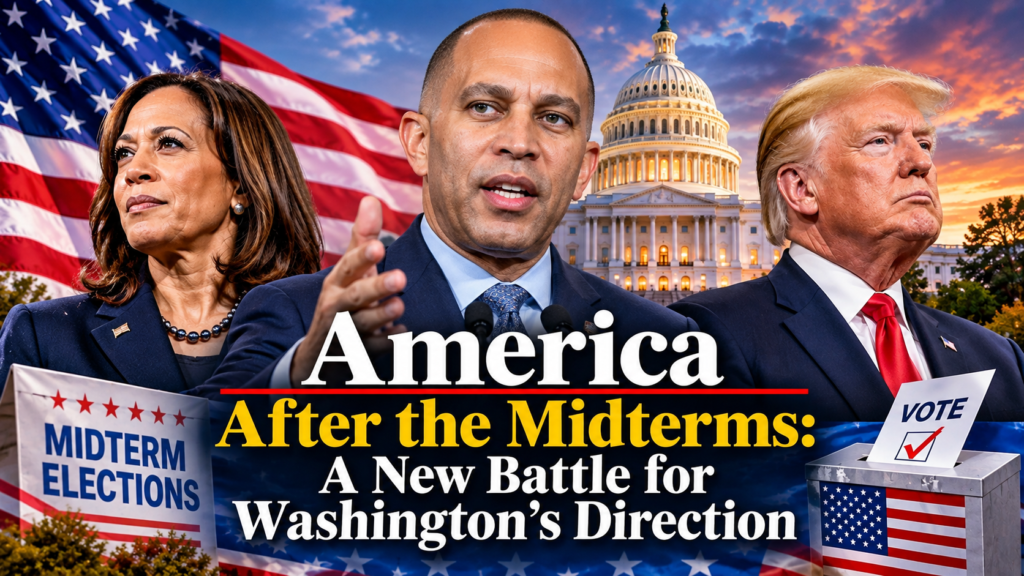
Nine days after American voters handed Democrats control of both chambers of Congress, Washington has the unsettled feel of a house where someone rearranged the furniture overnight. Everyone knows the rooms. Nobody is sure where to stand.
The numbers are not subtle. Democrats flipped seven Republican-held Senate seats, among them Texas, Ohio, Iowa, Kansas, South Carolina and Maine, and will hold at least 54 votes once the two allied independents are counted. In the House they are on course for a majority of roughly 254 seats, with a few close contests, including a razor-thin Senate race in Mississippi, still being sorted out. Some districts that backed Donald Trump by as many as 18 points in 2024 switched sides. An early CBS exit poll put the president’s approval at 38 percent, which would be the lowest recorded at a midterm.
Voters did not need a seminar to explain themselves. Prices, health costs and the energy shock that followed the war with Iran, which began in February, set the mood. Trump has acknowledged there is truth in the view that the war’s effect on energy prices cost his party its majorities, though he insists the conflict was worthwhile.
Hakeem Jeffries is expected to be elected Speaker when the new Congress convenes on January 3, becoming the first Black person to hold the gavel. His party’s first hundred days are pitched at the kitchen table: lower gas and grocery bills, restored health-care subsidies, reversed Medicaid cuts and votes on war powers. Beneath that sits a second agenda built on subpoenas. Democratic committee leaders are preparing investigations into the president, his family and senior officials, and Jeffries has backed impeaching Defense Secretary Pete Hegseth, a key figure in the Iran campaign.
Trump has answered with defiance and flashes of conciliation. He has vowed to return “bigger and stronger than ever before,” pointed to oil prices and weak candidates, and signaled that he will lean on executive power and the veto. But a veto cannot stop a subpoena, and executive orders can be challenged in court, which is where much of this fight is likely to migrate.
That points to the defining feature of the next two years: a government running at three speeds. Congress will move at the pace of hearings and deadlines. The White House will move at the pace of presidential signatures. And the courts, with their conservative majority, will set the tempo for whatever the first two produce. Americans who wanted relief from Washington may instead find themselves watching it argue over who is allowed to do what.
The first test arrives before the new members are even sworn in. Government funding expires on December 11, Iran war money is bundled into the same window, and Republicans are weighing a debt-limit increase while they still control both chambers, hoping to deny Democrats a bargaining chip. Once seated, the Senate majority will also give Democrats a powerful voice over nominees, including judges.
Republicans, meanwhile, are in the middle of an argument about themselves. Senator Ted Cruz has said the war dragged on too long, while others contend it was left unfinished. Some blame candidates, others blame the president. A contest over the party chairmanship is already forming ahead of a January meeting, even though Trump has backed the incumbent. Strategists such as Carlos Curbelo warn that the party must win back suburban and Hispanic voters, a task that will shape the early scramble for the 2028 nomination, where Vice President JD Vance is seen as a leading contender and California Governor Gavin Newsom is a prominent name on the Democratic side.
Democrats face a temptation of their own. Their voters want accountability and affordability, but the two do not always share a calendar. Party leaders describe impeachment as neither on nor off the table, and that ambiguity will be tested by an impatient base on one side and swing-district members who won on prices on the other. The last time a Democratic House confronted Trump, impeachment consumed much of the political oxygen. This time, the party knows the cost of that bargain.
Beyond Capitol Hill, the consequences ripple outward. Democrats will hold at least 28 governorships, strengthening their hand in state fights over health coverage and voting rules. Federal employee advocates see an opening to challenge workforce overhauls. Allies abroad, uneasy about the Iran war, will look to Congress as a brake on foreign policy. And markets, which Trump says slipped after the vote, will watch the December deadlines closely.
The election settled who holds the gavels. It did not settle what the country wants Washington to be for. To one side, the answer is a check on presidential power; to the other, a mandate interrupted by a war and a bad night. The next two years will decide which story voters believe when 2028 arrives, and both parties already have their candidates measuring the drapes.