
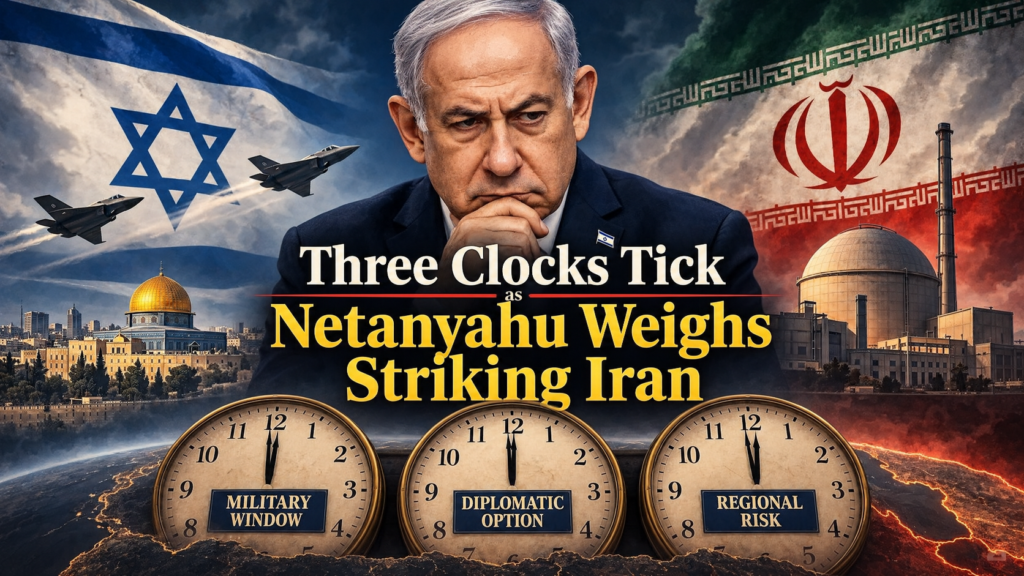
Benjamin Netanyahu will gather his security cabinet on Thursday evening with three clocks running at once: one in Israel’s parliament, one in Washington and one in the tanker lanes of the Gulf. Together they may decide whether a war that has never truly ended roars back to full strength.
The meeting, first reported by The Times of Israel, comes as Israel and the United States prepare for a possible new military operation, and amid warnings that Tehran could strike first. Hours before ministers were due to sit down, army spokesman Brigadier General Effie Defrin sharpened the message. “We are monitoring the situation and are ready to strike with force at any moment, including on our own, without the Americans,” he told the public broadcaster Kan. Instructions to civilians, he stressed, remain unchanged.
The immediate spark is an allegation. On Tuesday, Defence Minister Israel Katz said Iran was developing chemical weapons, although it could not yet use them against Israel. Iranian Foreign Minister Abbas Araghchi rejected the charge and accused Israel of trying to deceive America into fighting another war on its behalf. No conclusive proof has been made public, and Axios has reported deep scepticism among some senior US officials.
The conflict began on February 28, when joint American and Israeli strikes killed Supreme Leader Ali Khamenei and much of Iran’s military command. A memorandum signed in June was meant to end it. Instead, talks have stalled, Washington says it is blockading Iranian ports, Tehran claims control of the Strait of Hormuz, and the two sides have continued to trade fire.
The first clock is political. Netanyahu lost his parliamentary majority in the October 27 election and now leads a caretaker government. His rival, former army chief Gadi Eisenkot, has until December 6 under his initial mandate to build a coalition. His bloc holds 48 seats, 13 short of a majority.
Eisenkot calls Iran the gravest threat facing Israel, yet said on Monday that he saw no direct and immediate danger requiring action before a new government takes office. His ally Avigdor Liberman has gone further, arguing that a strike now would be driven entirely by politics. Netanyahu counters that Israel’s ability to face its enemies depends on unity, and accuses those who play down the threat of political motives. He has proposed a national unity government. On Wednesday, a court also cast heavy doubt on the most serious corruption charges against him, giving the veteran leader fresh political oxygen.
The security establishment does not appear to speak with one voice. Mossad chief Roman Gofman has reportedly argued for renewed action, while the military chief, Eyal Zamir, and Mossad researchers are said to see no case for an immediate attack. Military intelligence has reportedly cautioned that an Israeli strike could ignite Lebanon, Syria and Gaza, challenging hopes of a campaign lasting only days.
The second clock hangs in the White House. Donald Trump said on Sunday that he was inclined to resume strikes after the New Year if diplomacy failed. In a later New York Post interview, he said the war was funded through January, when a new Democratic majority arrives in Congress, and insisted: “We can put that war to bed anytime we want.” He also made clear that his priority is stopping an Iranian nuclear weapon, not regime change. NBC News reports that officials are debating targeted strikes on hardline Iranian leaders. Israel may be ready to move alone, but Washington’s calendar suggests less haste.
The third clock is economic. Iran’s currency hit a record low on Wednesday, beyond 2.9 million rials to the dollar. Yet its commanders promise new weapons and new targets if attacked. Across the water, Yemen’s Iran-backed Houthis have claimed an attack on a tower in Riyadh’s financial district, while vessels have again come under fire in Hormuz.
Oil traders have so far kept their nerve. Brent crude hovered around $90 a barrel on Wednesday morning, restrained by recovering Gulf exports and forecasts of surplus supply. That calm could prove fragile. A wider war would threaten shipping, aviation and gas cargoes just as winter raises Europe’s demand, feeding into household bills and inflation far from any battlefield. Gulf governments, directly exposed to retaliation, have reportedly urged Washington to rely on economic pressure instead.
Three paths now stand out. Israel could strike alone, gaining surprise but risking a multi-front war and friction with its closest ally. It could wait for Trump, trading speed for American firepower while a possible new government takes shape. Or mediators, including Qatar, could revive diplomacy, which would require movement on both the nuclear question and Hormuz.
There is also a quieter danger: miscalculation. When both sides expect an attack, a routine military movement can look like the opening shot.
A cabinet meeting is not, by itself, a decision to go to war. The signals to watch afterwards are concrete: changes to civil defence orders, contacts between Jerusalem and Washington, airline cancellations and the tone from Tehran. The harder question is whether an outgoing leadership should take a step whose consequences its successors may have to manage for years. All three clocks are still ticking.