
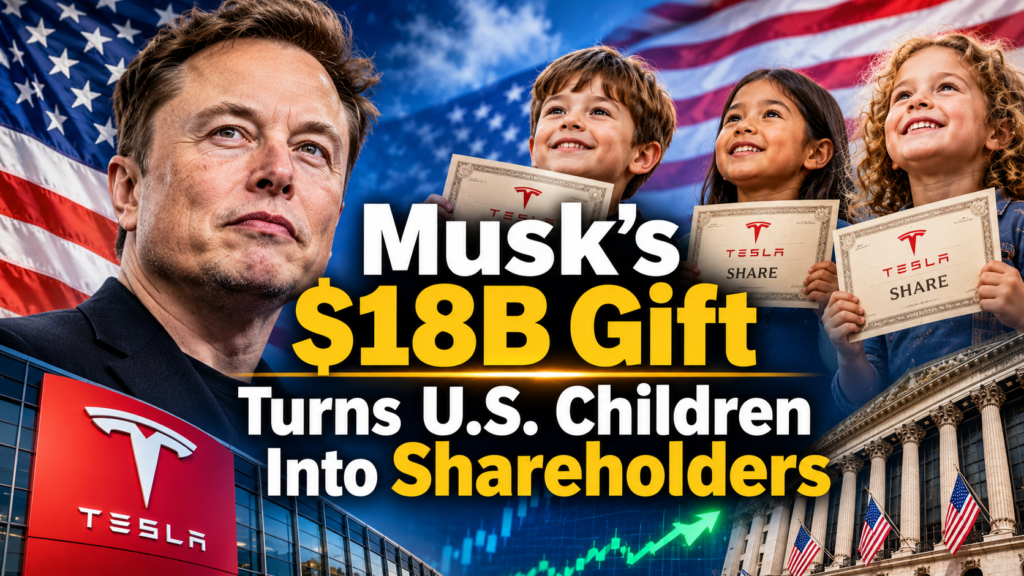
Elon Musk has decided that the next generation of American investors should not have to wait to grow up. On Wednesday the SpaceX founder said every child in the United States will receive two shares of his company, one issued by SpaceX and one from his own holdings, doubling a promise he made barely five weeks earlier. At Wednesday’s closing price of $127.44, the combined gift is worth more than $18 billion across the roughly 72 million minors counted by the Census Bureau.
The plumbing runs through Trump Accounts, the federal savings accounts for children under 18 that launched in July. SpaceX said it will put one newly issued Class A share into every currently active account, and Musk will personally match the number. In a separate post he said the shares would be transferred next month, although the company’s own statement offered no timetable.
Do the division and a pattern appears. Two shares come to about $255 per child, strikingly close to the $250 that Michael and Susan Dell’s $6.25 billion commitment places in accounts for some 25 million youngsters. Add the $1,000 Treasury seed for babies born between 2025 and 2028, plus the July pledge from SpaceX president Gwynne Shotwell and her husband to donate about two million of their own shares, and Trump Accounts begin to look like a stage where fortunes compete in generosity, with the state supplying the pipes and private wealth supplying the water.
For Musk the personal cost is modest. Matching 72 million shares at Wednesday’s price comes to roughly $9 billion, a little over one percent of a fortune estimated near $824 billion. The shares SpaceX issues itself dilute other investors by a sliver, an effect Axios judged unlikely to matter much. The real price is not financial but reputational: a promise this public is a promise everyone will audit.
The timing carries its own irony. SpaceX stock has slid about 13 percent since the original pledge on 19 October, caught in a wider sell-off of AI-linked companies, after a June listing that briefly made Musk the world’s first trillionaire. The gift has therefore doubled in size even as each share has become worth less, a neat first lesson for the youngest shareholders in history: ownership comes with weather.
Then come the questions the announcement leaves open. Nobody has said whether the shares will carry a lockup or transfer restrictions, or whether Musk’s matching shares will reach only children with active accounts or be spread more widely. That second point matters. Because the company’s wording covers active accounts, the families who have already filed the paperwork may collect, while children whose parents never enrolled could be left out. Musk’s earlier claim of tens of millions of accounts sits awkwardly beside that detail, and the gift may end up working as an enrolment drive, nudging unregistered households to sign up.
There is also a design puzzle. Trump Accounts bar withdrawals before age 18, cap private contributions at $5,000 a year, and steer cash into low-cost index funds. A single, volatile company stock is the opposite of diversification. Whether the Treasury, the IRS and SpaceX’s lawyers can fit one into the other, and whether the shares count toward the annual cap, will decide if this is a clean gift or a paperwork maze.
Supporters will see something larger than a donation. Musk framed it as handing people stakes in the future economy, and a child who owns a piece of a rocket company may be more curious about balance sheets, launch schedules and shareholder letters than any classroom exercise could make her. Seventy million tiny holders would also be a remarkable retail base for a newly public company, a thought skeptics will not miss: generosity and brand-building can share a single press release.
Politics hovers nearby. The accounts carry the president’s name and are a flagship of his administration, and Musk, who backed Donald Trump in 2024, is now pouring private capital into the programme. Whatever the motive, the effect is to make a government savings scheme look like a movement. Musk has called his pledge the first of many, and rivals in the billionaire class, from software founders to artificial-intelligence executives, will feel the pull to match it.
What to watch next is concrete: the December transfer, the Treasury and IRS guidance on how shares sit inside the accounts, and the share price itself. If it recovers, the gift will look like visionary civic finance. If it keeps falling, it will become a story about whether handing children a single stock is a head start or a gamble taken in their name.