
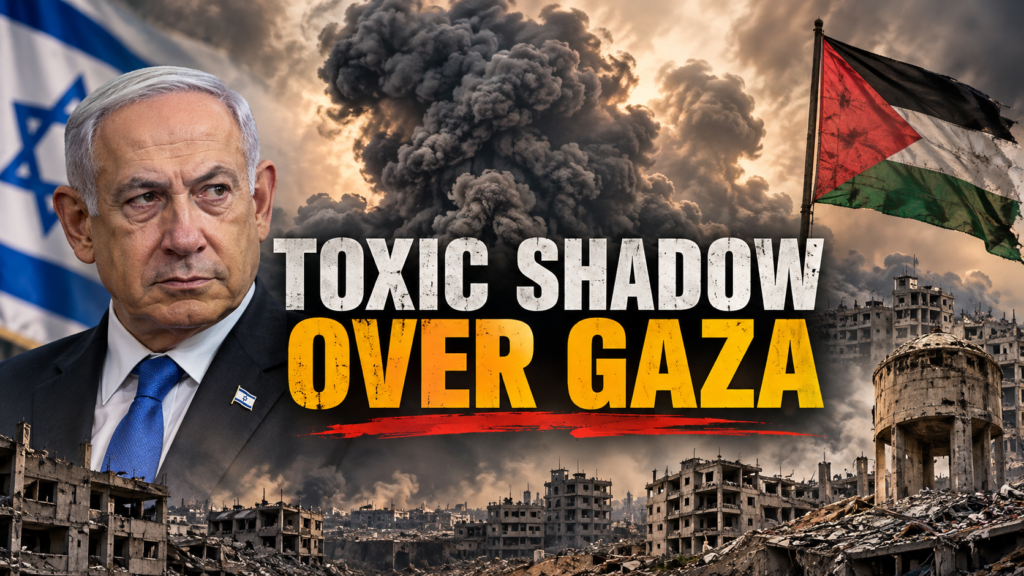
More than 99 percent of the Gaza Strip carries at least one potential source of contamination, according to a new report by Oxfam and the Conflict and Environment Observatory. Built from satellite imagery, remote sensing, scientific analysis and open data, the study calls the territory a “toxic wasteland” and warns that the poison now sits in the places where people must eventually live, farm and rebuild.
The headline number deserves a careful reading. It does not mean that every square meter has been tested and found toxic. It is a map of suspicion: wherever the researchers found a plausible hazard, they marked it. The greatest overlap lies in Gaza City, Khan Younis, Rafah, Jabalia and along the Salah al-Din road, and the military campaign touched about 78 percent of the land. That distinction is both the report’s honesty and its challenge, because Oxfam itself is asking for a full assessment of which contaminants are really present and how dangerous they are.
The list of suspects is long. Heavy metals, explosive residues and asbestos from collapsed buildings sit alongside chemicals from fires, wrecked vehicles, batteries and fuel stores. Corroding unexploded munitions can leach into soil and groundwater. The United Nations estimates 61 million tonnes of debris, about 29 tonnes for every resident, and says roughly 15 percent of it may carry a high risk of hazardous materials.
Water tells the most concrete part of the story. Daily supply dropped about 84 percent, from some 334,000 cubic meters before October 2023 to roughly 55,000 in June 2024. By April 2026 it had climbed back to about 130,000, still 61 percent below the pre-war level. In July 2026, faecal bacteria turned up in 15 of 79 tested wells, about 19 percent, compared with 2 percent in a 2021 assessment. All six wastewater plants were destroyed by April 2024, and an estimated 40,000 cubic meters of raw sewage reaches the Mediterranean each day, a sea shared with Israel and Egypt. The coastal aquifer was already 97 percent chemically polluted before the war, so the conflict landed on a system with no margin for error.
The toll in illness follows. In January and February 2026 alone, the report counts more than 1.9 million acute respiratory infections and about 81,000 cases of watery diarrhoea. Poliovirus was detected in wastewater in 2024, followed by Gaza’s first paralytic case in 25 years, and officials now warn of a possible meningitis resurgence among children. Hunger compounds the damage: more than 87 percent of cropland was damaged by late 2025, only 3 percent remained accessible and intact, and in July 2026 about 1.2 million people faced crisis-level food insecurity or worse. Oxfam cautions that pollutants may enter crops and seafood once production restarts, turning a first harvest into a medical question.
Here lies the paradox nobody planned for: cleaning up can be dangerous too. Clearing rubble lifts asbestos and silica into the air and endangers the workers who do it, while wind and traffic push settled dust back into the lungs of nearby families. A study cited in the report estimates that reconstruction could account for 31.4 million of the 33.2 million tonnes of carbon emissions linked to the wider conflict cycle. In other words, rebuilding may become a larger environmental event than the destruction itself unless it is done with care. Oxfam proposes a five-stage order: secure access, test, repair essentials, treat contaminated sites, then rebuild with safeguards and long-term monitoring.
The economic bill is equally heavy. Gaza’s output fell 83 percent in 2024 to about 362 million dollars, and an assessment by the World Bank, the European Union and the United Nations counted 35.2 billion dollars of direct damage and 22.7 billion of losses by October 2025, with 71.4 billion needed over a decade. Money, however, answers only half the question. Contaminated land cannot be sold, farmed or settled until someone has paid for testing, and no one has yet agreed who that someone is.
Then there is the dispute over blame. Oxfam’s international executive director, Amitabh Behar, calls the damage “environmental war crimes” that threaten life for generations, and argues that humanitarian law forbids methods of war causing widespread, long-term and severe harm to nature. The organization is demanding an independent investigation and reparations where violations are established. The Israeli military rejects the report as biased and misleading, saying it works to limit harm to civilians and civilian infrastructure and to maintain Gaza’s water supply. The war began after Hamas-led attacks on 7 October 2023 killed 1,200 people in Israel, by Israeli counts, and took 251 hostages; more than 74,000 Palestinians have been killed since, according to figures cited by the ABC.
Whatever the verdict, the report opens a question that law and diplomacy have rarely faced so directly: can soil, water and air be treated as victims in their own right? The answer will shape not only who pays in Gaza, but how future wars are judged long after the shooting stops. For now, the most urgent next step is also the least glamorous: send in the testers before the bulldozers, and find out what the ground is actually hiding.