
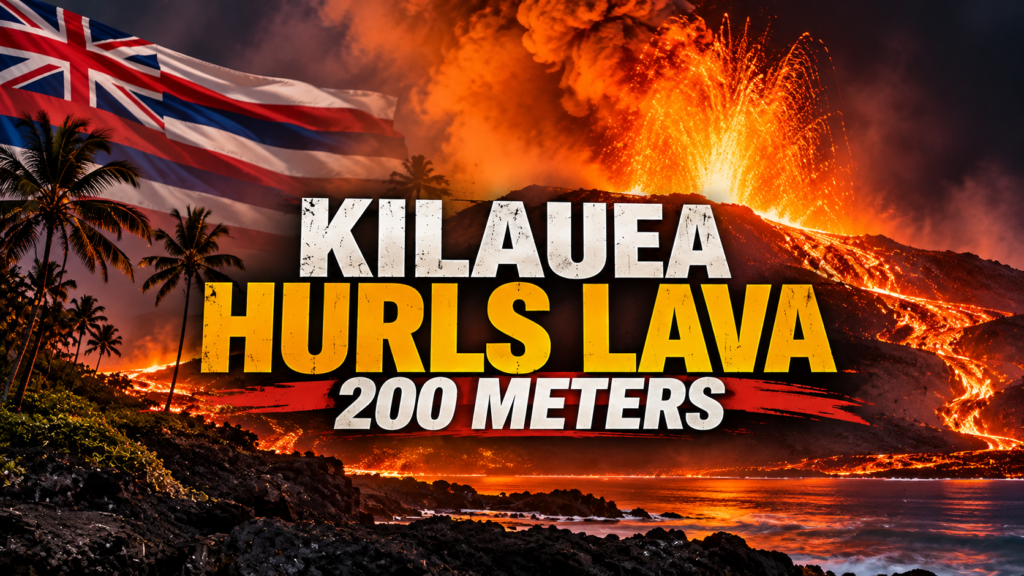
Shortly after midnight on Monday, a corner of Hawaii’s Kilauea volcano turned into a pillar of fire. Around 12:15 a.m. local time, molten rock began to leap from the north vent inside Halemaʻumaʻu crater, and by about 1:30 the fountain peaked near 200 meters, roughly the height of a sixty-story tower. A gas plume climbed some 20,000 feet into the sky. Just before six o’clock the roaring stopped, almost six hours after it began, and the crater fell quiet again.
The spectacle was the 57th episode of an eruption that started on 23 December 2024 and has never really been a single event. It behaves more like a heartbeat: long, silent stretches while the underground reservoir refills, then a violent release. The night before, lava had already spilled over the crater floor 21 times from two vents, a restless prelude that scientists read as the volcano clearing its throat. By the end of the fountaining, about 7.7 million cubic yards of lava had spread across roughly half of the crater floor, at a peak pace near 600 cubic yards every second.
The real drama, though, is happening in the ground. During the fountain, instruments recorded the summit sinking as magma drained away. Within hours of the end, they showed the first faint swelling as the reservoir began to refill. The observatory expects another episode in the coming weeks, but says it is too early to name a date. Officials lowered the alert level from Watch to Advisory and the aviation color code from orange to yellow, a quiet signal that the immediate danger to aircraft has eased.
That ability to say anything about the next show is a scientific achievement in its own right. A study led by USGS geophysicist Ashton Flinders, published in Science, found a tight link between summit inflation and eruptions across the first 52 episodes, and the observatory has issued forecast windows of a few days since early 2025. Households downwind use them as practical tools. Yet the same forecasters admit the volcano may be changing its habits. After an unusually long 39-day wait before episode 55, they said their model could no longer track the pattern, and that they may eventually lose the ability to forecast at all. Nature, in other words, has not signed the contract that science wrote for it.
For people on the Big Island, the consequences are less cinematic and more domestic. Eruptive episodes have released up to 75,000 tonnes of sulfur dioxide a day, which turns into vog, a haze that can irritate lungs far downwind. Even in the pauses, the summit leaks a thousand tonnes or more daily. The fallout also includes Pele’s hair, glassy threads spun out of the fountain that can irritate skin and eyes and foul rainwater catchment tanks, which many rural households depend on for drinking water. This time the heaviest tephra fell southwest of the vents, inside a closed part of Hawaiʻi Volcanoes National Park, but earlier episodes have dusted Highway 11 and nearby communities, and the wind decides who is lucky.
There is also a reason this eruption is watched with admiration rather than dread. In 2018, lava from Kilauea’s lower flank swallowed hundreds of homes. Today’s activity is confined to the summit crater, in a closed area where the public is not allowed, and viewers mostly follow it through photographs and live camera feeds. Still, the observatory warns that recent underground intrusions, including one at the turn of September and October, show that the eruption’s location could shift. Intrusions can bring earthquakes, ground cracks and small landslides, which is why scientists are coordinating with park managers and Hawaiʻi County Civil Defense rather than simply enjoying the show.
Beyond safety, the fountain carries a cultural weight that no instrument measures. Halemaʻumaʻu is traditionally regarded as the home of Pele, the goddess of fire, and many Native Hawaiians experience each eruption as a living presence rather than a natural hazard to be managed.
Italians know this rhythm well. Mount Etna, in Sicily, produces its own lava fountains and ash clouds, and has repeatedly forced airport closures in Catania. The lesson from Hawaii is how much a patient, decades-long investment in monitoring can turn fear into preparation: instead of asking whether a volcano will erupt, communities learn to ask how high, how long and which way the wind will blow.
For now, Kilauea has gone quiet, its crater floor still glowing and cooling. In a few weeks the ground will swell again, the tiltmeters will whisper, and the night will light up a 58th time. What nobody can promise is whether the volcano will keep the same script, and that uncertainty is the most honest forecast of all.