
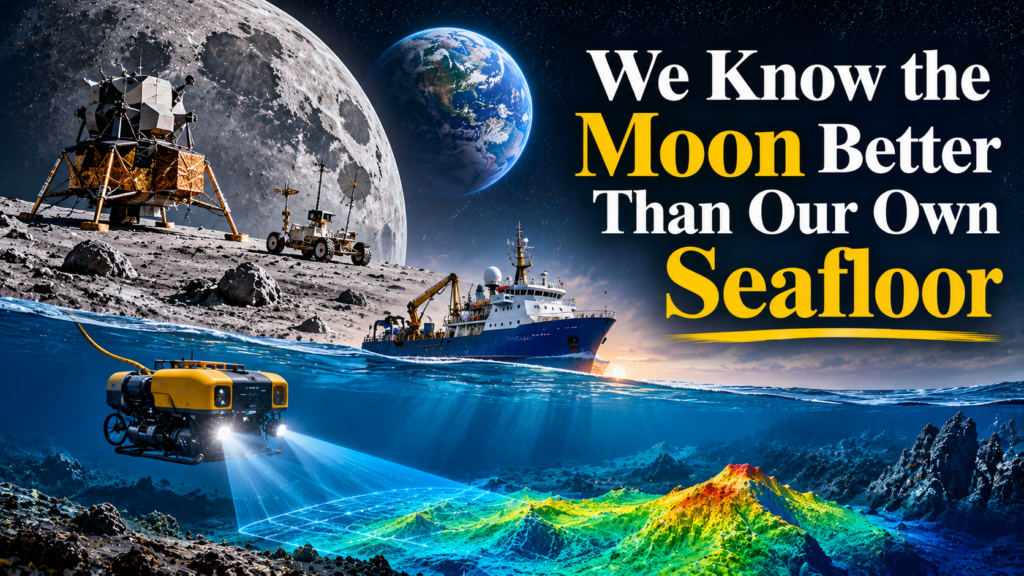
The Moon is 384,000 kilometres away, yet its surface has been mapped in remarkable detail by orbiting spacecraft. The floor of our own oceans, a short distance beneath the waves, remains largely unmapped at comparable resolution. A planet whose surface is mostly water has, in effect, explored the sky more thoroughly than the sea. We know the Moon better than our own seafloor, and that gap says a great deal about where science still has frontiers.
Oceans cover roughly seventy-one percent of the Earth’s surface, and they work as the planet’s thermostat. They absorb the great majority of the excess heat trapped by greenhouse gases and about a quarter of the carbon dioxide that people emit, moderating climate change at a cost to themselves in warming and acidification. Phytoplankton in the sunlit surface layers produce a large share of the oxygen in the atmosphere, often estimated at close to half. Whatever happens in the sea eventually arrives on land as weather, harvests and rising shores.
Mapping is only the beginning. The international Seabed 2030 project aims to chart the entire ocean floor by the end of this decade, using ships, sonar and increasingly autonomous vessels, and has reported that only about a quarter had been mapped to high resolution in recent years. Progress is real but slow, because deep water is expensive, dark and under crushing pressure.
What has been found so far is astonishing. In 1977, scientists exploring the Pacific floor near the Galápagos Islands in the submersible Alvin discovered hydrothermal vents, cracks where superheated, mineral-rich water pours from the seabed. Around them thrived communities of giant tubeworms, clams and crabs, living in complete darkness. Their energy came not from sunlight but from chemical reactions, a process called chemosynthesis. The discovery overturned the assumption that all life depends on the Sun and widened the search for life beyond Earth to the icy moons of other planets.
Life in the deep sea continues to surprise. Expeditions regularly bring back animals unknown to science, and researchers estimate that a majority of marine species have still not been formally described. Some produce chemicals of interest to medicine and industry, from compounds used in laboratory techniques to molecules investigated as potential drugs. Species that live without light, or in extreme cold and pressure, also reveal how flexible biology can be. Every unmapped valley is, potentially, a library that no one has opened.
Technology is finally catching up. A global network of thousands of robotic floats, known as Argo, drifts through the oceans, diving and surfacing to measure temperature and salinity, and has transformed our understanding of how heat moves through the water. Satellites track sea level and surface conditions from above, while underwater robots, gliders and remotely operated vehicles explore from below. Together they are producing the first near-continuous picture of the ocean’s changing state, much as weather stations did for the atmosphere.
Better knowledge matters because pressures are rising. Warming water bleaches coral reefs and shifts fish populations towards the poles, challenging fisheries and the coastal communities that depend on them. Plastic waste, including microplastic particles, has been found from beaches to deep trenches. And there is growing commercial interest in the deep seabed, where metal-rich nodules could supply materials for batteries. Supporters see a source of critical minerals; critics warn that damage to slow-recovering ecosystems we barely understand may be irreversible. The International Seabed Authority is debating the rules, a vivid example of decisions being made faster than knowledge.
That tension is at the heart of the story. Science cannot tell societies what to value, but it can tell them what they would be risking. A nodule field may take millions of years to form and support animals found nowhere else. Without baseline surveys, we cannot say what we would lose, or whether it could ever return. The precautionary instinct, to learn first and exploit later, is often cheaper than repairing a mistake that cannot be fixed.
Public involvement is growing, too. Amateur sailors collect data on water temperature and plankton, divers survey reefs, and volunteers help classify images from underwater cameras. Citizen science cannot replace deep-sea expeditions, but it multiplies the number of eyes on the water. It also builds something that science needs as much as data: a public that understands why the ocean matters.
What should we ask of governments and institutions? Sustained funding for ocean observation, which too often depends on short-term projects. Open data, so that maps, measurements and samples can be shared across borders. International cooperation, because the sea is no one’s backyard. And patience, since the most valuable discoveries may take decades to interpret. A planet that spends fortunes looking outward could surely afford to look down.
Exploration is often imagined as a journey to distant stars, but some of its greatest unknowns lie beneath the ships that cross the sea every day. Learning to read the ocean may be one of the most practical and thrilling scientific tasks of this century. After all, the more clearly we see the water that shapes our climate, our food and our future, the better we can decide how to treat it.