
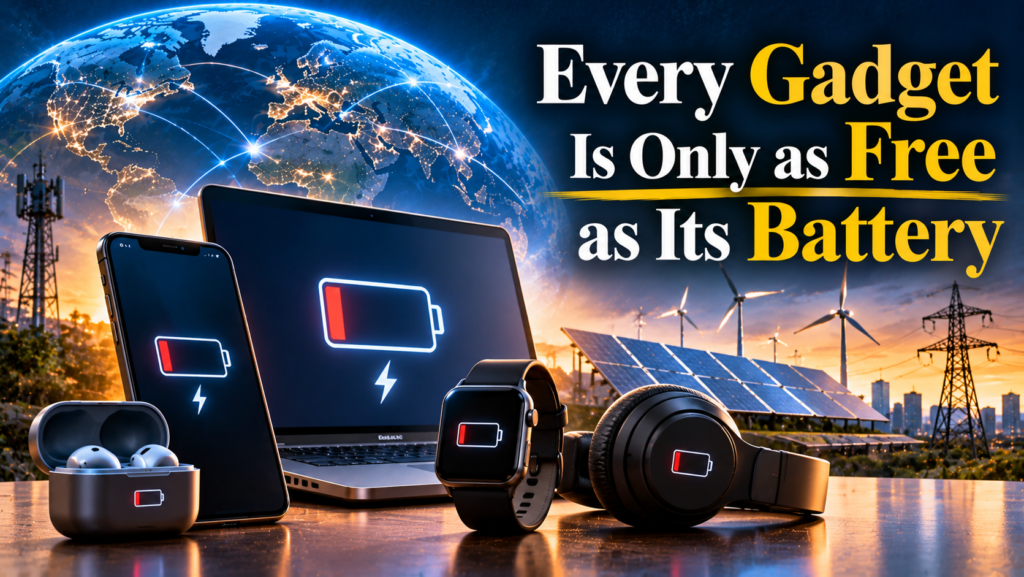
Every gadget makes the same promise: freedom. The phone slips into a pocket, the earbuds wander through a city, the laptop works on a train. Yet each of these devices is tied, invisibly, to a small chemical cell that decides how far the freedom extends. When the battery runs out, the sleekest machine becomes an expensive paperweight. In a very real sense, every gadget is only as free as its battery.
The battery in most modern devices is a lithium-ion cell, a technology whose roots lie in research in the 1970s and 1980s and which Sony brought to market in 1991. Its pioneers, John Goodenough, Stanley Whittingham and Akira Yoshino, received the Nobel Prize in Chemistry in 2019. Lithium-ion cells are light, rechargeable and powerful for their size, qualities that made the smartphone, the laptop and later the electric car possible. Few inventions have reshaped daily life so quietly.
Yet batteries have improved far more slowly than the chips they power. While processors have grown dramatically faster over the decades, battery capacity has crept upward by only a few percent a year, a gap that explains why phones still need charging daily despite remarkable engineering. Manufacturers have responded with cleverness rather than chemistry: screens that dim, processors that sleep, software that rations background activity. Much of a gadget’s design is, in effect, a battery-management plan.
Batteries also age. Each charge cycle slightly reduces the capacity, so a phone that lasted a day when new may struggle by lunchtime after a few years. Heat is the great enemy, which is why leaving a device in a hot car or charging it under a pillow shortens its life. Many manufacturers suggest avoiding constantly charging to full or draining to zero, and some phones now include settings that limit charging to extend longevity. Small habits can add months or years to a device’s useful life.
Safety deserves attention too. Lithium-ion batteries store a lot of energy in a small space, and when damaged, swollen or poorly made, they can overheat and, in rare cases, catch fire. Airlines require spare lithium batteries, including power banks, to travel in the cabin rather than the hold, so crews can respond quickly if one overheats. The sensible rules are simple: use certified chargers, stop using a device with a swollen or hot battery, avoid cheap unbranded replacements and never puncture or crush a cell.
The way batteries are built has become a political question. Many devices have sealed batteries, glued in place, which makes replacement difficult and often leads owners to discard a working gadget because its power cell has faded. The European Union has adopted rules requiring that batteries in portable devices be designed so users can remove and replace them, with the requirement phasing in from 2027. Repair advocates welcome the change, though manufacturers argue about water resistance and slimness. The battery has become a test of who controls a device: its maker or its owner.
Behind every cell are materials that carry costs. Lithium, cobalt, nickel and graphite are extracted in places from South America to Africa and Asia, sometimes with significant environmental and social consequences, including water use and concerns about working conditions in some mines. Recycling can recover a large share of these metals, but collection remains the weak link. A discarded battery in a bin can be a fire hazard in a waste truck and a lost resource at once. Returning old batteries to proper collection points is among the most useful habits a gadget owner can adopt.
Better batteries are being pursued around the world. Researchers and companies are working on solid-state designs that could pack more energy and improve safety, on cells that rely on more abundant materials, and on faster charging that does not damage the cell. Some of these will reach products, others will not; the history of battery research is full of promising laboratory results that struggled to scale. The most responsible approach is patience, with scepticism toward breathless claims.
The importance reaches beyond gadgets. The same technology that powers a phone also stores electricity for homes and grids, and large batteries now help balance wind and solar power. Improvements in the humble battery, therefore, ripple through climate policy, transport and energy security. What began as a way to make a camcorder portable has become one of the foundations of the energy transition.
For consumers, the lessons are practical. Choose devices with a decent battery life and a manufacturer that offers replacement or service. Avoid heat, use quality chargers, and do not hoard dead devices in drawers. Question whether a gadget truly needs to be thinner by another millimetre if it means a battery that cannot be replaced.
We tend to admire gadgets for their screens, cameras and clever software, and rarely notice the quiet cell that makes them possible. As devices multiply, the battery will decide how far they can go and how long they last. Freedom, in the world of gadgets, turns out to be a matter of chemistry, and of choices about how long we use what we already own.