
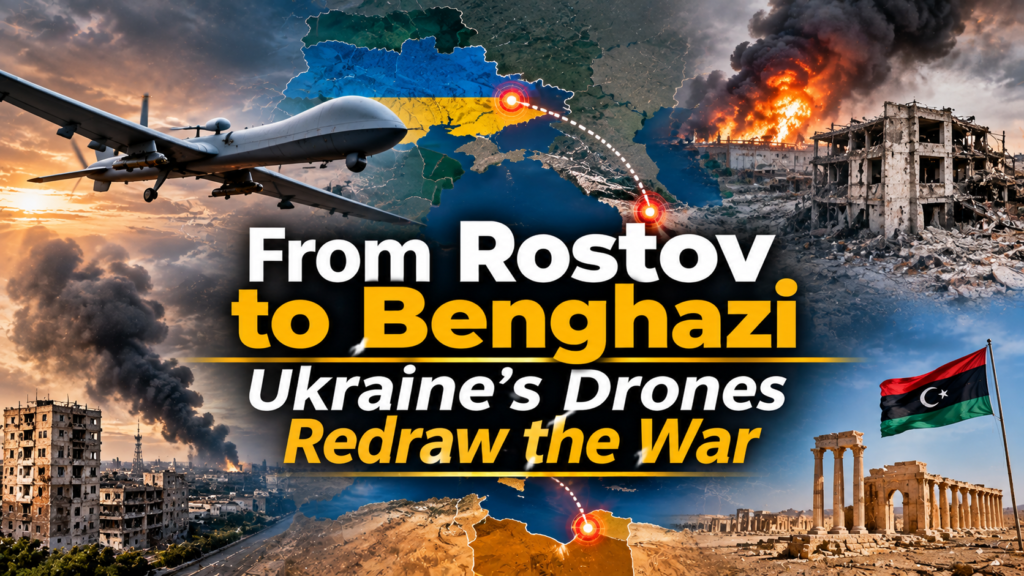
Ukraine’s president said on Monday that his forces were behind an attack on Russian vessels in the Libyan port of Benghazi, turning a night of confusion on the Mediterranean into a public claim of one of the war’s most distant strikes. Volodymyr Zelensky wrote on X that seven Ukrainian-made naval drones sank the Russian corvette Merkury, a ship commissioned in 2023, and destroyed a Ka-27 helicopter. A second target, the dry cargo ship MV Angara, was also hit, he said, adding that Moscow used it to move weapons. He called it an “exemplary” operation and promised more in designated waters.
Satellite images showed the Merkury capsized at the Benghazi naval base on Sunday. Authorities in eastern Libya, controlled by General Khalifa Haftar, said the ship had stopped to refuel and resupply under a cooperation agreement with Russia, and that Libya was not a party to the war. They did not name the attacker. The region’s health ministry said the crew had been rescued. Two Libyan military officials told the Associated Press that at least four drones were intercepted and two hit the ship, and claimed the drones were launched from a base in western Libya, an assertion Kyiv has not addressed.
The United Nations mission in Libya demanded an independent investigation and said the country must not become a battleground for foreign conflicts. The internationally recognized government in Tripoli rejected turning Libya into an arena for settling scores. A security expert told Al Jazeera that Ukrainian intelligence was likely behind the strike, pointing to earlier reports of a Ukrainian arrangement with Tripoli. Neither the arrangement nor the launch site has been confirmed. The reports available at the time of writing carried no detailed response from Moscow.
A war without a coastline
The Benghazi strike did not come alone. A day earlier a drone hit a Russian cargo ship in the eastern Baltic, near Finnish waters, and Finland’s border guard said the strike was Ukrainian, AFP reported. In March, a Russian liquefied natural gas carrier sank off the Libyan coast in an attack that Vladimir Putin blamed on Ukraine. In July, Iran vowed retaliation after a Ukrainian attack on a ship in the Caspian, and India summoned Ukraine’s envoy over a strike in the Black Sea.
The pattern suggests a change in how the war’s map is drawn. Targets are no longer chosen by their distance from the front but by their place in Russia’s supply chain, and wherever that chain touches a third country, the host inherits the risk. Call it the port-of-call problem: a refuelling stop that was a quiet service for Moscow yesterday is now a potential target for anyone with a long-range drone, and the neutral state that offered it is left to explain the damage.
Rostov and the logistics logic
At home, the logic is the same. Rostov-on-Don is a transport hub close to Ukraine that Reuters has described as hosting key military headquarters and supply routes, and it has been struck repeatedly. Russia said it destroyed more than 120 drones over the city and ten districts of the region on 13 November, during one of its largest overnight barrages of the year, and monitoring groups reported fires at a production facility and a warehouse. On 17 November drones reportedly hit an oil depot and a gas distribution station in Azov. On 21 November Russian authorities said an industrial facility was hit in strikes on the Rostov and Voronezh regions. Independent verification of damage and casualties remains limited.
What it changes
For Libya, the cost is immediate. Eastern authorities hosted a Russian warship as a matter of policy, and that choice has now put a hole in their harbor and a question to their sovereignty. Haftar may now have to decide whether to keep welcoming Russian vessels, seek air and naval defenses, or ask Moscow for protection. In Tripoli, the government must keep its distance from any suggestion of complicity. The risk is that a country still divided between rival administrations becomes a stage for someone else’s war.
For Russia, the Mediterranean was a convenient logistics corridor, and its safety can no longer be assumed. Moscow can respond by escorting ships, rerouting them, or retaliating elsewhere, and each option carries costs. For shippers and insurers, the signal is that war risk now extends to ports far from any front. For Europe, which has a strong interest in a stable Libya, the strike raises the prospect of a new proxy arena on its southern doorstep.
There is also a legal and political price for Kyiv. Hitting a warship in a third country’s port, whatever the justification, invites accusations of violating that country’s sovereignty and may strain partners who want the war contained. Zelensky’s decision to claim the operation openly suggests Kyiv judges that the deterrent value of being seen outweighs that cost. Whether Libya, Russia and Ukraine’s backers agree will shape the next phase of a war that is increasingly fought wherever Russia’s ships are tied up.