
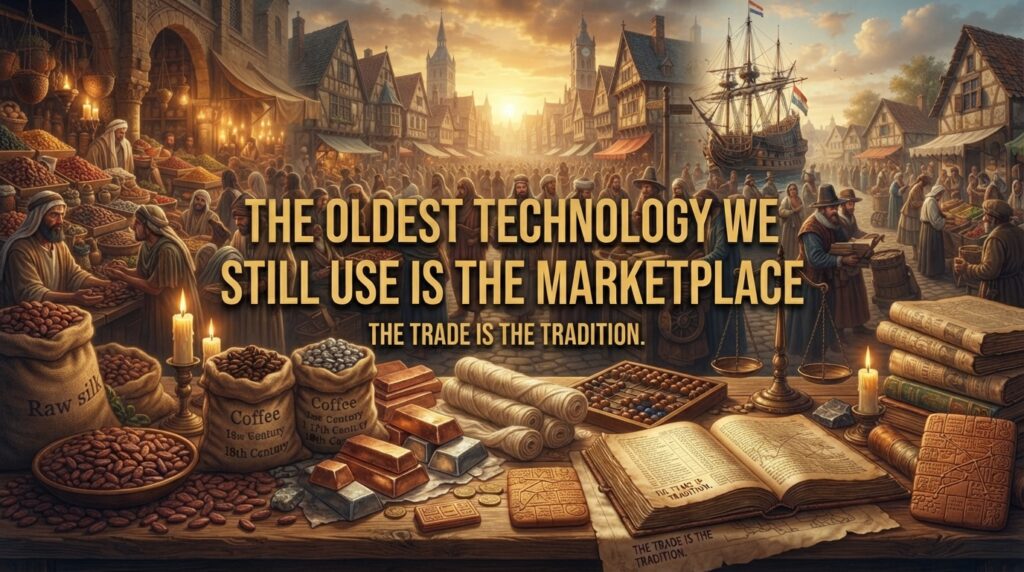
Long before coins, banks or screens, people gathered in one spot to swap what they had for what they lacked. The first marketplace was probably nothing more than a patch of trampled ground where strangers agreed, for an hour, to trust each other. Millennia later we still do the same thing, only now the patch of ground fits in a pocket and the strangers number in the millions.
A market is often described as a machine for setting prices, but its deeper job is carrying information. The economist Friedrich Hayek argued in the 1940s that no planner could ever know what millions of individuals know about their own needs and resources; a price compresses all of it into a single number. When a harvest fails, the price of bread rises, and without anyone issuing an order, people eat a little less of it and farmers plant a little more. The signal does the coordinating.
That signal has become faster and sharper. Airlines have adjusted fares to demand for decades; ride-hailing apps now do it by the minute; electricity markets in many countries change prices by the hour, rewarding households that run the washing machine when wind turbines are spinning. Even the advertisement on a web page is the result of an auction held in milliseconds, in which advertisers bid for a glimpse of one person’s attention. The scarcest good in the modern market may be attention itself.
Digital marketplaces have also reshaped who holds power. Platforms that connect buyers and sellers become more valuable with every new participant, so a handful tend to dominate. For consumers, the result is vast choice and easy comparison. For sellers, it can mean dependence on a single gatekeeper that sets the fees, ranks the listings and owns the data about who buys what. Reviews, once the casual word of a neighbour, have become a form of currency, and a vulnerable one, since fake praise is also for sale.
Here lies a lesson economists have repeated for decades: markets are not natural phenomena but designed ones. Their outcomes depend on rules about contracts, honesty, competition and what may be sold. In 1970 the economist George Akerlof showed, using the example of used cars, that when sellers know more than buyers, trust can unravel and good products can vanish from the market altogether. The same logic applies to insurance, online listings and anything whose quality is hard to see.
Markets can also fail in plainer ways. A factory that pollutes a river does not pay the full price of its choices; someone else does. A company that swallows its rivals may charge more because no alternative remains. And some things resist pricing altogether. Philosophers such as Michael Sandel have asked where the line should fall for goods like organs, votes or places in public life, and most societies have decided that certain things are simply not for sale.
The pandemic exposed another vulnerability: efficiency can be fragile. Supply chains tuned to deliver goods just in time worked beautifully until factories closed and shipping stalled, leaving shelves empty and prices climbing. The global shortage of computer chips that followed held up everything from cars to games consoles. Resilience, it turned out, is a cost that markets tend to underprice until the day it is needed.
Yet the oldest form of market is enjoying a quiet revival. Farmers’ markets, street bazaars and neighbourhood fairs offer something no algorithm can: conversation, tasting, the chance to ask who grew the tomato. Such places also work as social glue, giving residents regular, low-pressure contact with people beyond their own circle. Istanbul’s Grand Bazaar has been trading since the fifteenth century, which suggests that people want more from a market than a transaction.
What should an ordinary shopper take from all this? Treat urgency with suspicion, since countdown timers and “only two left” warnings are designed to speed up decisions. Compare prices across sellers, read reviews for patterns rather than stars, and when a service is cheap or free, ask what is being paid for in another way. Every purchase is a small vote about which businesses survive.
For governments, the task is to keep markets fair enough to deserve trust: enforcing competition, demanding clear pricing and protecting the people who depend on platforms they cannot leave. The market is a powerful tool, but it is a tool, and tools reflect the hands that shape them.
The marketplace has survived coins, empires, printing presses and the internet because it answers a permanent human need: to find one another and exchange something of value. Whether it stays a place of opportunity or becomes a place of quiet pressure depends, as it always has, on the rules we agree to play by.