
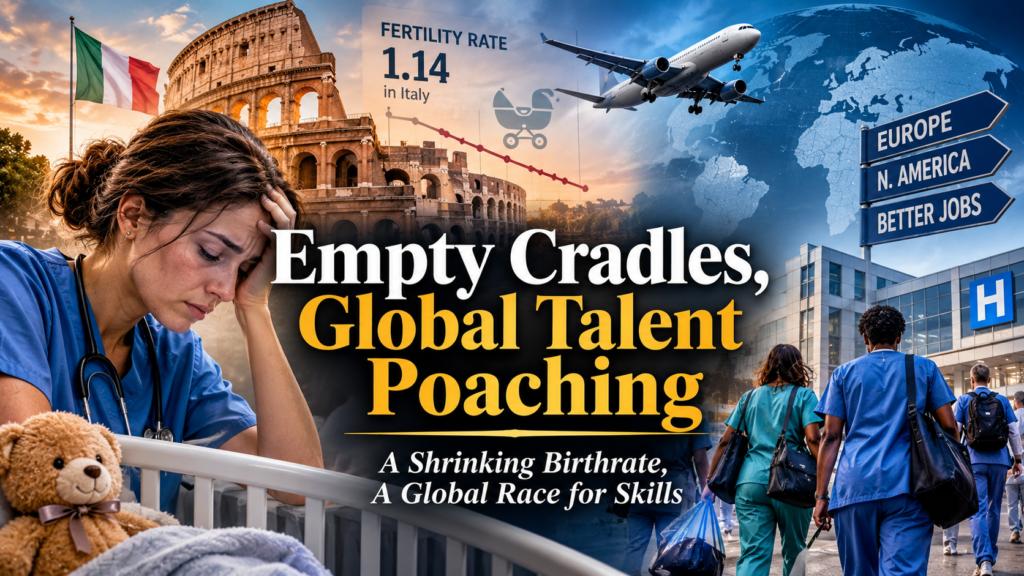
Behind every foreign-trained nurse working a night shift in a European or North American hospital is a childhood, a school and a degree paid for in another country. Nobody sends an invoice for that. Yet it has become one of the quietest transfers of wealth in the modern economy, and it is growing for a simple reason: wealthy societies have stopped producing enough young people.
Italy offers a sharp illustration. Only 355,000 babies were born there in 2025, the lowest figure since the Second World War, and the fertility rate slipped to 1.14 children per woman, roughly half the level needed to keep a population stable. With 652,000 deaths, the country lost almost 300,000 people through natural change in a single year. A report by the Fondazione per la Natalità, drawing on Istat data, links the decline mostly to economic and social obstacles, not to a lack of desire: if women’s stated intentions had been fulfilled, about 760,000 children would have been born, more than double the real number.
This is not an Italian peculiarity. A paper by economists Jesus Fernandez-Villaverde and Patrick Norrick, circulated in August, argues that humanity as a whole is probably already below replacement fertility, decades before the United Nations expects it. Of 236 countries they examined, 219 show falling fertility and none has levelled off. Singapore recorded 0.87 children per woman last year, and South Korea hovers around 0.8.
When a country cannot grow its own workforce, it buys one. Hospitals feel it first. The World Health Organization estimates that about one in seven nurses worldwide was born abroad, but the burden is wildly uneven: 23 percent of nurses in high-income countries are foreign-born, against just one percent in lower-middle-income ones. Around 78 percent of the world’s nurses work in countries holding only 49 percent of its people. In 20 countries, mostly rich ones, retirements are expected to outpace new entrants.
The WHO keeps a list of 55 countries, 37 of them in Africa, whose health systems are so thin that active recruitment from them should be limited. It is not a ban, and it is routinely tested by agreements that look like bilateral cooperation but work like hiring drives.
The contest is not confined to wards. Engineers and scientists are being fought over by governments in the same way companies once fought over them. When Washington imposed a $100,000 fee on new H-1B visas last year, China was launching, in the same weeks, a new K visa aimed at young science and technology graduates. Visas have become a form of salary, and countries now advertise like employers.
Seen this way, two ideas deserve more attention than they get.
The first is reverse aid. Rich governments spend billions on development assistance to help poorer countries train health workers, yet recruiters in those same rich countries collect the finished product. The destination skips roughly two decades of upbringing and training costs, and the origin pays them. Remittances help families, but they do not replace the midwife who left a rural clinic.
The second is what might be called the last-pool problem. Poaching works only while there is somewhere left to poach from. If nearly every country is seeing fewer births, the pool of young professionals will shrink everywhere, including in the places that now export them. A talent war on a shrinking planet is a zero-sum game, and its winners will be those who started recruiting early, not those who solved their own problem.
Italy sits on both sides of this equation. It needs workers and welcomes migrants to fill gaps, yet it also loses its own young graduates. Recent national figures show about 25,000 graduates aged 25 to 34 leaving in 2024 and only about 4,000 returning, a net loss near 21,000. A country that exports its trained young while importing nurses has not found a strategy, only a rotation.
The consequences are already visible. Sending countries risk hollowed-out hospitals and lost investment in education. Receiving countries become dependent on staff whose arrival depends on visa politics, a dependence that sits awkwardly beside hostile rhetoric about immigration. And the workers themselves, often highly skilled, are pulled between obligations to families at home and better pay abroad.
Practical answers exist, and none requires abandoning migration. Recruiters could pay a training dividend, funding nursing and medical school places in the countries they hire from, in proportion to the numbers they take. Contracts could be built around circulation, with guaranteed return paths and paid secondment of skills, rather than one-way departure. Governments could publish how many professionals they recruit from countries on the WHO list. Most important, rich countries should treat their own missing children as the root problem: more than three million Italian women are economically inactive for family reasons, against 151,000 men. Better childcare, housing and stable work are not only family policy. They are talent policy.
The poaching will continue, because the arithmetic of ageing societies leaves little choice. But a country that treats imported nurses as a permanent solution is deferring its bill, not paying it. The decisive contest of this century may not be over who attracts the best minds, but over who is willing to grow them.