
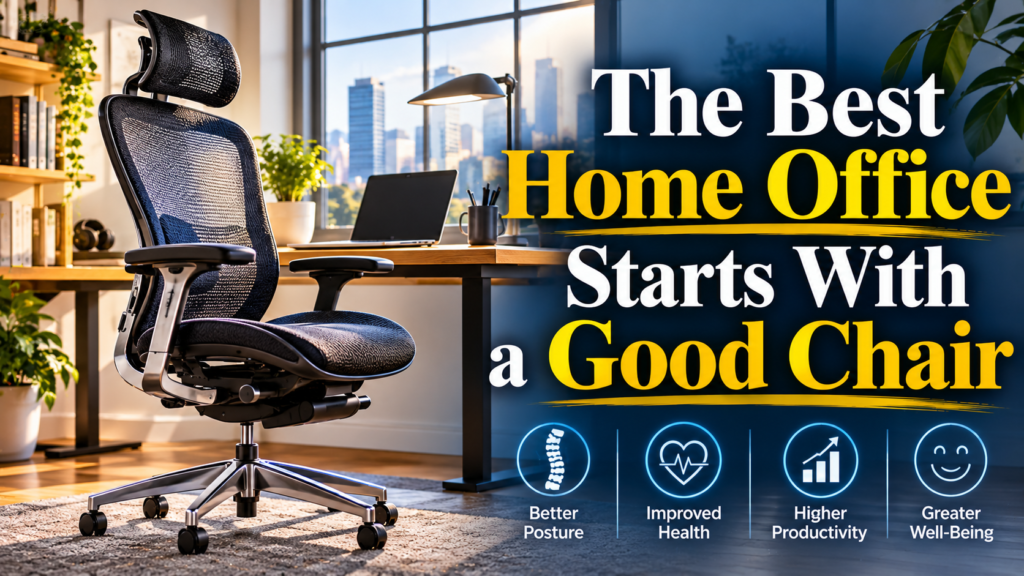
Most people begin a home office with a laptop and a kitchen chair, and most discover their mistake some weeks later, in the small of their back. Working from home is often discussed in terms of software, meetings and schedules, but it is also a physical activity, carried out by a body that sits for hours. The best home office starts with a good chair, not a fast laptop.
The reason is simple: bodies are built to move. Sitting for long periods in a poor posture strains the back, neck and shoulders, and workers who spend all day at a desk often report aches that arrive gradually and then stubbornly stay. Occupational health bodies in many countries recommend that employers assess home workstations as they would an office, because the law in some places treats the home workplace as a workplace. Even without such a rule, comfort is the foundation of productivity.
What does a good setup look like? Ergonomists generally suggest a simple arrangement: feet flat on the floor or on a footrest, knees at roughly right angles, lower back supported, forearms level with the desk and shoulders relaxed. The top of the screen should be at about eye level, an arm’s length away, so that the neck stays neutral. A laptop alone defeats this, since the screen and keyboard are fused. Adding a separate keyboard and mouse, and lifting the laptop on a stand or a pile of books, solves it cheaply.
Standing desks have become a symbol of the modern home office, but evidence suggests that the key is variation, not a particular posture. Standing all day brings its own strains, and so does sitting all day. Many specialists recommend changing position regularly, taking a short break every half hour or so, and walking during calls. A kitchen timer or a phone reminder is more valuable than an expensive gadget.
The eyes need care as well. Long hours of screen work can cause dryness and strain, and a commonly suggested habit is the 20-20-20 rule: every twenty minutes, look at something twenty feet, around six metres, away for twenty seconds. The evidence for its precise numbers is modest, but the principle of regularly relaxing the eyes is sound. Positioning the screen to avoid glare from windows and lamps helps, and so does adjusting brightness to match the room.
Sound is the invisible stress of the home office. Children, neighbours, traffic and household appliances intrude on concentration, and the cost of an interrupted train of thought can be considerable. Soft furnishings such as rugs, curtains and bookshelves absorb noise, a door that closes is worth more than any app, and headphones with a good microphone make calls clearer for everyone. If the home is crowded, agreeing quiet hours with family or housemates can matter as much as acoustics.
Video calls have changed the nature of work. Researchers at Stanford University have described exhaustion linked to long video meetings, pointing to factors such as seeing one’s own face constantly, being close up to colleagues and being less able to move. Practical remedies include turning off the self-view window, using audio-only for some meetings, taking breaks between calls and sitting far enough from the screen to allow natural gestures. Not every discussion needs a camera.
Boundaries are as important as furniture. When the desk is also the dining table, work can invade every corner of life. Many remote workers find that a small ritual helps: a walk before starting, a closing routine at the end of the day, a shutting of the laptop and the putting away of the equipment. These habits act as a substitute for the commute, signalling the mind to switch gears. If space permits, a dedicated corner or room provides a physical boundary as well.
Money and rules come into it. Some employers provide equipment or allowances, and in several countries part of the cost of a home office can be deducted for tax purposes, though the rules vary widely and often depend on whether the space is used exclusively for work. Anyone planning to claim should check local rules and keep receipts. Where employers do not provide equipment, a modest investment in a good chair is often the best-value purchase, since it pays back every working day.
There is a fairness question too. A professional with a spare room and a budget can create an ideal workspace, while someone in a small shared flat may work from a bed. Employers can help by offering equipment loans, coworking passes or flexible days at a well-designed office. Recognising that workers’ homes differ is part of treating them equally.
The home office is a small stage on which much of modern working life is played. A sensible chair, a screen at the right height, a quiet corner and a few habits of movement and rest cost little compared with the hours they protect. Those who take the setup seriously may find that the best productivity tool is not an app, but a body that is not in pain at three o’clock in the afternoon.