
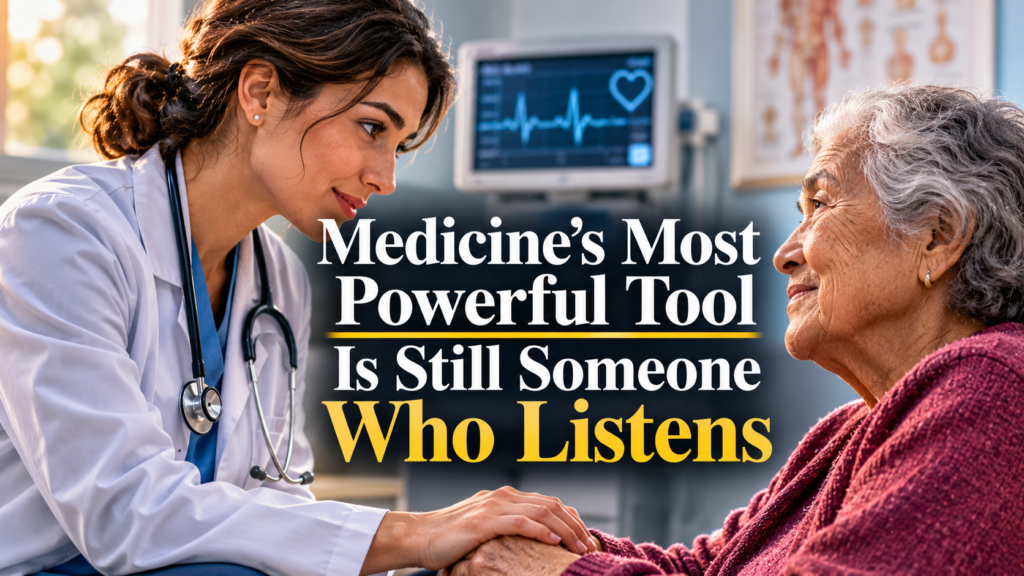
A patient walks into a consulting room carrying months of worry and is given, often, only a few minutes. The doctor glances at a screen, asks the most urgent questions, orders a test, and the door opens again. Nobody in this scene is careless. They are all caught in a system that has built extraordinary machines for finding disease and given surprisingly little time to the simplest tool in medicine: listening.
The achievements of modern medicine are real and breathtaking. Smallpox, a disease that killed on a vast scale for centuries, was declared eradicated in 1980 through cooperation between nations. Childhood vaccines, safer surgery and treatments that turn once-fatal cancers into manageable conditions have added years to life in much of the world. But a longer life is not automatically a healthier one. The gap between lifespan and healthspan, the years lived in good health, has become one of the defining questions of ageing societies.
Meanwhile, the people who deliver care are under strain. The World Health Organization has projected a global shortfall of roughly ten million health workers by 2030, concentrated in lower-income regions. In wealthier countries, nurses and doctors describe heavy paperwork, long shifts and a feeling of working against the clock, and burnout has become a widely documented problem. When clinicians are exhausted, patients feel it: shorter conversations, missed details and a gentle erosion of trust.
Why does the conversation matter so much? Because most diagnoses begin with a story. Patients who feel heard tend to share more complete information, and research on communication in medicine suggests they are also more likely to understand and follow treatment plans. The opposite is also true. Studies in several countries have suggested that women, minorities and older patients are sometimes taken less seriously when they describe pain or symptoms, which can lengthen the road to a correct diagnosis. A health system that listens unevenly will also heal unevenly.
Technology is arriving as both rescuer and rival. Algorithms can already help radiologists spot suspicious shadows on scans and flag patients at risk of deterioration, and video consultations spare people hours of travel, especially in rural areas and for those with limited mobility. Used well, these tools hand clinicians back time. Used carelessly, they can put more screens between patient and doctor, spread errors at scale or reflect the biases of the data they were trained on. The evidence on many such tools is still developing, and the sensible response is neither hype nor fear but careful testing.
Another, quieter problem is health literacy. Leaflets full of jargon, forms that assume prior knowledge and appointments explained at speed leave many people unsure what they have been told. A person who cannot understand a prescription label or a discharge note is, in a practical sense, less healthy, however good the hospital. Plain language, teach-back methods in which patients explain the plan in their own words, and pharmacists with time to talk are inexpensive upgrades with large effects.
Information outside the clinic is no simpler. The internet has made medical knowledge available to anyone, and made it just as easy to find confident nonsense. Searching a symptom at midnight can reassure or terrify. Clinicians increasingly find that patients arrive with printouts and social media claims, and that the most useful response is curiosity rather than irritation. Trust is rebuilt in the room, one respectful conversation at a time.
The consequences of a hurried system are costly. Late diagnoses mean more complex and expensive treatment. Patients who feel dismissed delay returning, or disengage altogether. Staff who are exhausted leave the profession, deepening shortages, and the cycle repeats. A modest investment in time, training and support may therefore be one of the most economical forms of healthcare reform, even if it never produces a headline.
What would a listening health system look like? Appointments long enough for a story to be told. Teams in which nurses, pharmacists, therapists and community workers share the load, so that doctors can focus on what only doctors can do. Digital tools designed with clinicians and patients, not only for administrators. Community health workers who visit homes and notice what a clinic never sees. Several countries have shown that strengthening primary care can produce healthier populations at lower cost.
Individuals can contribute too. Before an appointment, write down the three things that worry you most. Bring a list of your medicines. Ask what a result means and what happens next. If something has not been understood, say so; a good clinician will want to know. And if you feel dismissed, seeking a second opinion is not rudeness but self-care.
Medicine will keep producing marvels, from gene therapies to smarter scans. Yet its oldest tool remains its most human one. Technology may find the illness, but it takes a person to understand the one who has it. A health system that remembers this will heal better, and spend its marvels where they matter.