
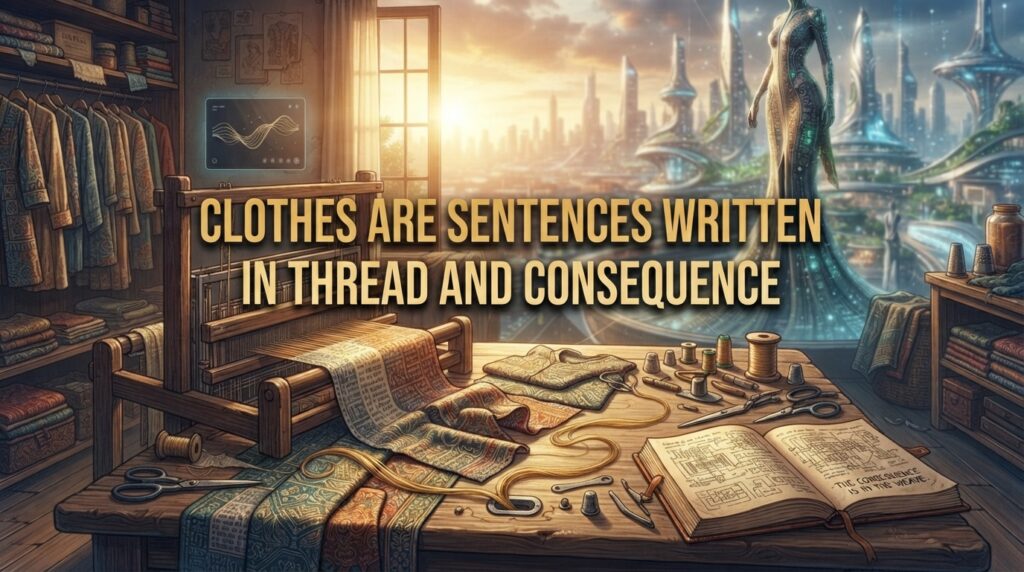
In the moments it takes to cross a room, a stranger has already begun to read us. The cut of a jacket, the age of a pair of shoes, the colour of a scarf: clothes speak before we do. Fashion is often dismissed as frivolous, but it is one of humanity’s oldest languages, used to signal belonging, rebellion, status, mourning, celebration and faith.
That language has a long and sometimes surprising history. Sumptuary laws in medieval and early modern Europe once restricted who could wear certain fabrics and colours, because clothing was too important a marker of rank to leave to chance. The sewing machine and the department store later democratised style. Today, fashion is a global industry employing tens of millions of people, from cotton farmers to seamstresses to designers, and its influence reaches well beyond the catwalk.
The defining change of recent decades has been speed. Fast-fashion brands learned to turn runway ideas into shop-floor items within weeks, and social media then shrank the cycle further. A style can emerge, peak and be declared over within a few days. According to the Ellen MacArthur Foundation, clothing production roughly doubled between 2000 and 2015, while the number of times a garment is worn has fallen. A dress bought for one occasion, photographed once and discarded is not so much a purchase as a rental with no return.
The costs fall in places shoppers rarely see. Growing cotton can demand thousands of litres of water for a single shirt, and synthetic fabrics such as polyester are made from fossil fuels and shed microplastic fibres each time they are washed. Estimates of the industry’s share of global greenhouse gas emissions vary widely, but they are commonly placed at several percent. And when clothes are discarded, many do not find a second life. Vast quantities of used clothing are shipped each year to markets in the Global South, where the volume can overwhelm local capacity to sell or recycle it.
Behind each seam stands a person, and the human cost has occasionally forced the industry to look at itself. In 2013, the Rana Plaza garment complex collapsed in Bangladesh, killing more than a thousand workers and shocking consumers and brands around the world. The disaster led to safety agreements and greater scrutiny of supply chains, yet low wages and long hours remain common in many producing countries. A very cheap garment is cheap for a reason, and someone along the chain is bearing the cost.
There is a psychological dimension too. Feeds filled with curated outfits encourage constant comparison, and some shoppers admit to feeling that an outfit has been used up once it has appeared online. Fashion has long traded on a mix of belonging and distinction, the desire to be like our group and slightly better than it. Digital platforms magnify both urges. The result can be a wardrobe full of clothes and an uneasy sense of having nothing to wear.
Yet fashion is also a force for creativity and inclusion. Craft traditions such as hand-weaving, embroidery and natural dyeing sustain livelihoods and cultural memory in communities around the world. Adaptive clothing designed for people with disabilities has widened who can dress with ease and dignity. The debate over cultural appropriation, uncomfortable as it can be, has pushed designers to ask whose heritage they borrow from, and whether credit and income flow back to its source.
Change is arriving from several directions. Second-hand shopping, once seen as a matter of thrift, has become a mainstream and even fashionable choice, helped by online resale platforms and clothing rental. Repair and tailoring are enjoying a revival. Governments are stepping in as well: France has restricted the destruction of unsold goods, and the European Union has been developing rules that aim to make textiles longer-lasting, more repairable and more transparent about their origins. Whether such measures prove effective will depend on enforcement.
For individuals, the most useful idea may be cost per wear. A jacket that costs more but is worn two hundred times is cheaper than a bargain worn three times. A few habits follow naturally: buy fewer pieces that fit your actual life, choose fabrics and construction that last, wash gently and less often, repair before replacing, and pass on what no longer serves. Style, after all, is not the same as shopping. Some of the best-dressed people are those who know exactly what suits them and wear it again.
Fashion will never stop changing, and it should not. The urge to dress up, to experiment, to say something without words, is deeply human. The question is whether the sentences we write in thread can be written with fewer broken promises: to workers, to the environment, and to our own sense of what is enough. A wardrobe, at its best, is a lifelong autobiography. It deserves editing, not endless rewriting.